Monthly Archives: March 2019

Santa Monica’s Palisades Park

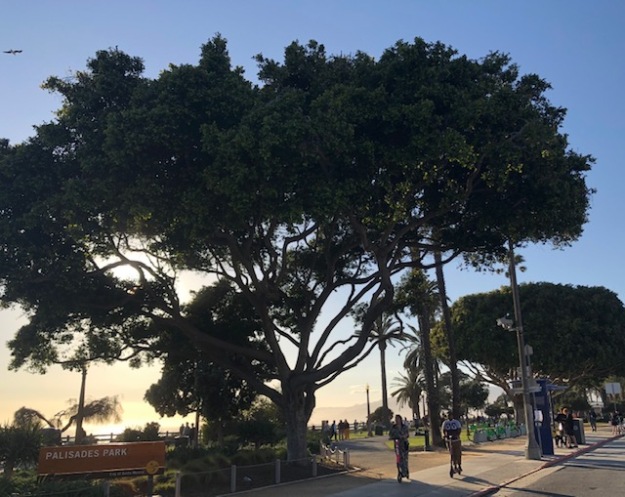
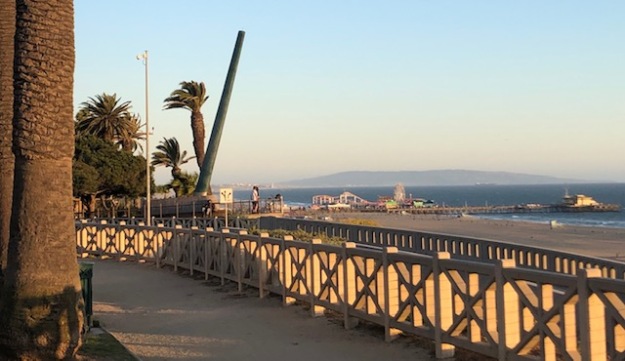
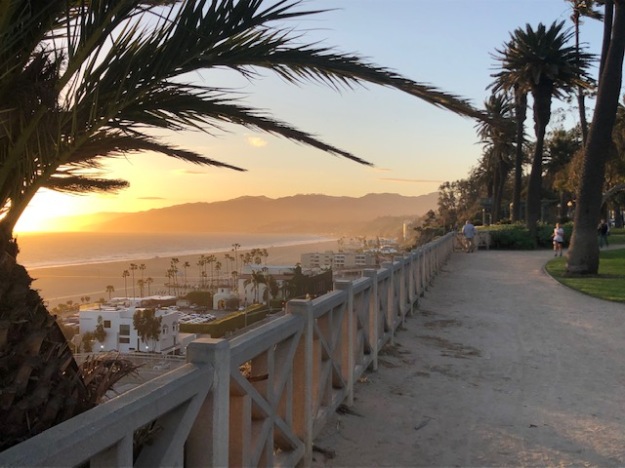
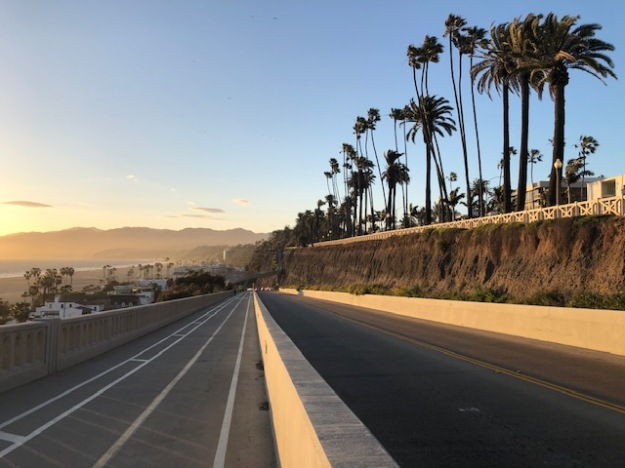
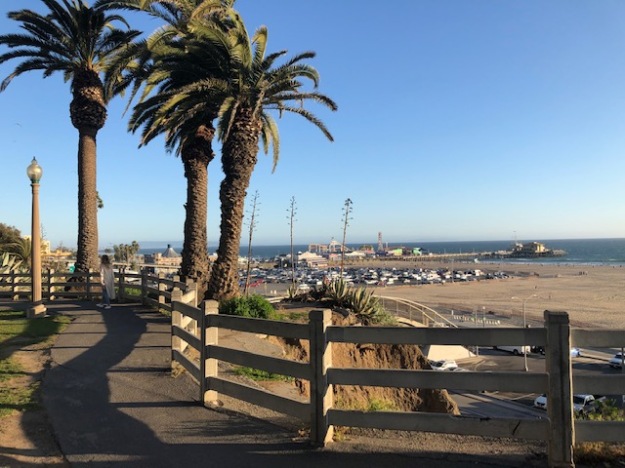
Nature contributes the sea, the sun and the wind; but the astonishing gardens on the cliffs are the legacy of three fascinating individuals, each, in a way, a genius. Each is well-known in the history of the region, for doing other things. The garden was merely a happy accident in each of their lives, but in the view of posterity, these bluffs have become a grace upon the coast Southern California, and the credit of our gratitude is due.
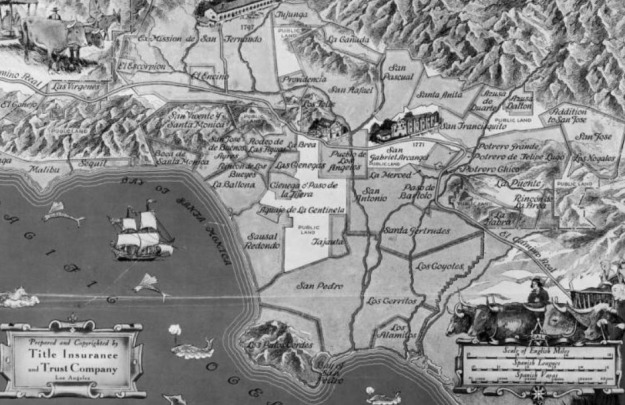
Until 1872, the mesas overlooking Santa Monica Bay were part of the Rancho San Vicente y Santa Monica, the rich grasslands of the Sepulvedas; and Rancho Boca de Santa Monica, the equally lush ranges of the Marquez family. The vague grants overlapped by several thousand acres; and disputes before the (notorious) U.S. Land Commission were not settled until 1872, when the ranchos were consolidated, parceled, and sold off. The principal buyers had big plans for the sun-drenched coastal cliffs.

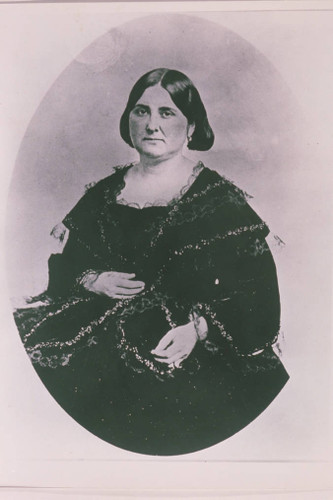
Chief visionary was Dona Arcadia Bandini de Stearns Baker, a true grande dame, the social lioness of the Old Californio Families. Arcadia foresaw luxury hotels, wealthy retirees, and pleasure gardens in her new city. But her partner was mining magnate and Montana Republican Senator, John Percival Jones, who hoped to turn Santa Monica into the Entrepot of the Pacific, distribution hub of the combined products of North America and Asia. Jones conspired with the Southern Pacific’s Collis P. Huntington to build the Long Wharf rail terminus right at the bottom of the cliffs. They hoped a bustling port-railhead on Santa Monica Beach would eat San Pedro’s lunch (see “Los Angeles Harbor Fight.”)
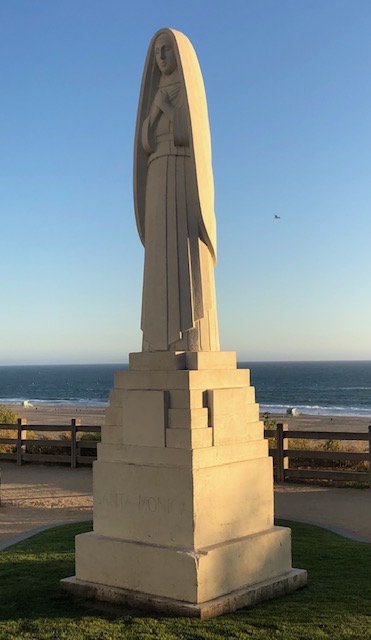
These formidable speculators named their city, as did the rancheros, for twin springs (now on the grounds of University High School.) These wells had seemed to Fr. Juan Crespi in 1769 like two gushing eyes, “The Tears of St. Monica.” They formed a creek which flowed through Santa Monica Canyon, splitting the bluffs at its mouth (“Boca de Santa Monica”). This verdant canyon would attract our third genius to the shore of Santa Monica Bay.

Abbot Kinney. Wealthy New Jersey tobacco magnate, millionaire gadabout. He came to California to cure his athsma; became a pioneering forester; saved the San Gabriel Mountains by establishing what became the Angeles Crest National Forest; propagandized the eucalyptus; and founded Santa Monica’s southern neighbor, Venice-by-the-Sea..

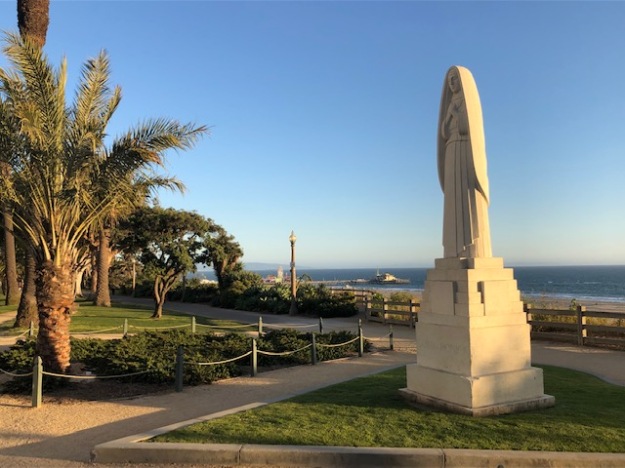
Senora Baker had agreed with Sen. Jones that if he had his railhead under the northern bluffs, then the land of the southern bluffs would be given to the public forever as a promenade. Dona Baker then enlisted Abbot Kinney, the new California State Forester, to cover them with his exotic plants from all over the world.
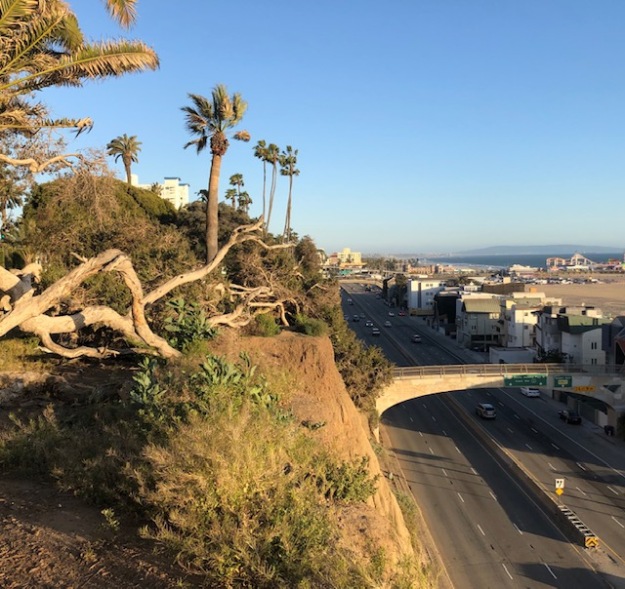
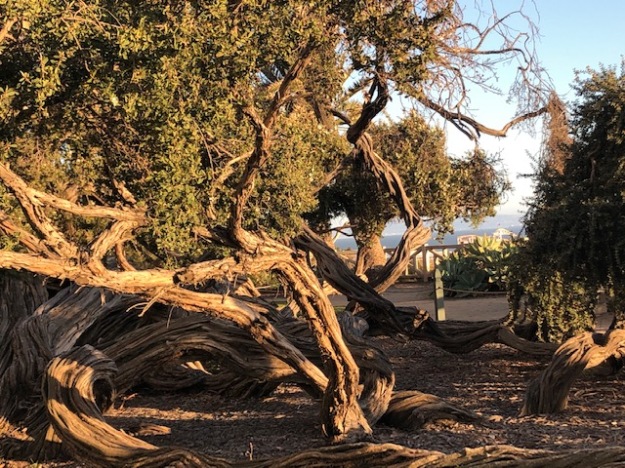
Kinney was the apostle of the eucalyptus, that Australian import that he hoped would cover the “bare, treeless, arid plains” of California with marketable timber. Urbane, handsome and cultured, Kinney had cultivated the socially susceptible Dona Baker, and gotten her to grant him a research plot in Rustic Canyon, the first forestry research facility in the U.S. In gratitude he filled Arcadia’s public park on the bluffs with the exotic specimens of the Antipodes. The trees are now over a hundred years old, and gloriously sculpted by the constant Bay breeze into the fractal forms of frozen time.
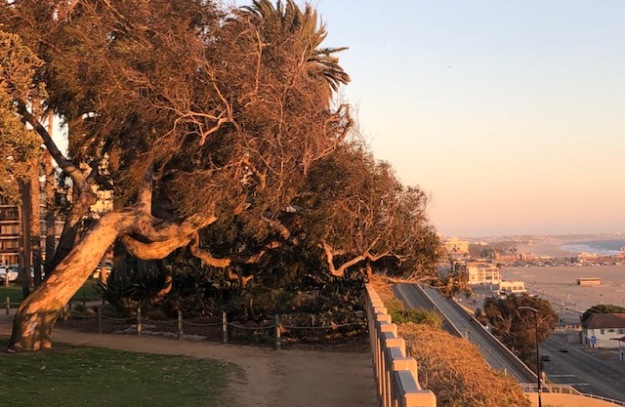
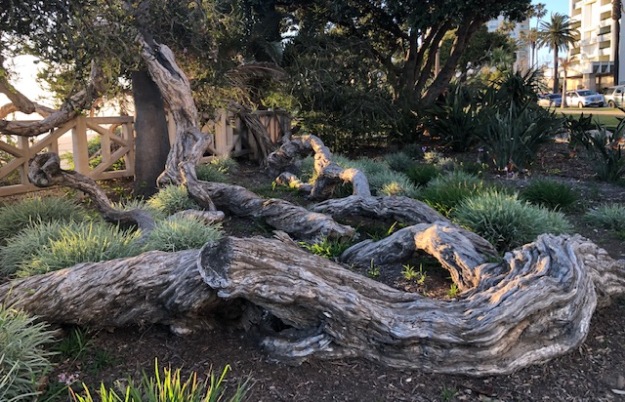
Kinney’s hopes for eucalyptus as an American hardwood were dashed, as fast as a falling eucalyptus branch; the cracking, twisting, splitting wood is no good as timber. The legacy of Kinney’s crusade means a California plagued by useless and destructive, but beautiful, naturalized eucalypts; but it also includes the arboretum that is Palisades Park.

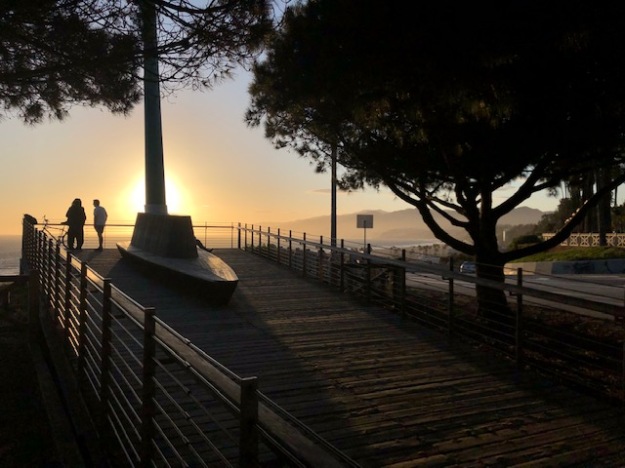
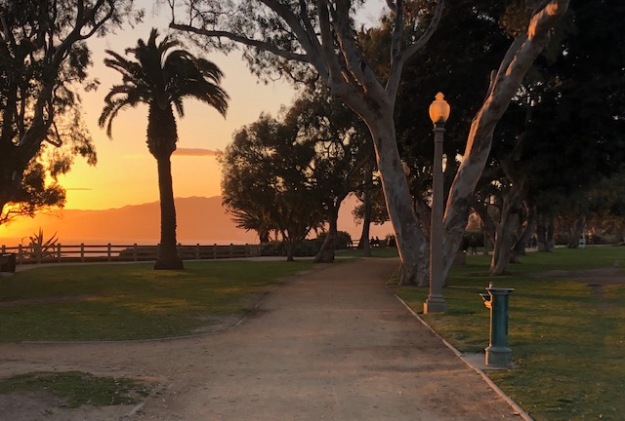
More fortunate, was that Sen. Jones’s Long Wharf also failed. Santa Monica never became the Gateway to the Indies; today the area isn’t choked by diesel and warehouses, but a world beauty spot. Maybe that became clear to the Senator, who also loved the bluff gardens, and reputedly came here every day with his dogs to watch the sunset, until the day he died.

Arcadia’s paradise awaits the intrepid soul that dares look over the western rim of the world.

Where Are They Now? San Fernando’s Fan Palms

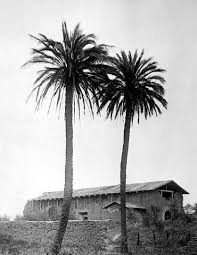
Recall, Patient Reader: the very first palm trees in Los Angeles were those Canary Island date palms (below), planted at San Fernando Mission. This once-famous pair were planted, probably by Fr. Lasuen and Fr. Dumetz themselves, at a solemn mass at the 1797 dedication of the cemetery. These were the palms to be used on Palm Sunday, the emblems of triumph, martyrdom, and resurection, Phoenix canarensis. These palms, which were admired by travelers and painted and photographed as beloved relics, even after the Mission had crumbled, somehow disappeared from history without a trace.

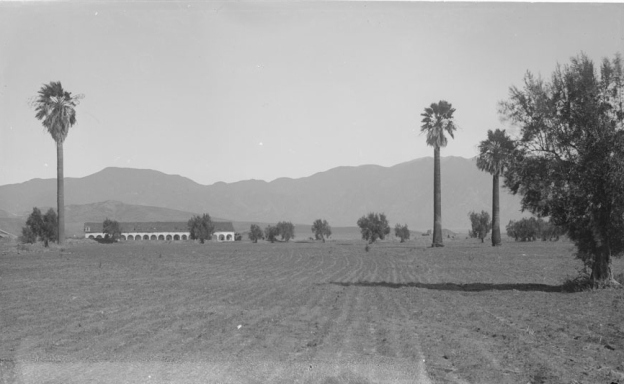
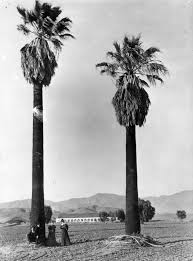
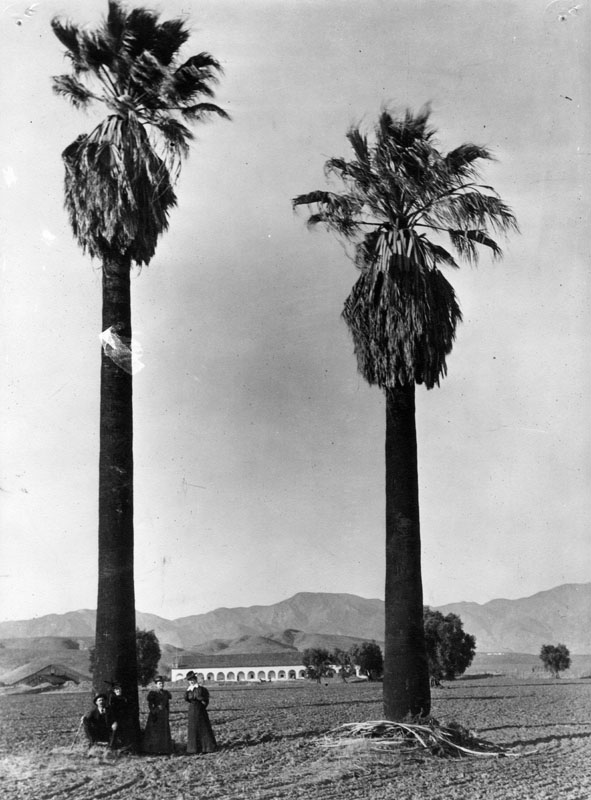
But there were other, equally famous palms at San Fernando: that towering row of California Fan Palms that were planted out in the olive groves, just south of the Convento, probably sometime in the mid-1820’s. Since the first Spanish contact with the Agua Caliente band, whose canyons at Palm Springs engendered the palms, seem to have been in 1822, it need not have been long after that a few of those palms ended up at San Fernando.

[Intriguingly, an artist depicted Don Andres Pico in the 1850s, at home on the Convento corrida, with a view south over the olive grove. The artist notes both kinds of palms out there, the bushy fan palms on the left, and date palms, center and on the right, toward the ranch house.]

I hunted around Mission Hills to find old Washington filiferas, and tried to triangulate distance by the hills. There were some stately trunks the south side of Brand Blvd. that gave pause, especially this one:

Maybe it was put in when Brand Park and the P.E. station were developed, i.e., 1913? Plus it’s too close to the Convento; the historic trees were out in the groves, not close to the road.

Then I found…

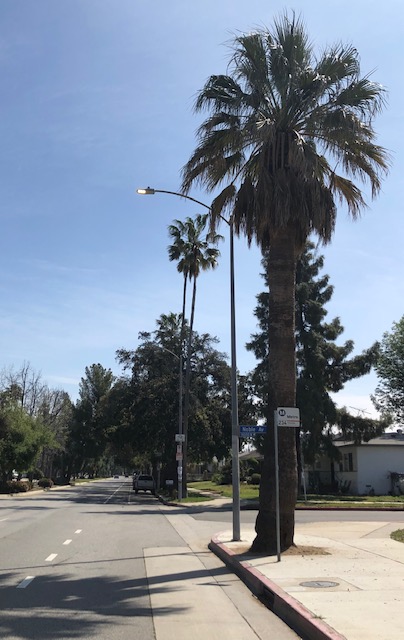
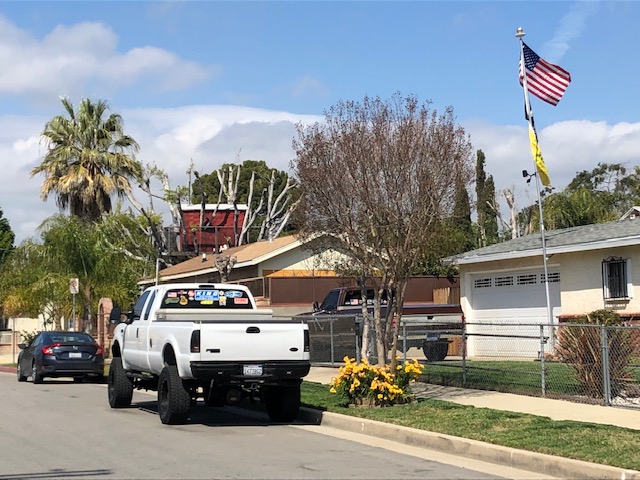
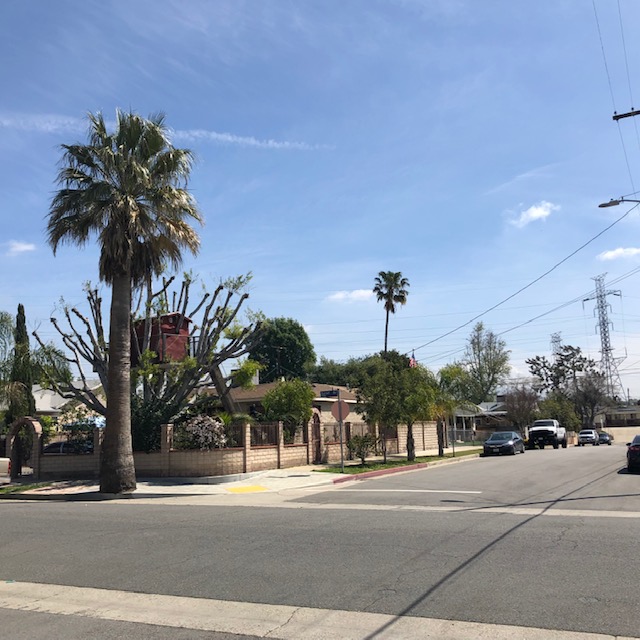
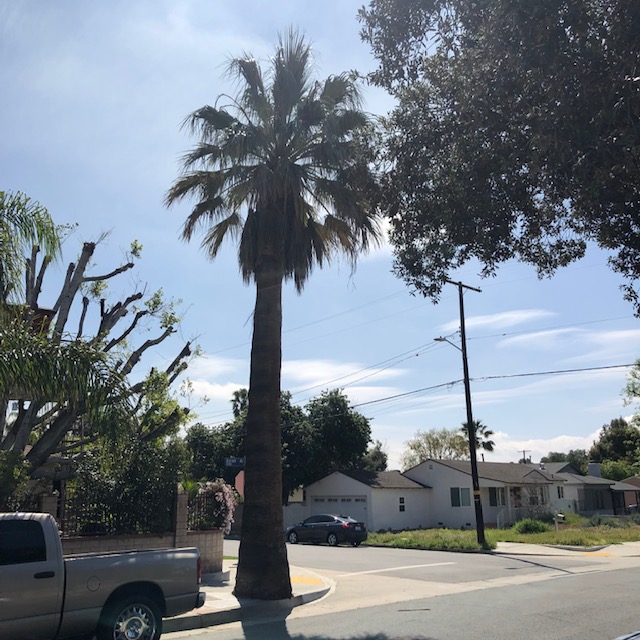
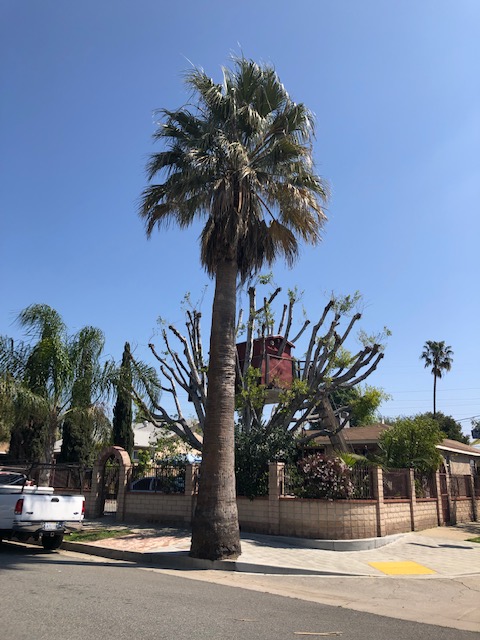
The corner of Los Olivos Street and Burnett Avenue, I was amazed to spot the following battered but hardy specimen, which seems to have lived a life of incident. Is it the right trunk size and shape to maybe be the small palm to the east? Suspiciously off plumb from the street grid, the base has been (recently!) encased in concrete. It was common just before WWI, in the Valley, for developers to build rail-adjacent tracts sold as small farm plots, with only dirt roads and no sidewalks (low taxes, rural feel). Could this palm have survived simply because it fell on a strip of “public” land at the back of an old farm lot, and a sleepy lane? One that was, in the ’50s, subdivided and graded, but never (until recently) put to sidewalk? Yes, theoretically; this sequence is typical of the Valley.

The land south of the Convento seems to have been an open wheat field until after the turn of the century. When the Red Cars came in along Sepulveda/Brand boulevards, about 1913, the P.E. laid out six streets just south of the Convento and the station, for a sub-division tract. This neighborhood is right on top of the olive grove, directly adjacent to the old mayordomo’s house (i.e., the Pico Adobe). There are still many olive trees in the vicinity. But only one big filifera.

Modernity may diminish this specimen in photographs. Those white pickups are monster vehicles compared with, say, the Tin Lizzie in the tourist shot above.

Its height roughly triangulates with the hills and the Convento, following the treeline and the electrical tower. I hazard the guess that this may be a last survivor of the historic San Fernando fan palms; or at least, it is on the spot and may be kin to one of those trees. Any reader suggestions on how to pin this down further?

The Other Folks Who Live On The Hill

The Case Study House #22 is often called “L.A.’s Most Iconic House.” Of course, the Stahls didn’t spark the tradition of hillside living — they merely perfected it.

California is all either “hills” or “flats”, with both sectors in more or less constant view of one another, locked in an inherently invidious social hierarchy. This starkly obvious, divided social geography can tempt out the worst devils of our human nature. Hilltop clearance for monster mansions has been in process since Gilded Age L.A., but has been taken lately to Neronian extremes.

One reason the Stahl house is successful and beloved is that it a serene grace note on the hillside — perfect urban luxury, privacy and comfort within, but from outside, or from below, the house can scarcely be seen. No arriviste statement was being made at all. One doesn’t envy or socially tick off the folks who live in the Stahl house — all one wants is to be up there with them enjoying life in the air. The house is socially generous in not imposing itself on others, and environmentally generous, with its tiny footprint. Not all houses in the hills are so generous with their “statements”.


The Stahls’ House — Case Study House #22

In 1958 Buck and Carlotta Stahl built a house on an impossible bluff above the Sunset Strip. Buck bought the land on a handshake deal with the owner, cleared the site himself, and hauled the foundation rubble up the hill, ton by ton, in the trunk of his car. He and the kids piled rock until the site was graded and firm. Then Buck pencilled out a design and hired young USC architect Pierre Koenig to bring it to life for the delight and comfort of the Stahl family, using modern methods and materials. Koenig deserves full credit, but so do Buck and his wife and kids. Properly, it wouldn’t be the “Case Study House #22” or even “The Stahl House,” but “The Stahls’ House.”

And, yes, this is California Vernacular Architectue as much as it is International Style or Mid-Mod or anything else. In fact, this is the aesthetic culmination of California Vernacular. Buck dreamed this out of the hills; Pierre built it, safely, beautifully.

Clkick on the link above for a video tour.

On one hand, this was an ordinary middle-class home; small and modest; but its spectacular site and its vision of technology made its modesty and simplicity seem luxurious,. Then Julius Shulman made it famous and chic with his wonderful photos; and suddenly one family’s eccentric vision of democratic, private, modern family living became universal.