Welcome to the blog of writer and musician Andrew Martin. Here I'll post original photographs and observations as I encounter the history and culture of the San Fernando Valley, the City of the Angels, Alta California and the far-flung Pacific Rim… but mostly the Valley.
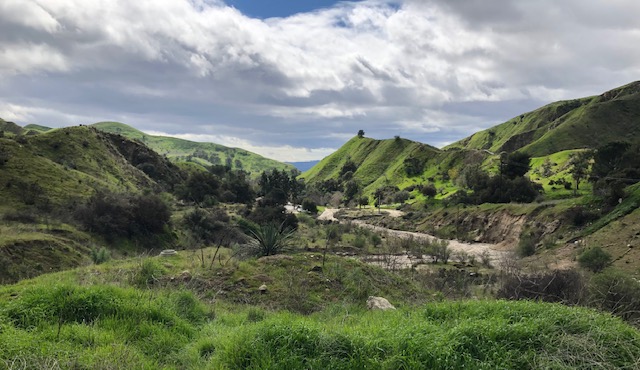
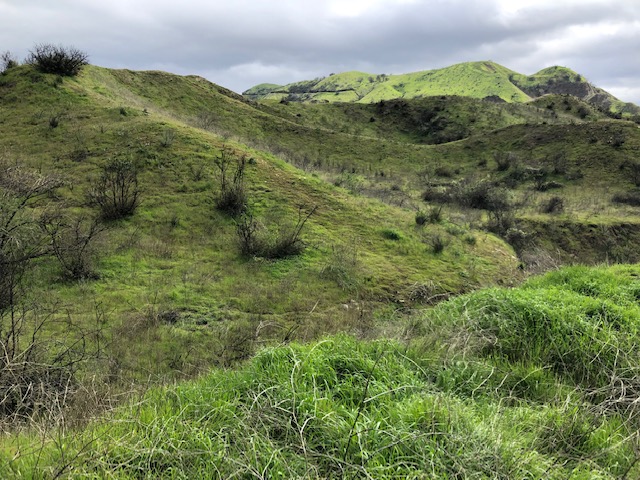
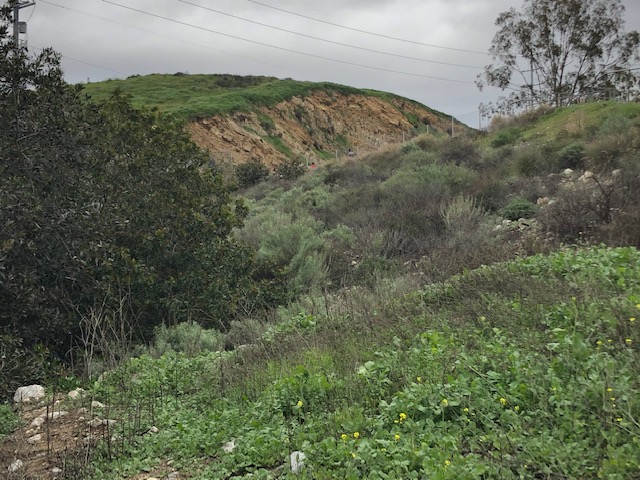
In 1975, the City of Los Angeles looked at Lopez Canyon and said “What a great place to put a municipal garbage dump!” The landfill was, mercifully, finally closed in 1996 and the land was left to its own devices. The drought years followed. Massive fires have burnt the hillsides and creek beds repeatedly. [The Santa Monica Mountains Conservancy has controlled the area since 2008.] Finally, the very wet winter of 2019 gave the hills the soaking they needed to get started on filling out the chaparral. lt’s looking practically bare now, yet somehow potent. This is first in a series that will follow the Transformation of Lopez Canyon, 2019 — ?
HILLS WITH BIG SHOULDERS
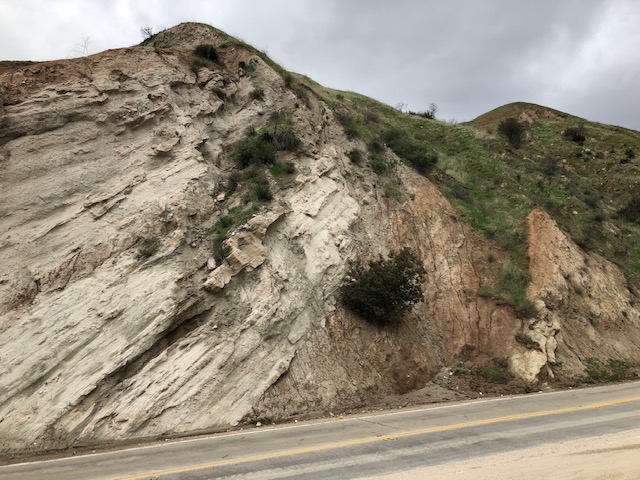
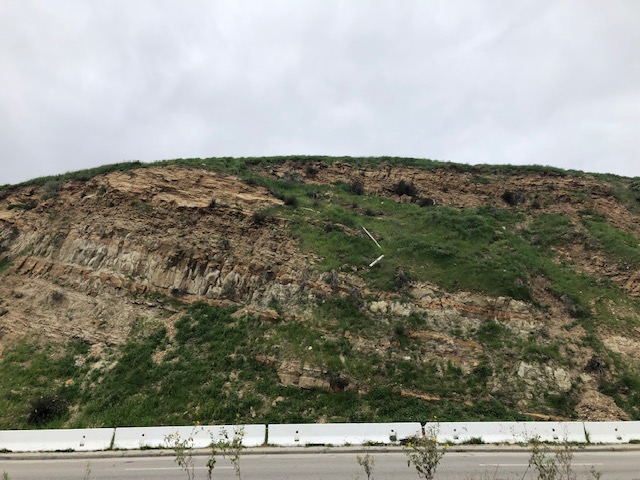
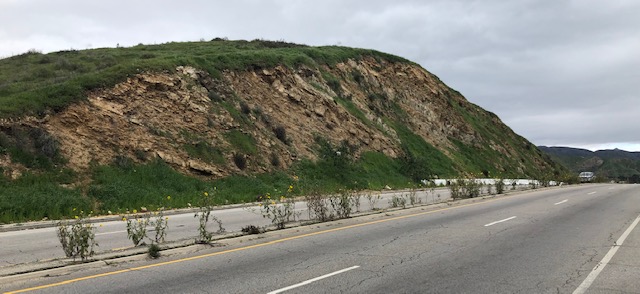
Lopez Canyon is really several canyons and arroyos cutting trenches through the soft sediments of a Pleistocene alluvial fan. Loose conglomerate has been dumped over layers of sediments laid down in an ancient bay. then got pressed and pleated and faulted and broken and uplifted out of the sea, rising to about a thousand feet.
“Continental sediments” washed over accordion-squeezed “accreted terrain” shows how Lopez Canyon formed.
The terrace below (part of the old landfill?), was just nicely graded. Oak and other native seedlings were planted by the SMMC and the sand-plain area regraded and restocked with chaparral staples.
The oak grove — pretty scorched over, but seemingly rarin’ to go.
Quercus agrifolia. Not our state tree; but live oaks are a familiar emblem of the California landscape. Since tbey thrive in the coastal valleys and hills where most of us live, they bless our stuck-in-traffic commutes with their message of slow perseverance. And the image of their fractal branches, black against the sunset, grace the labels of a thousand wineries.
Oaks are laden with cultural lore, whatever your culture. Groves were cultivated by the Indians for their staple food: acorns; and for the unique habitats that oak groves build: cool and fertile.
So mighty oaks, from tiny acorns, grow.Oak woodlands create habitat for a rich variety of native plants and animals.
Live oaks are “live” because unlike Eastern oaks, they stay green all year; they aren’t deciduous. They evolved in a complex relationship with condensed water, aka, our coastal clouds and fog. They’ve even come to resemble clouds: their pools of inky shade match the cloud shadows on the hills. And in the canyons, oak groves flow along the reach of the wispy fingers of morning fog.
The canopy grows where condensed moisture flows.
In fact, oaks help create both the fog, and the canyon, with their remarkable little cup-shaped leaves and their creeping, stooping branches. The domed leaves allow night moisture to condense underneath. This keeps the air and the soil around the oak reliably cool and moist through the hot sunny hours, when the fog is sipped slowly by tiny little hairs on the underside of each leaf. Oaks literally hug the moisture down out of the wind, and into the ground.
Parasols, each shading
…a column of moist air
Much of the alluvium they subsist upon is sand. But the oaks conserve whatever fertile soil does wash down, grabbing it in place with the deep mesh of a tiered root system, that lets the sand sift down to the creek bed. Once more, the shape of the leaves helps the oak: a thick litter of discarded leaves lets water percolate into the sand, but caps the soil surface, holding it in place, and keeping it cool and moist. The decomposing organic matter of leaf, twig and acorn gets enriched by the soot and charcoal from scrub or other oaks burned in wildfires. (Their extra-thick bark gives them the ability to survive flash fires.) It all creates a well-drained but rich structure, with a complex mycorrhizal community.
The white sand in the creek, the brown fertile soil retained in the terrace.
Many oaks are scarred by fire;
charred trunks feed the grove.
Over time, this makes soil that gives oaks the nutrients and mineral uptake they need. The terrace stops being loose sand, liable to wash in the next flood; it becomes stable woodland terrain. The canopy and the litter both protect the topsoil by filtering the pelting rain into a gentle drizzle. A flood may swell the creek and erode its banks, but the core of the terrace remains in place. See how the soil appears crowned with a thousand towers, each capped by a stone, a leaf, or an acorn. This good sticky soil is the oak’s creation, and tons of it has been deposited in the Valley since the Ice Ages.
This grove on Big Tujunga Creek built their terrace out of a sandy fan of loose alluvium.Little Tujunga live oaks creating a terrace atop San Gabriel fault.
When the Franciscans came, the Indians were forced to sacrifice their trees in the thousands to feed the Hellish fires of the San Fernando tile and lime kilns. Oak burns long, and hot.
Silent, patient, laden with mystique, oaks are rarely the focus of our attention, but they massage the peripheral edges of our mammalian psyche. The fact that they have adapted to this new, strange, dry land at the rim of the Western World, reassures Californians, native and immigrant alike, that here life is good, here life is righteous.
Ancient grove in Lopez Canyon. All these trees are genetically identical.
Marvel of nature, Kagel Canyon. Underneath, a sharp V-shaped terrain. But at some point in the Pleistecene, or, gulp, even more recently, a sudden Uplift Event pushed the Valley up hard against the San Gabriels, which were squeezed up 2,000 to 3,000 feet essentially “overnight”, cracking through the sedimentary crust, which then flopped back down again, broken up and tilted every which way. All this caused a lot of rock and dust and sand, both from the Valley’s seafloor side, and the mountains’ cruystalline rock side. Much of it tumbled down into Kagel Canyon and filled it with this “fanglomerate”, rocks and gravel mixed with flood alluvium. This forces the creek into a deep, confined channel. During the recent rains, it cut at least three feet deeper than it had been last fall. View, and read what Benjamin F. Howell has to say about Uplift in the Kagel Canyon formation.
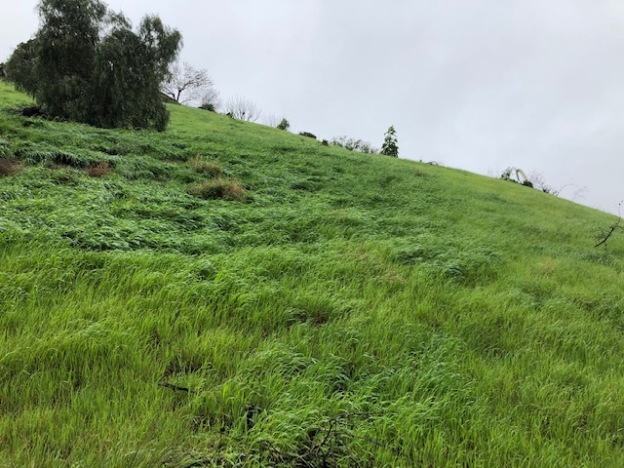
Winter rains bring out the Spanish in California. If a growth of grass like this year’s had come in the ranching period, the herds of Mexican longhorns would have increased past counting. The profits from the tallow-and-hide trade with the Yankees at San Pedro would have been a cause for setting off fireworks. Ramona’s Allesandro would have grown so drowsy counting the sheep in his flock, he might have lain down in the hills for a ten year snooze, like Rip Van Winkle. Andres Pico never saw it looking so lush and fat. But this is the Spanish winter green that he, and the Franciscans, labored to create.
A landscape that was re-grassed for, and by, European stock animals.
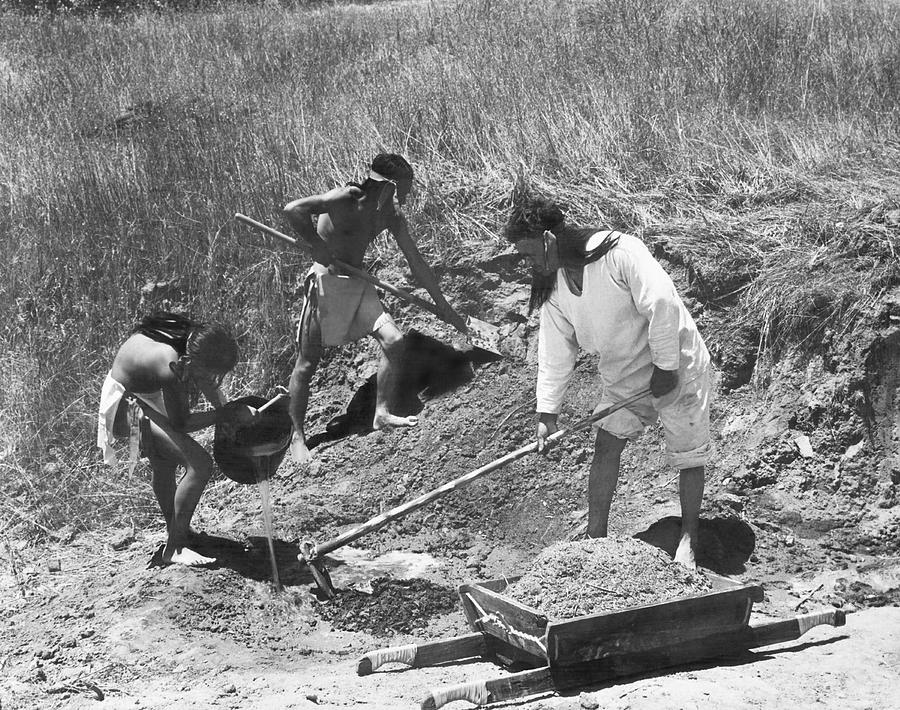
How did it happen so quickly? You can’t make bricks without straw. It explains why the Missions took so long (the 1790s, really) to get up their great adobe buildings.
“ And Pharaoh saith, Go ye, get you straw where ye can find it: yet not ought of your work shall be diminished. So the people were scattered abroad throughout all the land of Egypt to gather stubble instead of straw…
And the taskmasters hasted them, saying, Fulfil your works, your daily tasks, as when there was straw. And the…children of Israel…were beaten, and…cried unto Pharaoh, saying, Wherefore dealest thou thus with thy servants?…There is no straw given unto thy servants, and they say to us, Make brick: and, behold, thy servants are beaten; but the fault is in thine own people.”
Exodus 5
Mission San Fernando was the largest adobe complex ever built in California. Adobe bricks themselves cure in the sun; but if they are not covered with a tile roof and slathered with gleaming whitewash, they slump into mud with the first rain, just like the hills. Now, terra-cotta tile, and quicklime for whitewash, had to be fired in kilns, and kilns had to be fueled with oak. (Don’t blame the padres entirely: most of the Mission quicklime was sold to the pobladores of Los Angeles, to whitewash their adobe casitas downtown.)
“Gen. Andres Pico and Two Old Indians at San Fernando Mission” (1865). Left to right in background: glimpses of Limekiln, Lopez, and Kagel Canyons.I’m pretty sure these are the Pacoima Hills at sunrise. That’s Tujunga Wash; the Verdugos; and, in a haze of purple mountain majesty, the distant San Gabriels fading away. 1883.Spanish grass pasture has taken over the thin, recent layer of fertile soil that masks the fact that these hills are essentially uplifted dunes of beach sand.
“The conversion of California’s grasslands to non-native grasslands began with European contact. European visitors and colonists introduced plants both intentionally and accidentally. Adobe bricks from the oldest portions of California’s missions (1791-1800s) contained remains of common barley (Hordeum vulgare), Italian ryegrass (Lolium multiflorum), redstem filaree (Erodium cicutarium), wild oat (Avena fatua), spiny sowthistle (Sonchus asper), curly dock (Rumex crispus), wild lettuce (Lactuca sp., wild mustard (Brassica sp.) and others (Hendry 1931).
Most of the nonnative and invasive plants in California originated from the Mediterranean region of Eurasia and North Africa. Exotic Mediterranean annual plants altered California’s native grasslands to such an extent that it has been called “the most spectacular biological invasion worldwide” (Kotanen 2004).”
Land that is disturbed for any reason (fire, flood, landslide, man or beast traffic) gets immediately be re-colonized by the invasive grasses. Mudslides, in particular, displace native plants.
Three different green California hillsides.
The peculiar geology around Hansen Dam allows a View of three green communities, on three ridges. The middle ridge is a forgotten corner of the golf course. Somehow this olive-green hued knoll either retained, or re-grew after the Army Corps left, a native foothill chaparral flora: mature laurel sumac trees, shoulder-high sagebrush, buckwheat, cholla cactus, native sunflowers and bunch grasses. Above it, carpeting Top Hill., is the deep green of the naturalized Spanish/Mexican pasture grass mix, Old World foxtails and wild oats and rye and brome.
The bottom, bright green and yellow ridge is a small alluvial dump that just a week ago washed down from a new bridle path ramp. The disturbed soil immediately sprouted mustard shoots and turf weeds. The native plants nearby are putting out root; they won’t get a chance for a foothold until they set seed in the fall. If a hot summer burns off the “weeds”, the California natives might get a chance.





 The Valley Village View