Welcome to the blog of writer and musician Andrew Martin. Here I'll post original photographs and observations as I encounter the history and culture of the San Fernando Valley, the City of the Angels, Alta California and the far-flung Pacific Rim… but mostly the Valley.
“Californ-i-ay, where the rain doesn’t rain, it just drizzles champagne.” — Yip Harburg
We finally had a real winter storm, two days of nice soft rain. Thank the Elye-wun, or whose-ever long white beards those are, flowing over the hills.
The hollyleaf cherries greeted me as if they were Irish Spring models, fresh and perky.
The deerweed has pinked up remarkably; the tired wilted look is gone everywhere. It’s a pioneer species in recovering disturbed areas: it cleverly fixes nitrogen in the soil, preparing for fertility.
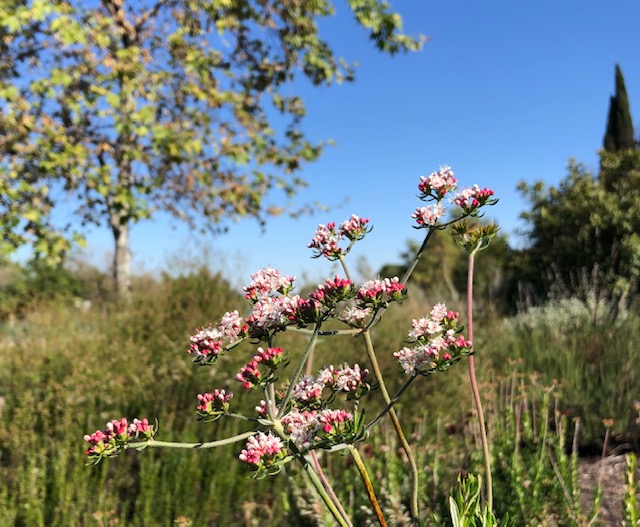
The star of the show is an elegant hunting-pink buckwheat variety, Eriogonum fasciculatum, only this strain seems very gracile, and ripens to ruby red, not orange-brown.
The gracile buckwheat strain blooming white, and the deerweed in gold, in the June, 2020 Superbloom.Comparing the LOC buckwheat, left, with your common-or-garden variety, right.
Re-capping from Feb. 2019:
January, 2019. Hills bare, contrasts extreme, and the creek bed was streaked with oak-char, but…potential!
Here’s one year later, Spring 2020:
January, 2020
In August 2020 we had a single-day spike of 118 degrees, and everything then alive, sizzled, I thought to death. By Christmas Day of 2020, after months of no rain, the hills had roasted up brown and crispy.
Christmas, 2020. Looks pretty fried, doesn’t it? But one month, and a couple inches of rain later:January 29, 2021. The land is filling in with “Foothill Alluvial Fan Chaparral.” It’s far more diverse than ever.
Tempus adest floridum, surgunt namque flores Vernales mox; in omnibus immutantur mores. Hoc, quod frigus laeserat, reparant calores; Cernimus hoc fieri per multos colores.
— Carmina Burana, CB 142, 12th c.
Sambucus mexicana — elderflowers
Blossom time’s a-comin’ fast, rilin’ all them flowers. Spring gets into everything, with her eerie powers. “Rainy Season’s gone at last! Sun’s out! Tanning weather!” Scrub greens bronze, turn pink, red, gold, purple, brown-as-leather.
— ‘Tujunga Wash Carol,’ trad., SFV. Recorded by VVV, Easter, 2020
NEW TO THE VIEW! A strain of Rosa californica — wild rose — but with ruffled white flowers
Laurel sumac; eponym of the canyon and the boulevard.
Buckwheat
Ice plant
Holly-leaf cherry
‘When it’s Cherry-Blossom Time In Tujunga”
…the rest of the chorus writes itself.
How’d ya like them drupes?
Dennis Moore, Dennis Moore
NEW TO THE VIEW!
Erect shrub, not a vine
Lonicera interrupta
Chaparral honeysuckle. WINNER OF THE EASTER PARADE!
Sagebrush –the soul of scrub.
Graceful like seaweed
Mountain mahoganies JUST setting catkins
Females have pretty yellow flowers, but this year seems a sausage-fest.
It’s close enough to meet “exercise within neighborhood” guidelines, so it’s the perfect place to get some vitamin D and socially distant exercise. (Sadly, nobody goes to look at native plants. To 99% of Angelenos, these are “the tules,” the weeds, the sticks, the scrub, the wash, the concrete canyon, the waste place. Thus to escape Angelenos, native plants are a sure resort.)
The color palette of sage scrub is about subtlety; the sophistication of grey-green.
It’s been a torrent of a spring, changeable and tempestuous, weather that is itself a fun thing just to be out in, when every winged creature is cheeping and buzzing and flapping and croaking and cawing and wheeling overhead in a Wedgwood sky. It’s been torture every day to resist going out in the weather, to see what flowers have popped.
Phacelia calendula, California bluebells. Only two plants, but that’s all you need to tango.
Prunus illicafolia, the holly-leaf cherry. The only cherry in the CFP. The flesh is delicious when ripe; the pits are highly nutritious, when the toxins are leached out by soaking. The pits were pounded into flour for a special kind of tortilla, or even a kind of honey-sweetened confection, like halwah.
To keep my weekly “parole” legal, focused and therefore efficient, instead of walking aimlessly, I’m planning to do a week-by-week photo-document of how this patch of scrub grows and develops through the season. Jepson couldn’t have asked for a better laboratory. In the next few weeks you can watch, with me, as Tujunga Wash Comes Out; the San Fernando Valley’s Oldest Spiring Debutante. (Ignore the concrete dress, writes Dorothy Kilgallen; Tujunga’s an Army Corps brat; but she’s got good breeding. She’s descended from Big Tujunga on one side, and Little Tujunga on the other; so there is good potential here.)
The Island snapdragon, native to the Channel Islands. Galvezia speciosa. Hummingbird, bee attractor.
Smog-free skies have contributed to this very robust growth. Pollution is even more toxic to the CFP than it is to traditional North American landscapes, so this is a good spring to monitor a smog-free bloom (we hope, the first of many.) Below, the lupines are going crazy; lupines and cholla and sunflowers? What an amazing habitat.
A very young laurel sumac leafing out…
Mature laurel sumac: life’s the berries.
The spring’s sole, bellwether, buckwheat flower…
Eriogonum fasciculatum
Baccharis salicifolia
Mulefat, a sweet-smelling key species for riparian habitats. Take this away and the birds and bees go, too.
We just had a week of record rainfall. too. But even with the sparkling air and the Midas touch of sunshine, this biome feels like it has found its feet at last; that individual plants are at last working together, merging into that emergent organism, the aromatic, wildlife-attracting, self-evolving scrub.
Black sage, Salvia mellifera
It’s the black seeds that give the name. Sage seeds, highly nutritious, were a staple for the Indians.
White sage, Salvia apiana
White sage, keystone of Coastal Sage Scrub. It has fragrant, almost pungent leaves, good for smudging.
I had no idea sage could grow old enough to develop a gnarly, grapevine-style trunk.
In coming weeks, if I’m not in a ventilator, watch this space to see those white sage spikes fluff out in flower.
Hollyleaf cherry – prunus ilicifolia. Edible California wild cherries. The Indians, I’m told, used to ferment the fruit into cherry wine. It’s the only prunus species native in California, and it doesn’t seem to grow anyplace except California.
I found a vigorous shrub this morning high up in Griffith Park, on a “north-facing slope,” its favored terrain. Then I found one this afternoon in a dry gully of the Tujunga Wash. The Valley shrub had plenty of drupes, but they got scorched by our 118-degree day in July. I’ll try starting them anyhow.




 The Valley Village View