Tag Archives: Capitulation at Cahuenga

Van Nuys — a Viewing

A new series applying history’s tire-iron to the rusty Hub of the Valley
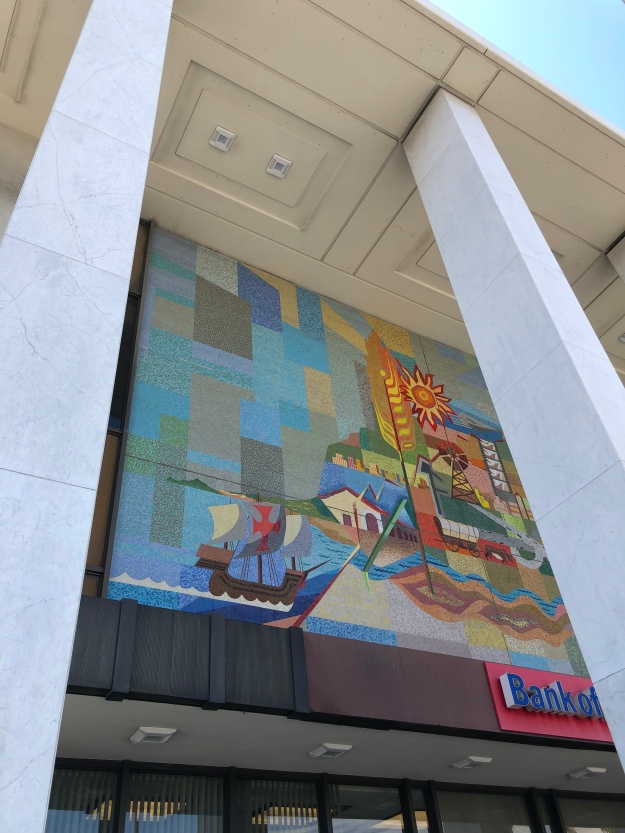
Millard Sheets, 1965. HSFC Bank on Van Nuys Boulevard, now BofA

PART ONE: ‘WHEN ALL THIS WAS FARMLAND’

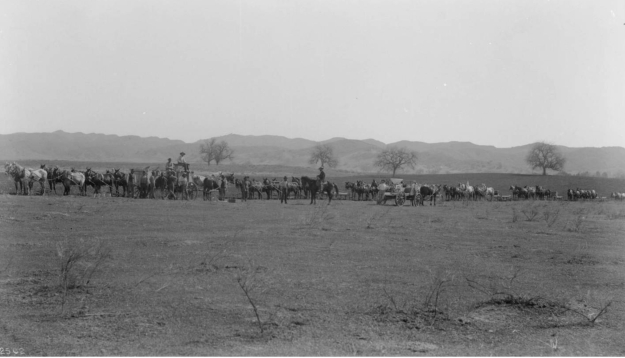
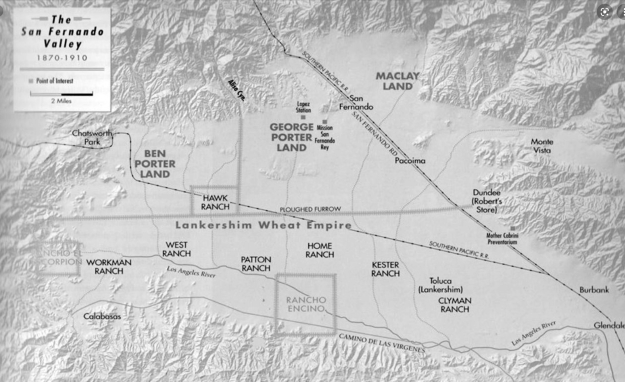
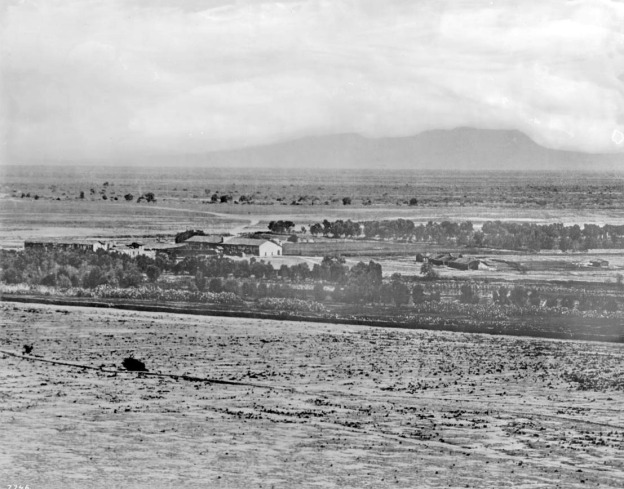
In the photo below, the sun-baked middle ground is today’s Van Nuys. Van Nuys is unusual in America in that the historian can’t sanctimoniously intone in the opening paragraph “For time immemorial People of the Ancient Ways called this land home, at one with Nature’s Ways.” Nobody called Van Nuys “Home” until Isaac Newton Van Nuys. And for the Tongva, the Chumash and the Tataviam who lived in the surrounding hills, the way to be at one with Nature’s Ways was to hot-foot it across the Valley as fast as you can in the dry seasons; and avoid it completely during the dangerous wet times when it swamped and Tujunga or Pacoima Wash could rampage. Of the two pleasant spots where natural wells and pools spring up, and the Indians had mixed-tribe rancerias, neither of them is Van Nuys. One was Encino [Siutcanga]; the other of course was San Fernando [Achoicomenga], where the Mission was built. But Van Nuys belonged to the antelopes. When the Indians were almost gone and the Mission was secularized the Valley was heavily ranched. Gen. Andres Pico took his interest in San Fernando and the northern half of the Valley, and his brother Don Pio Pico, the last Californio governor who had signed the original grant in 1846, by the 1850s had somehow come to own the southern half himself — including the cattle-tramped hardpan we call Van Nuys, that nothing in the middle:

Don Pio Pico, executing rights from a complicated chain-of-title victory from the Land Commission, sold his half of Rancho Ex-Mission San Fernando to the Yankees because beef prices had collapsed. Around 1865, the 15-year Gold Rush boom waned, then busted. The days were bygone of Valley rancheros driving thousands of cattle up to San Francisco and Sacramento to be slaughtered for twenty-dollar beefsteaks. The problem of a sudden oversupply of lowing stock solved itself, when a searing drought gripped the Southland, leaving the Valley full of cattle bones by 1868. The land sale was pervaded with ironies; Col. Fremont had made the Mission the headquarters for his California Battalion, and across these very plains had ridden in triumph to receive the sword of capitulation from Gen. Andres Pico, who claimed the Mission and its lands for his own. In 1848, Pico capitulated to save the Californios’ ranchos. Now the Picos were selling theirs off to the Yankees. But Pio Pico was the wiliest California land-jobber of them all. Realizing a profit from the switch of allegiances to Norte America, even so land could be liquidated legally, was their triumph. Pio was was certainly shrewd enough to realize a Hotel on the Plaza would bring steadier returns, and more genteel social connections, than running stock on the hoof. It was a brilliant trade for Pico, one of his canniest bets, for it kept him in good credit. It was also a decisive investment in downtown Los Angeles; the first moment when the dusty pueblo earned any notice at all in the world. Pio Pico put the Merced Theatre in back of the Pico House, with a door to the lobby; and put Jules Harder in the hotel kitchen; and made LA a city on the map.

1880s: the combine and twenty-mule team.

And it was a great deal for Van Nuys, who was the partner responsible for actually running the farm operation. Lankershim had tried dry wheat farming for a couple of seasons but had busted. Van Nuys said he could do it, and he did; with true Yankee luck, the middle of 1870s when he experimented brought some good El Niño rains, and by the 1880s Van Nuys was harvesting boatloads of grain with Lankershim’s capital, and shipping it overseas at a branded premium. Thus it was a great return for the San Franicsco investors, too. Lankershim had found this land destroyed by heavy cattle ranching and failed to work it; it was Van Nuys who made it into a productive monocrop that brought other wheat farmers to make fortunes here too. He was one of the greatest farmers who ever lived.

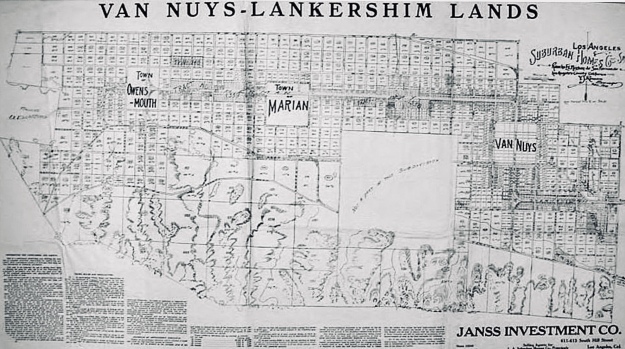
But who was Isaac Newton Van Nuys? He wasn’t the founder of Van Nuys, but it was named for him when he sold in 1909. (The town was founded in 1911). Speculative towns are usually named after the developer’s signature on the front of the check, not the farmer’s name on the back. Significantly, also, the name ‘Van Nuys’ is practically the only one of the developers’ original town names not to have changed; meaning, Van Nuys never actively voted to change its identity, as did social-climbing Toluca to Lankershim to North Hollywood, or Zelzah to Northridge, or Marian to Reseda, or Owensmouth to (the equally unappealing) Canoga Park. In the next part we’ll take the man, and his name, and his Life, in View, to glean what civics lessons we can.

Jan. 13, 1847: The Capitulation at Cahuenga

Today marks 172 years since Don Andres Pico, General of the California Lancers, met with Lt. Col. John C. Fremont, of the California Battalion of Mounted Naval Dragoons (sic), at Campo de Cahuenga to accept American rule of Alta California.

Janet and Damon endure “one of those” versions of The Star-Spangled Banner.
The old El Camino Real bell. Mrs. A.C. Forbes, II, presented this morning’s dramatic re-enactment.
The Scouts, Webelos and Cubs did a fine job of raising the Stars and Stripes.

The morning was drizzly and cold, just like today, and the spot was on land that Don Andres thought of as his own. His enemy, Fremont, had spent the previous night encamped around Pico’s Rancho Ex-Mission San Fernando.

Pico had stopped at this Campo many times, on trips through the Cahuenga Pass to and from Los Angeles. (Pico once may have had a mayordomo living at the Campo, managing his interests.) Nevertheless, for his own sake, and charged with the greater interests of California, Pico accepted Capitulation.

By repute, this is the Sanchez Table upon which hostilities were signed away.

The paper was signed on a porch, giving on the rainy Valley Village View.

Capitulation meant saving the land.

That moment, Pico and Fremont ended the Mexican War in California. Manifest Destiny had completed its work, the continent west of the Rockies became America, and the Californios were brought into the American people with the very highest honors that humanity knows — the rights of free and equal citizens in a democracy. It’s true: all this happened right here in Studio City.

These rights, the Californios had fought and died to vouchsafe. The Lancers had liberated their capital Los Angeles from the Yankee invaders; trounced the U.S. Marines at San Pedro, and scourged the regular Army at San Pasqual in the months leading up to Cahuenga. But Fremont offered honorable terms to achieve what most Californios wanted most dearly: that their land would remain theirs. (The other two commanders in California, Stockton and Kearny, wanted to hang the Californio leaders, loot and dispossess the ranchos, and let the coyotes nip the heels of the hindmost Californios fleeing “back to Mexico.” Stockton, in particular, vowed that he would achieve victory if he had to “wade through the Los Angeles Plaza with the blood of Mexicans lapping over the tops of his boots.”) Upon hearing of Fremont’s publicity-hogging masterstroke, Stockton reputedly had a connitption, but then wisely accepted that Manifest Destiny would have the last word in history.

The Universal City Metro Station tells the story, in tile and in Spanish, of the Conquest of California.

Kit Carson was Fremont’s guide, sidekick, and stalwart friend. Thanks to “Golden West” mythologizing, Carson remains the only figure of that day remotely remembered by the American public. Sadly, Carson’s savage record as a man-killer probably helped the dime-novel myths take root.

As the ink on the armistice dried, and a somewhat garbled Spanish translation was written out, Gen. Pico rode with his Lancers over the Pass to Los Angeles, into the Plaza, and there under the American flag they lay down their arms, with the colors of Mexico (above). Fremont (who had hurried ahead to gussy up in his epaulettes and ostrich plumes) received them in triumph, mounted on his horse “Sacramento” beside a humiliated, out-foxed, and up-staged Stockton. Still, the Commodore from Princeton had his crack Marine Brass Band unit on hand to play out the old regime, and play in the new. Surely it’s only a legend, that the relieved Angelenos brought out their guitars and aguardiente, let out their daughters, and lit off fireworks while the senoritas danced for the Yankees all night long.

During the weeks after the conquest, while he was Jefe of California, Fremont reportedly infuriated his envious commanding officers by sauntering around Los Angeles in a silver-spangled sombrero and colorful serape, kicking his boots up onto the desk as he presided over the LA ayuntamiento, and generally endearing himself forever to the people of Los Angeles. He had gone native. His court-martial followed soon after.

“…the vast San Fernando Plain”

I discovered this evocative photograph of the Valley (thank you KCET).

The view, taken on a cool drizzly day in 1875, is south, looking over what had been lands of the Mission San Fernando Rey de Espana, toward Mt. Cahuenga and the Cahuenga Pass. Los Angeles lies just over the hill.

The Valley was, in the Mexican period, historically contested land, the buckle of Alta California.  One army could camp at San Fernando and the other at the Cahuenga Pass, and they could lob cannonballs and race squadrons of cavalry at each other across the Valley floor.

John C. Fremont would have seen it looking much like this on the rainy January morning in 1847, as he rode from the Convento toward Campo de Cahuenga to receive the surrender of Gen. Don Andres Pico, and end the Mexican War in California. In fact, as Fremont knew, the whole plain was Pico’s land, Rancho Ex-Mission San Fernando. It must have especially galled Don Andres that Fremont and his Battalion of Bear Flag ruffians were camping there.

This view also was important to Gov. Juan Bautista Alvarado in 1836, during his coup d’etat. Southern Californios, led by the Pico Brothers and the Carrillo clan, had camped with their militia at San Fernando Mission. The rebels hoped to sever Southern California from the tyranny of Monterey, and to spite the treachery of Alvarado; but to do so they had to defend their capital of Los Angeles, and head off Alvarado’s Norteno army at the Pass. Bloodshed on this plain by fathers and sons on both sides was a real threat, but the Surenos finally acquiesced to Alvarado’s rule.  Soon after, the land grants began, and the loyal Surenos weren’t stinted.

This strategic plain was also the site of the Californio rebellions against the Mexican Governors Micheltorena and Victoria. These Battles of Cahuenga and Providencia were violent and explosive, and they had real political consequences. But casualties were almost nil, intentionally, of course.

The land was shaped this way by the Franciscans, with orchards, arable, and rangelands. It was then managed by Don Andres Pico, and his mayordomo Valentin Lopez. Tongva and Tataviam Indians were the vaqueros and orchardmen who worked the ranch. It appears here roughly in the condition in which it was sold off by the Picos to Isaac Lankershim for his huge dry-wheat farms and farmstead tracts; and to Charles Maclay for his City of San Fernando. The line of oaks in the center marks the San Fernando Road.

This is the landscape as Collis P. Huntington and his SPRR engineers saw it. In fact this may have been a surveyor’s photograph: a year later, in 1876, they and thousands of Chinese workers drove the tracks of the Southern Pacific Railroad right down that line of oaks, along San Fernando Road, and changed this view forever.

The Mission lands ran to the line of mist before the hills. This is roughly the line of the Los Angeles River. Here, in the cool shade of Cahuenga, the beautiful mountain that looks like a lady lying down, was the Tongva Council Grove of Sycamores (by the Gene Autry National Center in Griffith Park.)  Beyond the River, most of the hill-scape you see was Col. Griffith J. Griffith’s portion of the old Rancho Los Feliz. Today it is Griffith Park.

The Convento of the Mission appears still in good shape, but the church, the farmyard and outbuildings (including possibly the Andres Pico Adobe?) are muddy piles. Charles Fletcher Lummis would find the ruins in even worse shape ten years later. Appalled by the decrepitude of California antiquities, Fletcher founded the Landmarks Club to rally public forces in Los Angeles and across the nation to preserve San Fernando, and three other Missions.

Land that became North Hollywood and Valley Village appears here, at the center far right, between the orchards and the low-sloping Cahuenga Pass.

The Mission Sam Fermamdo Rey de Espana is fronted by this magnificent arcade that stretches along Camino San Fernando, its shady recesses still beckoning visitors. This building is the high-water mark of Franciscan architecture in California. 

This was the largest adobe building in Alta California.  It was also the most comfortable place to stop for a few days. Here were dense orchards, spring-fed Moorish fountains and irrigated gardens, workshops to repair your careta or shoe your horse. San Fernando also boasted fine old vineyards producing some of the best wine and brandy in the province. Plus it housed the padres’ splendid library; and important visitors could expect fine beds in private apartments. Humbler folk bunked down in the breezy arcade.

John C. Fremont made this the headquarters of the California Battalion in the first week of January, 1847, on his march south toward Los Angeles. Though Fremont was noted for sleeping out in the rough, his officers certainly took the warm beds in the Convento. This must have galled Andres Pico, hiding out with his Lancers at Verdugo’s ranch. Pico had leased the former Mission property; he had run cattle on it and vinted wine there, and considered the site his own rancho. 

On the cold morning of January 13, 1847, down this arcade Fremont sauntered; upon these steps he saddled up, turning his collar up against the steady rain; along this road he cantered out to the Campo de Cahuenga, under flag of truce, to receive Andres Pico’s, and California’s, surrender. Was he whistling an air as he rode?