Tag Archives: Achoicomenga

Van Nuys — a Viewing

A new series applying history’s tire-iron to the rusty Hub of the Valley
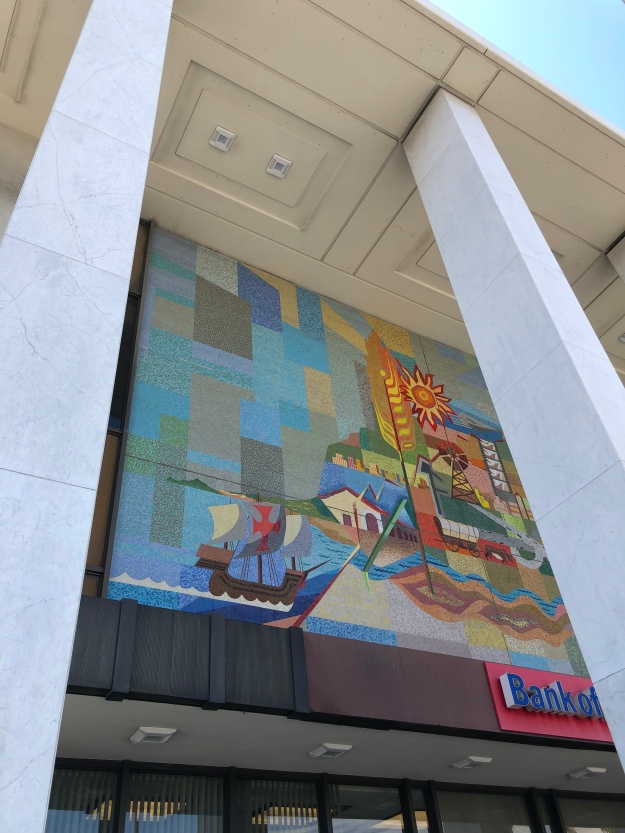
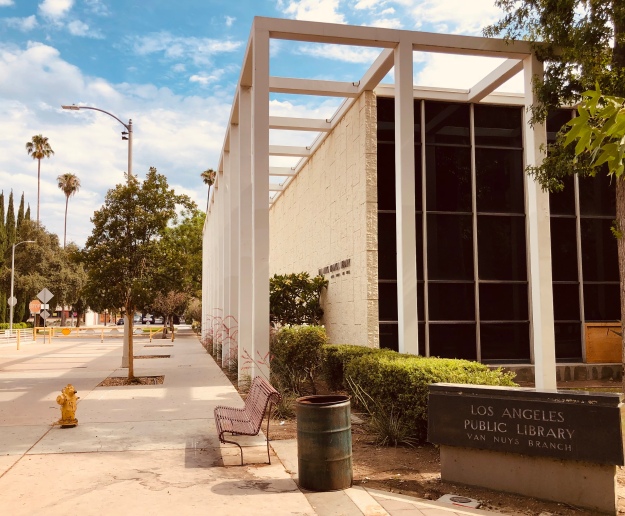
Millard Sheets, 1965. HSFC Bank on Van Nuys Boulevard, now BofA

PART ONE: ‘WHEN ALL THIS WAS FARMLAND’

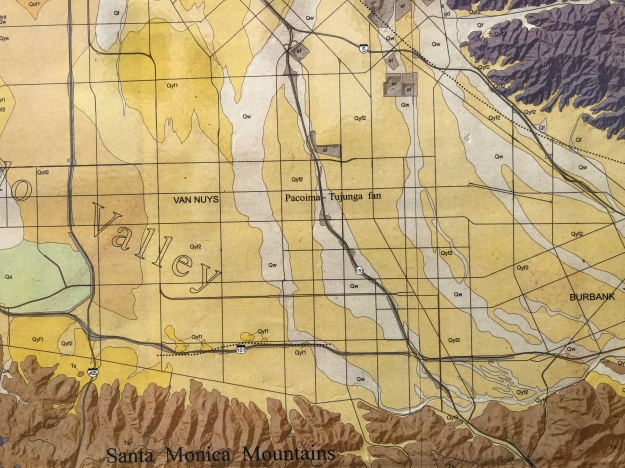
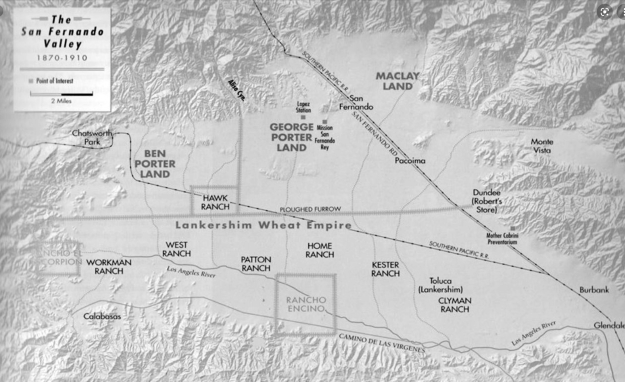
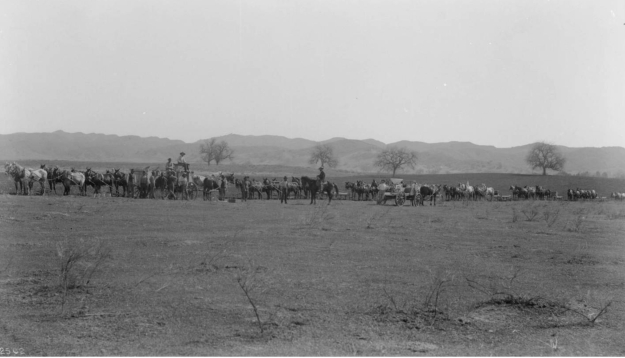
In the photo below, the sun-baked middle ground is today’s Van Nuys. Van Nuys is unusual in America in that the historian can’t sanctimoniously intone in the opening paragraph “For time immemorial People of the Ancient Ways called this land home, at one with Nature’s Ways.” Nobody called Van Nuys “Home” until Isaac Newton Van Nuys. And for the Tongva, the Chumash and the Tataviam who lived in the surrounding hills, the way to be at one with Nature’s Ways was to hot-foot it across the Valley as fast as you can in the dry seasons; and avoid it completely during the dangerous wet times when it swamped and Tujunga or Pacoima Wash could rampage. Of the two pleasant spots where natural wells and pools spring up, and the Indians had mixed-tribe rancerias, neither of them is Van Nuys. One was Encino [Siutcanga]; the other of course was San Fernando [Achoicomenga], where the Mission was built. But Van Nuys belonged to the antelopes. When the Indians were almost gone and the Mission was secularized the Valley was heavily ranched. Gen. Andres Pico took his interest in San Fernando and the northern half of the Valley, and his brother Don Pio Pico, the last Californio governor who had signed the original grant in 1846, by the 1850s had somehow come to own the southern half himself — including the cattle-tramped hardpan we call Van Nuys, that nothing in the middle:

Don Pio Pico, executing rights from a complicated chain-of-title victory from the Land Commission, sold his half of Rancho Ex-Mission San Fernando to the Yankees because beef prices had collapsed. Around 1865, the 15-year Gold Rush boom waned, then busted. The days were bygone of Valley rancheros driving thousands of cattle up to San Francisco and Sacramento to be slaughtered for twenty-dollar beefsteaks. The problem of a sudden oversupply of lowing stock solved itself, when a searing drought gripped the Southland, leaving the Valley full of cattle bones by 1868. The land sale was pervaded with ironies; Col. Fremont had made the Mission the headquarters for his California Battalion, and across these very plains had ridden in triumph to receive the sword of capitulation from Gen. Andres Pico, who claimed the Mission and its lands for his own. In 1848, Pico capitulated to save the Californios’ ranchos. Now the Picos were selling theirs off to the Yankees. But Pio Pico was the wiliest California land-jobber of them all. Realizing a profit from the switch of allegiances to Norte America, even so land could be liquidated legally, was their triumph. Pio was was certainly shrewd enough to realize a Hotel on the Plaza would bring steadier returns, and more genteel social connections, than running stock on the hoof. It was a brilliant trade for Pico, one of his canniest bets, for it kept him in good credit. It was also a decisive investment in downtown Los Angeles; the first moment when the dusty pueblo earned any notice at all in the world. Pio Pico put the Merced Theatre in back of the Pico House, with a door to the lobby; and put Jules Harder in the hotel kitchen; and made LA a city on the map.

1880s: the combine and twenty-mule team.

And it was a great deal for Van Nuys, who was the partner responsible for actually running the farm operation. Lankershim had tried dry wheat farming for a couple of seasons but had busted. Van Nuys said he could do it, and he did; with true Yankee luck, the middle of 1870s when he experimented brought some good El Niño rains, and by the 1880s Van Nuys was harvesting boatloads of grain with Lankershim’s capital, and shipping it overseas at a branded premium. Thus it was a great return for the San Franicsco investors, too. Lankershim had found this land destroyed by heavy cattle ranching and failed to work it; it was Van Nuys who made it into a productive monocrop that brought other wheat farmers to make fortunes here too. He was one of the greatest farmers who ever lived.
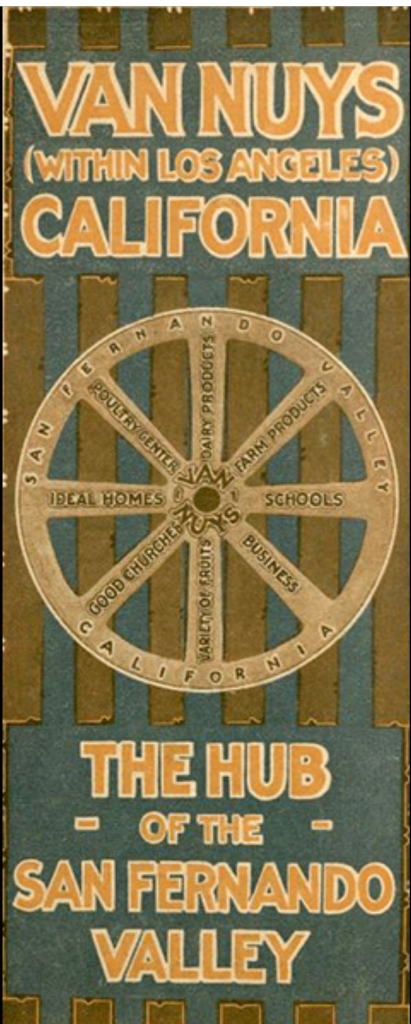
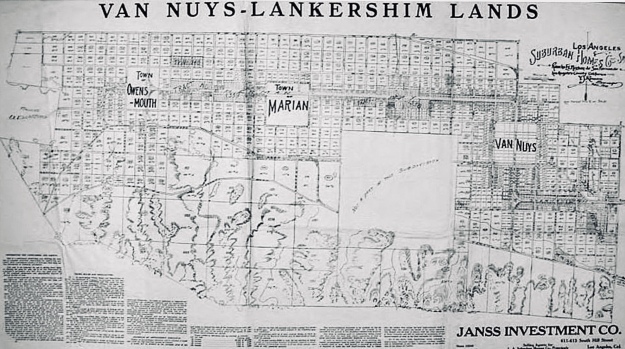
But who was Isaac Newton Van Nuys? He wasn’t the founder of Van Nuys, but it was named for him when he sold in 1909. (The town was founded in 1911). Speculative towns are usually named after the developer’s signature on the front of the check, not the farmer’s name on the back. Significantly, also, the name ‘Van Nuys’ is practically the only one of the developers’ original town names not to have changed; meaning, Van Nuys never actively voted to change its identity, as did social-climbing Toluca to Lankershim to North Hollywood, or Zelzah to Northridge, or Marian to Reseda, or Owensmouth to (the equally unappealing) Canoga Park. In the next part we’ll take the man, and his name, and his Life, in View, to glean what civics lessons we can.
Kas-ele-wu, in Bloom, in Gloom

Early August brought foggy foggy gloom, so I hied me out to the West Valley, to Calabasas, to El Escorpion Park, which was known to the Chumash as Kas-ele-wu, Swordfish-God Peak.

It’s a tiny vest-pocket park in L.A., right on the Ventura County border, but it was once the center of an Indian-owned rancho called “El Escorpion,” on a site where the Chumash had long had a town and a holiday resort. The sacredness is palpable here.

The Elye-wun were the ancient Swordfish-Men, a cantankerous, gut-stuffing brotherhood of fishermen who lived at the bottom of the sea just off the coast. If tricked or bargained with, or following their own gluttonous hunt, the greasy, bloody-mawed Elye-wun would drive pods of whales up onto shore at Malibu, where the Chumash gratefully kindled roasting fires on the beach. The Elye-wun would heave whales out of the waves on the points of their “gaffes” which were of course their headspikes, idealized as huge manual harpoons.

Almost as sharp, is the pungent fragrance of the vinegarweed. This is a handsome native plant, with beautiful green awl-shaped leaves and nice purple flowers. It is a starter in disturbed areas, such as the sides of cleared trail cuts. I’d never come across it before, but the not-unpleasant dill-vinegar-chip odor in the grass was a dead giveaway.


The harbinger of the Elye-wun’s hunt was the coastal fog, when their great long white beards hung over the mountains. For this reason, on a day like today, Kas-ele-wu was full of Big Medicine. Below: white sage, buckwheat; white sagebrush and chamise; oaks and a young sycamore. Biggest medicine of all, of course, is momoy, datura, moonflower, the central ritual hallucinogen of the local religion.

There were bush mallows everywhere along the creek, beautiful as flowers in a storybook. Their burst into lavender cups of glory, and their withering to a desiccated brown shrivel, is a potent Memento Mori. A whole bank of them got draped this year with a noisome net of chaparral dodder — yecch.

There were powerful shamans here, including Munitz. Kas-ele-wu was a center of the ?antap cult of aristocratic ancestral dances, ceremonies and datura ingestion. The shamans from here nurtured the Chinigchinich religion down in the cosmopolitan Valley below, at Siutcanga and Achoicomenga. The bowl was a place of pilgrimage especially at the Winter Solstice. But I can’t imagine this place is more beguiling than it is now, in August. Look at the reds.

The uplifted crags are full of clefts and caves. My guess is, the south-facing Munitz’s Cave is suffused with a very intense sunbeam, maybe around noon on the Solstice.

On the other hand, the Chumash were great star-watchers, and it is probable that there was some phenomenon of the constellations dramatically apparent there. I Meanwhile, the constellations in the tall grass were the finest stars one could wish.

Going Over the Tehachapi Line, Through The Grapevine

An old-fashioned holiday View: the ravishing scenery of Tejon Pass covered in snow, as I travel over the Tehachapi Mountains in a Greyhound Bus, from North Hollywood into the Great Central Valley.

Just last week, on Christmas, snow had closed the 5 Freeway; more snows were predicted this morning. But half an hour before my trip, the dark clouds vanished, and across the Valley, skies suddenly turned blue. Our route is along the “Old Los Angeles – Stockton Road”, also known as “El Camino Viejo.” Stockton or Bust!

“Southern California is the land ‘South of Tehachapi’ — south, that is, of the transverse Tehachapi Range which knifes across to the ocean just north of Santa Barbara… In the vast and sprawling state of California, most state-wide religious, political, social, fraternal, and commercial organizations are divided into northern and southern sections at the Tehachapi line. When sales territories are parceled out, when political campaigns are organized, when offices are allocated, the same line always prevails.”

— Carey McWilliams, Southern California: An Island On The Land, 1942

These lands, the lush hills and canyons between San Fernando and Grapevine, were the core territory of the Tataviam, the “People of the Southern Slopes.” This territory was between the Chumash peoples’ hills toward the Ventura coast, and the Kitanemuk peoples’ hills clustered around mighty Mt. Tehachapi itself. The Tataviam range was small but it was incredibly strategic; then, as now, the Pass was an economic corridor. Naturally, the big Tataviam rancheria in the pass, Castac, was, like Achoicomenga to the south, a prosperous mixed-language settlement and trading center. Unlike Achoicomenga, which was obliterated by Mission San Fernando being built on top of it, Tataviam speakers somehow survived around Castac, even after the U.S. Army built Fort Tejon at the top of the Pass (1850). There were even Tataviam speakers working at Tejon Ranch in the 1920’s when anthropologist J.P. Harrington found them and worked with them to preserve Tataviam language and culture. One of these last Tataviam was the chief stockman and overseer of the whole massive ranch.

And just like that, you’re “through The Grapevine,” out of the Pass and into the awesome Central Valley. All this range-land is, or has been, part of Tejon Ranch. The huge estate became the private farm of the Chandler family, who used to publish the LA Times. The descendants are always threatening to develop the hell out of it. So far, most parts of the storied spread seem scarcely to have changed since the 1950s.

The Ancient Dance of Gratitude

The richness of the urban experience in the Valley fascinates me. Thursday evening, I took an after-dinner stroll down Magnolia Blvd. and caught the sound of distant drumming. Intrigued, I followed the thrum on the breeze all the way into NoHo Park.

A circle of indigenous dancers was …dancing, rather than performing a dance, as I’ve seen folklorico groups do many times for the tourists in Hollywood, or Venice Beach. Here there were no tourists, there was no real audience. The dancers were worshipping in an ancient way; or rather, the worshippers were dancing in an ancient way. Someone said they meet for these ceremonies at different sites all around Southern California. The costumes were all exquisite — hand-tooled hides, real bead work, etc. They appeared a cut above the usual performers’ costumes. Many must have been made by, and for, the dancers themselves.

Click on the link for One Minute of Tranquility — “The Ancient Dance of Gratitude”

https://drive.google.com/file/d/1VjOXGyinL0x4ArCCRMPL4UEwiGqOf5OP/view?usp=sharing


Remember, Patient Reader, that for the Ute-Aztecan peoples who settled the Valley, the Tongva and Tataviam, ancient Mexican religious circle-dances like this one were the ancestral basis of both the ?antap cult, and the Chinigchinich cult. Thus, three forms of dance-based worship — three levels of spiritual exploration through dance — were the core of the spiritual life of Achoicomenga before the arrival of the Franciscans. Here, before my eyes, was such a circle-dance.


The dancers were ecstatic, meaning, in this case, preternaturally outside of their normal selves, focused intensely on the steps. Their concentration was absorbed by the throbbing tattoo, the cool night air, and the slow, ceaseless circling of the group. Powerful sensual stimulants heightened the occasion — puffs of sweet incense, and the strobe-like flutter of the feathered headdresses in the glaring lights of the basketball court. The drums must have throbbed a good two hours, but the dancers seemed to derive power from the constant shaking of their sweaty limbs. Standing nearby, I could feel the acoustic force of the rattling ornaments on their shins — like hundreds of tiny maracas on each leg.


And there were sacrificial food offerings on tables — plates of sliced fruit and cakes — meant to nourish the gods. Who, as in all rituals, are personated in our world by the sweaty shakers on the dance floor.

The medicine man in front — a homeless denizen of the park, normally twitchy and jerky — sat transfixed by the dance.


A lady was carrying a bowl of smoking incense around the circle. I asked her what I was witnessing. She said they were celebrating the ancient Aztec dance of gratitude. Then she asked me: “Is that English word?” “Yes,” I answered, but remembering it was Thursday night, added “Better, though, is Thanksgiving.” She smiled and remembered. “Gratitude. Thanksgiving.” Then she pushed her censer at my face, and quickly turned away. A cloud from the canyons — sage and juniper — wreathed my scent-drunk head. “Thanks,” I muttered to the gods, and floated back across the dark park, towards Magnolia and home.