I., Van Nuys

PART TWO OF “VAN NUYS — A VIEWING

The Hub of the San Fernando Valley is flattered, frankly, to bear the Van Nuys name; this may be why it has never changed. (The View regrets the loss of Lankershim; but that burg went “Hollywood.” Show people, shudder.)

Remember Isaac was technically not the founder of the City of Van Nuys but the wheat farmer who sold out to the developers. Technically, too, there never was a City of Van Nuys; it is, and was planned as, Los Angeles. But Van Nuys knew this. He understood regional planning from the ground up and it is a mistake, as has been suggested, to think of him as a rube gulled by the Chandler syndicate or flattered into reducing his price by the developers’ offer to name the town after him. If anything, the Van Nuys and Lankershim names were premium branding; their commercial success (agro-biz) had made them rural celebrities at a time when almost 80 percent of Americans were farmers and 99 percent were desperate to get rich. The syndicate’s development planned mostly 40 acre farmsteads with strategically-placed small-lot market-towns. They hoped to attract young white Eastern farm families fleeing the frost, good kids starting out but who couldn’t afford land back home. Little capitalists — this was explicit — eager for a warm, sunny spot to claim their “little land and a living” (Bolton Hall’s phrase, meaning freedom through farming from debt and wage-slavery). Isaac Van Nuys signed off on, allowed his good name to be put on, plans for a modern, model farm-servicing and depot buckle in an integrated agricultural belt, irrigated by nearly free public water, main streets blazing with light at midnight, linked by clean electric rail, to serve a growing metropolis. Isaac was, individually and in partnership with his brother-in-law James Lankershim, already heavily invested in booming Downtown.

Ike had known and dealt with the Huntingtons for years as a leading farmer in Los Angeles County, through whose land passed the SPRR. He had bought (or, I believe, advantageously swapped for) the old Southern Pacific Depot on the old bottomland of the LA River downtown, so that his new grist-mill enterprise “Los Angeles Farming and Milling” could be most advantageously placed right on the tracks between the Valley and San Pedro. In this sense, he was one of the planners of the vision. So the Valley annexation plan as a whole and Van Nuys’s land sale were not “wheel estate” flim-flummery. Rather, all the players were informed by, and self-consciously in-line with, the most progressive, up-to-date, economic, organic and holistic urban design thinking of the time. Remember civic theorist Patrick Geddes?

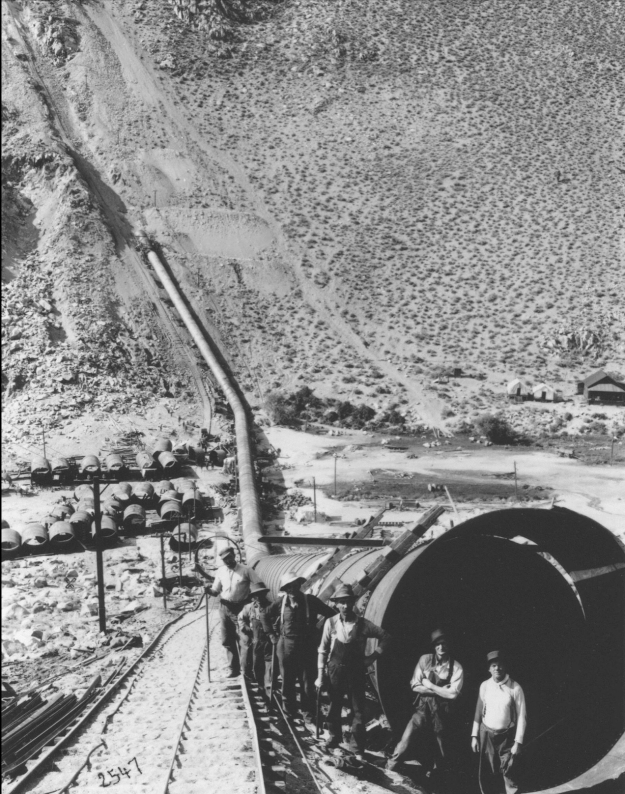
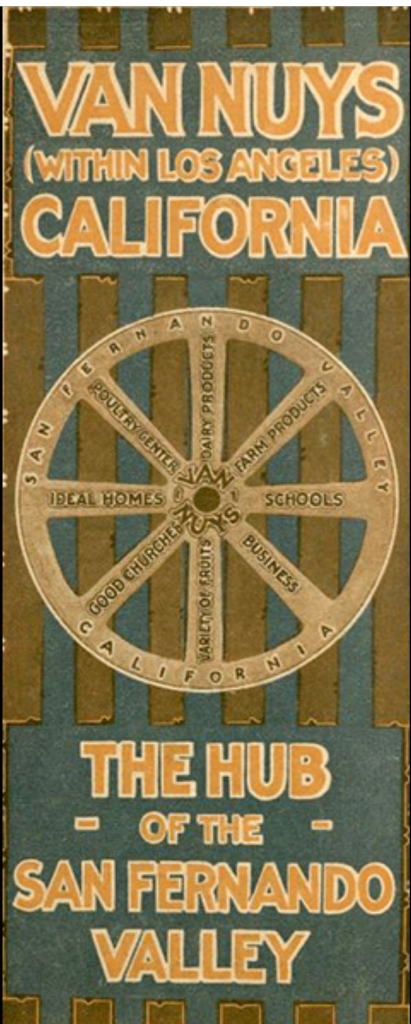
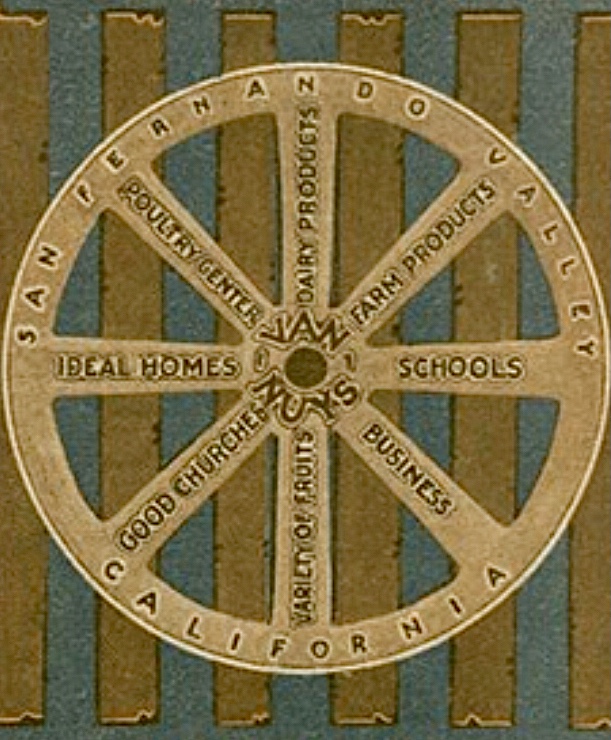
The drawing above is the famous “Geddesian Valley Section.” The other illustrations are also foundational to modern urban studies. Geddes wrote volumes of essential essays and studies, but his prose is tough sledding for laymen. His gift was inspiring an organic vision of cities through right brain engagement. The Boosterism of the Van Nuys promotional image may be corny, but it clearly reflects Geddes’s ideas.

Van Nuys was a key part of a planned Greater Utopia, Ltd. But that meant, it was condemned from the start to be the dusty, Babbittty, railroad farm-town part of Utopia. By plan, Van Nuys was the back service porch of gilded Downtown Utopia, where the nobs would forever guzzle champagne, over the hill and far away. Van Nuys is a Potemkin prairie village: it would never, could never, grow to overtake Downtown in commerce and real estate values, no matter the citizens’ thrift or ambitious industry. Early investors might not have thought about it too clearly, but they could never hope that someday their corner of Van Nuys would be the new booming “Boardwalk and Park Place,” full of hotels. Van Nuys proved the point; Like Pio Pico before him, he brushed off his last ceremonial pair of dusty trousers — his hard farming days of handling a team of twenty mules from the dusty box seat of a combine had gone years ago— and he moved back to LA to throw his pelf on the pile Downtown. Ike spent the last year of his life in silk pajamas unrolling blueprints, planning to corner the era’s Boardwalk and Park Place, 3rd and Spring, supervising construction of this:

The I.N. Van Nuys Building, at 3rd and Spring, LA’s hottest and most-marbled office block. 1912.

Van Nuys sold the ranch in 1909; the town opened in 1911, and Mr. Van Nuys died in 1912 — a few weeks before the I.N. Van Nuys Building opened. He died, also, a few weeks before the first Pacific Electric light-rail train arrived in Van Nuys and rolled passengers up Van Nuys Boulevard (then called Sherman Way). Ike possibly never set foot again in the Valley, never saw the new place called “Van Nuys.” He isn’t to blame for the sprawl, the blight, the anomie of today’s automobile graveyard Van Nuys. For Isaac, eternally, the town with his name was a four-square model farm town, with all the hook-ups a family needed to just move in and start plowing. And for years, it was.

Van Nuys The Man is absolutely absent from popular history as a personality — no memorable words, no bloviations on issues of the day; no hints of his pleasures and peeves, no memoir revealing his evolving sense of himself as a ‘player’; no scandals or rivalries in a town full of them. But this very absence to Modernity, is like the absence of sharp marble chips to a polished sculpture within. It reveals a hard core of values once so common-sensical and traditional they seem colorless today: he was sober, determined, loyal, ambitious, thrifty, patient, enterprising, dogged, nimble, polite, conservative, free-thinking, closed-mouthed, and open-minded. He was quiet and hoed his own row, minded his own family’s interests, yet everywhere he founded and built public things that made LA a first-class city and himself a millionaire. He was good with horses, a proud Mason, a father of three, and he made a fine husband to Susannah Lankershim, for whose mother’s sake he consented to become a public Baptist. He watched the weather, planted seeds and they grew. He was an upstate New York farmer from the old Dutch stock.

NEXT PART: How the name Van Nuys came to be permanently stamped on the dusty lower-left corner of our map, turns out to be a very rich land story indeed if we look into his Dutch ancestors’ experience, and Isaac’s own parents’ experience, and how they found land to farm. It is a Tale of Three Valleys — the San Fernando being the third. The progress of the Van Nuys family encompasses our whole history as an American people. It shows striking continuities, and illuminates pivotal moments in the rise of capitalism and modernity. It is the history of America itself. So View soon, THE HUDSON VALLEY VAN NUYSES

Van Nuys — a Viewing

A new series applying history’s tire-iron to the rusty Hub of the Valley

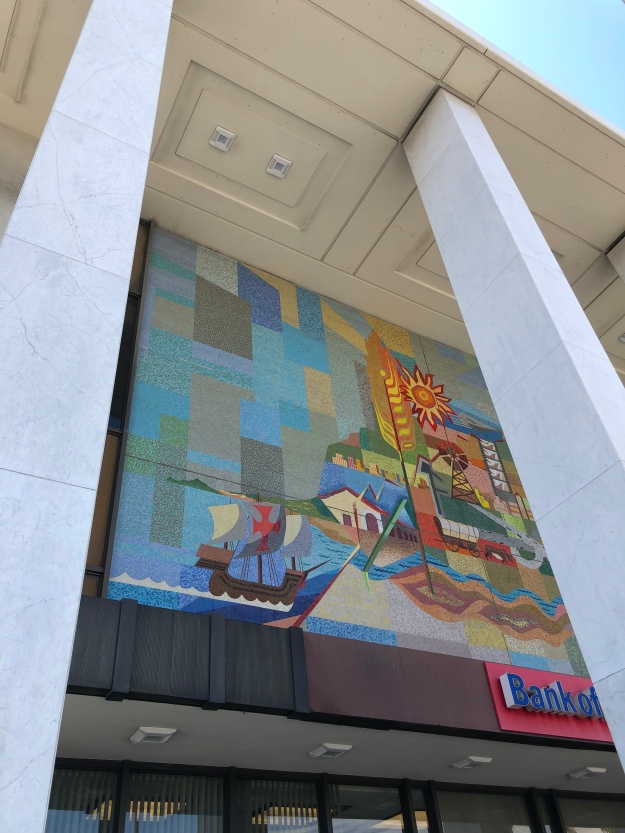
Millard Sheets, 1965. HSFC Bank on Van Nuys Boulevard, now BofA

PART ONE: ‘WHEN ALL THIS WAS FARMLAND’

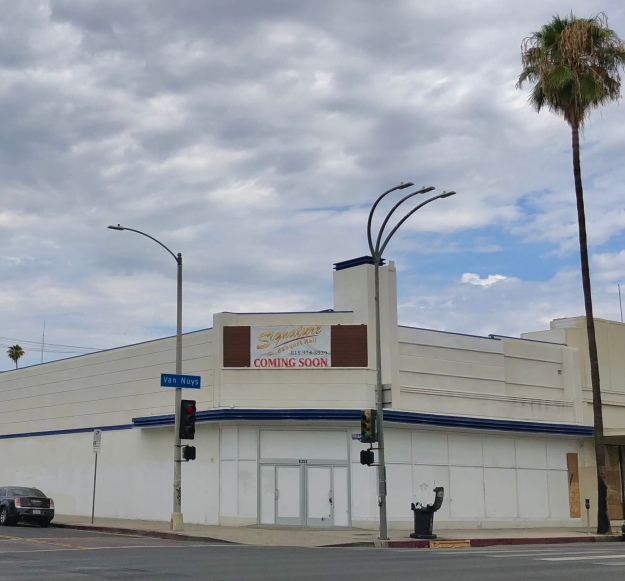
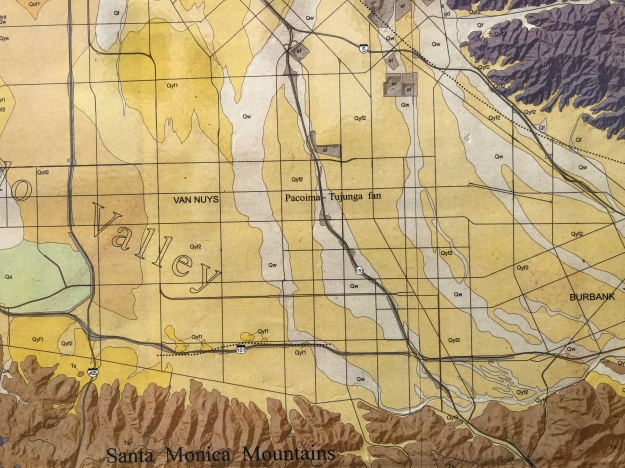
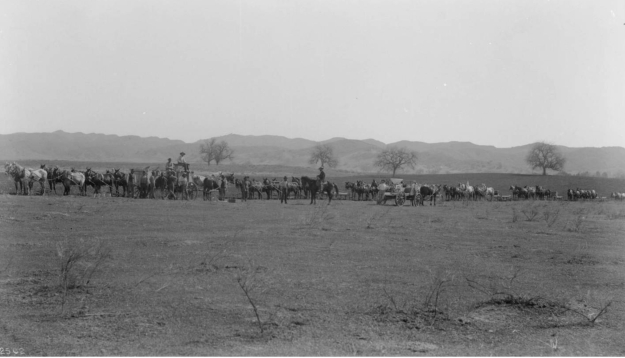
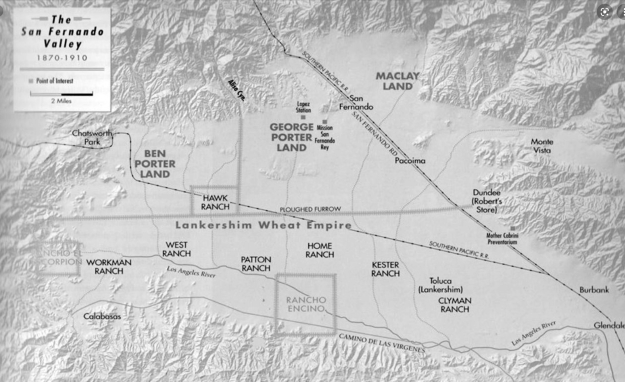
In the photo below, the sun-baked middle ground is today’s Van Nuys. Van Nuys is unusual in America in that the historian can’t sanctimoniously intone in the opening paragraph “For time immemorial People of the Ancient Ways called this land home, at one with Nature’s Ways.” Nobody called Van Nuys “Home” until Isaac Newton Van Nuys. And for the Tongva, the Chumash and the Tataviam who lived in the surrounding hills, the way to be at one with Nature’s Ways was to hot-foot it across the Valley as fast as you can in the dry seasons; and avoid it completely during the dangerous wet times when it swamped and Tujunga or Pacoima Wash could rampage. Of the two pleasant spots where natural wells and pools spring up, and the Indians had mixed-tribe rancerias, neither of them is Van Nuys. One was Encino [Siutcanga]; the other of course was San Fernando [Achoicomenga], where the Mission was built. But Van Nuys belonged to the antelopes. When the Indians were almost gone and the Mission was secularized the Valley was heavily ranched. Gen. Andres Pico took his interest in San Fernando and the northern half of the Valley, and his brother Don Pio Pico, the last Californio governor who had signed the original grant in 1846, by the 1850s had somehow come to own the southern half himself — including the cattle-tramped hardpan we call Van Nuys, that nothing in the middle:

Don Pio Pico, executing rights from a complicated chain-of-title victory from the Land Commission, sold his half of Rancho Ex-Mission San Fernando to the Yankees because beef prices had collapsed. Around 1865, the 15-year Gold Rush boom waned, then busted. The days were bygone of Valley rancheros driving thousands of cattle up to San Francisco and Sacramento to be slaughtered for twenty-dollar beefsteaks. The problem of a sudden oversupply of lowing stock solved itself, when a searing drought gripped the Southland, leaving the Valley full of cattle bones by 1868. The land sale was pervaded with ironies; Col. Fremont had made the Mission the headquarters for his California Battalion, and across these very plains had ridden in triumph to receive the sword of capitulation from Gen. Andres Pico, who claimed the Mission and its lands for his own. In 1848, Pico capitulated to save the Californios’ ranchos. Now the Picos were selling theirs off to the Yankees. But Pio Pico was the wiliest California land-jobber of them all. Realizing a profit from the switch of allegiances to Norte America, even so land could be liquidated legally, was their triumph. Pio was was certainly shrewd enough to realize a Hotel on the Plaza would bring steadier returns, and more genteel social connections, than running stock on the hoof. It was a brilliant trade for Pico, one of his canniest bets, for it kept him in good credit. It was also a decisive investment in downtown Los Angeles; the first moment when the dusty pueblo earned any notice at all in the world. Pio Pico put the Merced Theatre in back of the Pico House, with a door to the lobby; and put Jules Harder in the hotel kitchen; and made LA a city on the map.

1880s: the combine and twenty-mule team.

And it was a great deal for Van Nuys, who was the partner responsible for actually running the farm operation. Lankershim had tried dry wheat farming for a couple of seasons but had busted. Van Nuys said he could do it, and he did; with true Yankee luck, the middle of 1870s when he experimented brought some good El Niño rains, and by the 1880s Van Nuys was harvesting boatloads of grain with Lankershim’s capital, and shipping it overseas at a branded premium. Thus it was a great return for the San Franicsco investors, too. Lankershim had found this land destroyed by heavy cattle ranching and failed to work it; it was Van Nuys who made it into a productive monocrop that brought other wheat farmers to make fortunes here too. He was one of the greatest farmers who ever lived.

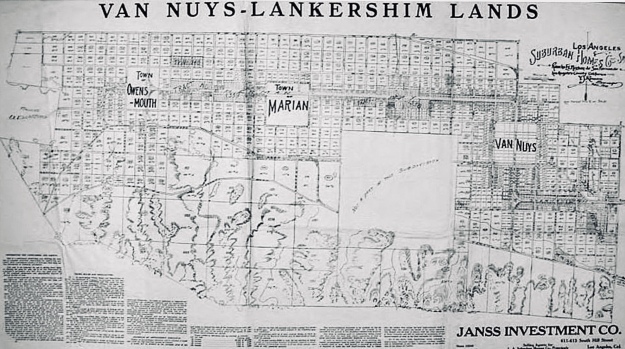
But who was Isaac Newton Van Nuys? He wasn’t the founder of Van Nuys, but it was named for him when he sold in 1909. (The town was founded in 1911). Speculative towns are usually named after the developer’s signature on the front of the check, not the farmer’s name on the back. Significantly, also, the name ‘Van Nuys’ is practically the only one of the developers’ original town names not to have changed; meaning, Van Nuys never actively voted to change its identity, as did social-climbing Toluca to Lankershim to North Hollywood, or Zelzah to Northridge, or Marian to Reseda, or Owensmouth to (the equally unappealing) Canoga Park. In the next part we’ll take the man, and his name, and his Life, in View, to glean what civics lessons we can.

Bitcoin: Digital Beanie Babies

Economics is semantics. It is emotion, it is euphemism, it is improvisation, it is narrative, it is Greek, it is fudge. It is breeding for ill or for good character; it is status enforcement for ill or for good society, it is constant work for feast or famine — but it is not numbers [Remember that the next time we hear an oraculation from the Fed. Only human work will solve economic problems, and humans won’t work long for numbers.]

Bitcoin is not economics, but “pop-Econ.” It is Cinderella at the Ball — a welter of hopes, dreams, schemes, flirtations, sex, wheeling, dealing, satisfying, faking, social climbing, inheritance; of peer competition, invidious comparison, conspicuous consumption; of frantically watching the clock, and of revenge. That worthless pumpkin on the stoop — that figurine of Darth Vader your kid never opened — suddenly somehow IS valuable! The gods must be crazy! Your kitschy hoarding has paid off! Cinderella’s squash became her ticket to ride. Cinderella’s elation is infectious, but it is magic, not economics. The amount of her glee at getting a handsome prince can not, itself, be priced and sold, only her story can. Nobody ever stops to ask: the footmen and scullery maids and vintners at the Ball needed, actually, to be paid for working that night, right?
(Assume a 16-year-old girl, as the economists say, and there will be a Ball, whether there is money to pay for it or not.)

Until recently I could get you a link to read the whole fascinating piece on Substack. Since they outlawed blogs linking to blogs, you’ll have to go hunt it out for yourself at Brettscott.substack.com, or find the link where I did, at nakedcapitalism.com. The enclosure is almost total now.

This is an important piece, the best piece I’ve ever read on Bitcoin. It explains the fallacy of money as an intrinsic collectible; and thus explains why Bitcoin is popular among gamers, geeks, Trekkies, Marvel fans, comic book collectors in general, gold bugs, and Ren-Fest “Game of Throners.” Bitcoin is money as if.

Where Are The Insurance Companies?

…you know, the huge trillion-dollar octopus that runs our health care system as a vast casino? The shaming ones, always brandishing actuarial tables and beating Americans up on things like “risk factors” and “risky Zip Codes” and “moral hazard” and “pre-existing conditions” and “acts of God,” and backing it up with tables of rates that quickly skyrocket if you, say, smoke, or eat fatty foods, or don’t belong to a gym, or have an accident while not wearing your glasses, or live in Watts or West Hollywood or South of Market, or have a sudden health emergency from inhaling fumes not AT work exactly, but out in the parking lot at 5:15. These insurance geeks are the medical geniuses who decided that, if a policyholder is prudent and asks the doctor to test for certain chronic diseases, or needs certain tests regularly, he will get summarily dropped from the plan. A hundred thousand things we can’t do in modern society, or are afraid to do, are too poor to do, because the insurance companies don’t like it or won’t allow it.

But if you are an American who chooses not to mask, not to social distance, or refuses to get a Covid-19 vaccine? They’re just fine with that. They’ve got you covered — and apparently are okay with everyone else in your community getting infected! They won’t raise your premiums or cancel your policy or make you do regular testing, or insist on a robust quarantine to try to protect the community. Big Insurance honors your guts and your freedom. So far, no super-spreader yahoo or casual moron has been told his activities are shamefully reckless and expensively idiotic. None of the thousand stories of selfishly insane behavior, of feckless, entitled narcissism, of unhinged melt-downs in the Trader Joe’s line, have resulted in a letter of cancellation, nor a single penny being added to anybody’s monthly premium.

IT MAKES YOU THINK.
President Biden of Delaware is the grandfather, or should I say The Godfather, of America’s whole medical insurance racket, and the engineer of the whole ACA. Since Covid-19 hit, insurers have maintained complete silence about “how they’re going to pay for all this,” as they’re always asking progressives when we bring up Universal Care. With every hospital in America burning fast and bright for a year and a half, and staff cut to the bone by disease and burnout, the medical industry’s Wall Street prices have only soared. It seems Pres. Biden has simply reassured them that the coffers of the U.S. treasury are open to them any time they like, day or night, here’s a key to the back door, take what you need. Insurers have expressed no fear of picking up the increasingly astonishing tab for the trillions of dollars the epidemic is obviously costing. Are insurers just happily absorbing people’s hospital bills? I doubt millions of sick families across America are able to just shrug off high deductibles, or write a 30,000 check for everyone in the family who gets sick.

If the insurers are paying people’s bills, that’s good and all right. And if the government is offering them a blank check, that might even be okay at this point. But a potent tool for stopping the disease is being ignored, and that’s NOT okay, especially given the insurers’ traditional greed and recent meanness. The greatest and most obvious examples of moral hazard in history are Covid-denial and vaccine resistance. If we were a moral nation, and conservatives really cared about “personal responsibility,” or really wanted to use the “Free Hand of the Market” to solve a problem, then why shouldn’t stupid anti-social schmucks be getting their insurance policies cancelled, or rates reassessed, to accurately “cover their risk,” as we‘ve heard all our lives is imperative?