Welcome to the blog of writer and musician Andrew Martin. Here I'll post original photographs and observations as I encounter the history and culture of the San Fernando Valley, the City of the Angels, Alta California and the far-flung Pacific Rim… but mostly the Valley.
I’ve snarked about V.P. Joe Biden’s insufferable line “Get up, Champ, you’ve got to pull yourself up on your own two…blah blah blah.”
But Biden squares off against a certifiable nut in a few minutes. Here’s hoping that our Champ knocks the bully on his fat wheezing ass.
If there’s anything like good Pennsylvania sense, let the spirit of Benjamin Franklin bless Biden, as channeled by the amazing Robert Preston (and lyricist Sidney Michaels and composer, amazingly, none other than former Hollywood executive Mark Sandrich, Jr.?? Damn that alone, is inspiring.)
The good part begins at 2:00. If you don’t cry when the kid pipes up you have no heart.
Another little bit of good news: the recovery of a lost American masterpiece. And just in time for a blockbuster exhibit at the Met. (Remember New York?)
Moms turned me on to the art of Jacob Lawrence a couple of years ago; I think she must have seen the traveling show (in St. Louis?). Looking over the exhibit program, I immediately fell in love with Lawrence’s style. Plus, he carried on the noble and necessary work of the history painter — rare among the moderns. His compositions and colors stand out in a gallery; I’ve been lucky to discover a few of his works serendipitously, here in LA at the African-American Museum.
But, hallo…? Shays’s Rebellion of 1787, America’s first insurrection, marches the View right back to the redoubt of Alexander Hamilton’s legacy. Art fans, you may now leave the tour. Don’t forget to visit the gift shop. Geeks, slog on:
Why Did Daniel Shays Hate Freedom?
Scrip issued by the emerging States of America. Current until…it wasn’t.
Moms may have left the tour but she also gets credit, or chagrin, for interesting me in colonial scrip. In the years surrounding the Bicentennial, she and Dad made sure we kids got plenty of exposure to re-enactments, parades and musters; each event had booths selling souvenir tricorn hats, fifes, hand-dipped candles, funnel cake, and reproduction colonial parchment scrip. Notes came in cellophane packets (probably for .76c.) The crinkly paper was fun to handle and the 18th c. printing, fascinating. Though, you never knew whether your packet would yield notes reckoned in mere pennies, or pounds, or dollars amounting to a fortune. Oddly, their value was nearly that uncertain, just after the Revolution:
“The Revolution’s costs left severe financial problems, both private and public. Wartime disruption to production had spread poverty and personal indebtedness. The coming of peace released a pent-up demand for goods, and 1783-84 witnessed a significant surge of imports from Britain. These goods would have to be paid for in addition to the unpaid pre-war debts that the peace terms between Britain and the United States permitted British creditors to collect. By 1784-85 the combination of old and new debts imposed substantial private obligations, especially in rural regions still recovering…In addition to this arose the severe effects of public financial burdens. The War had left state treasuries empty and their finances in chaos. In an effort to replenish them and repay their debts, states raised taxes by amounts ranging from double to six time their pre-Revolutionary levels. These demands were imposed on a society where inequalities had widened sharply.“
Christopher Clark, Social Change in America (2006)
Again, how was all this debt acquired? Reckless liberal spending? No; to pay these guys. Who was paying these exorbitant taxes? Rich foreign playboys? No; these guys.
Von Steuben drills frostbitten men
Empty stomachs rowed to Trenton
Gate-crashers with Ethan Allen
Skinning an ox for Col. Knox, to capture the ordnance of Ticonderoga
Nathaniel Greene and Casimir Pulaski rally the starving and sober at Brandywine
“Molly…Pitcher?” Great guns, gal.
“Look! The French fleet!”
“Huzzah, did they bring quarters for laundry?”
The war had largely been financed by the issue of paper money and the payment of soldiers and others in paper warrants and other instruments entitling them to land or cash in the future. Most holders of these paper instruments, however, needed ready cash or goods to live on, and could not afford to keep them. Meanwhile the crises of wartime and the uncertainties of the future of Revolutionary governments severely deflated the current values, and many holders were obliged [i.e, by compounding debt] to sell it to others at mere fractions of its face value. Wealthier men accumulated these paper promises and titles to land, [speculating on] the potential repayment of the debt by the states.
— Christopher Clark, Social Change in America
Continental currency, unbacked “fiat” money
They claimed bi-metal backing…a feeble gambit. Everyone knew Congress had no chest full of milled dollars; anyway not enough for the blizzard of bills issued. And there was no bank to go to, even if you wanted to try your foolish luck cashing it.
John Dunlap, successor to BF as PA’s primo printer. Fought bravely at Trenton/Princeton.
There were thousands of British counterfeits, debasing everything. Outside Philadelphia, Continental currency was almost worthless. So was it scrip or scrap?
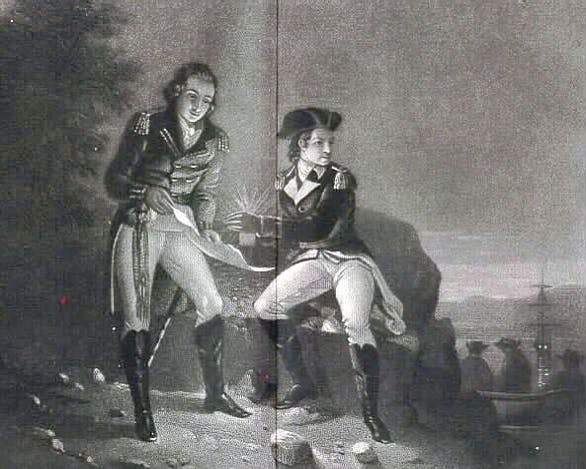
Consider the depreciation of Revolutionary era money as the underlying cause of Benedict Arnold’s treachery. He was desperate to escape from debts he had drawn straight off of Congress in ever-more-worthless money; and at pains to satisfy his high-maintenance comme-il-faut Loyalist-heiress party-girl bride Peggy Shippen. Inflation can help debtors, but it is ruinous for habitual spenders. At bottom, Arnold was greedy for Maj. Andre’s note promising a hard-metal 20,000 pound bounty, drawn in his name on the Bank of England, money that wouldn’t disappear in a puff of inflation next week, next year, or even next decade. In exchange, Arnold took no skin off his own scabby knee — just the silly old paper plans of the fort he commanded at West Point.
“In Annapolis, from 1781 on, merchants were buying soldier’s pay certificates and land warrants at one-seventh of their face value. In 1783, Rhode Island merchant Nicholas Brown paid out goods worth 246 pounds, for Continental certificates worth fifty times as much. Of Pennsylvania’s $4.8 million in outstanding wartime debt in 1790, 96 percent was in certificates held by just 434 individuals, and 40 percent was held by just 28 Philadelphia lawyers, merchants, and brokers. Commercial elites in the port cities influenced government to retain a tight financial regime. Merchants’ letters filled with tales of uncollectible debts. Forced sale-offs of those who had back taxes or debts mounted.
— Christopher Clark
‘Shays’s Rebellion’ by Jacob Lawrence
“In Massachusetts conflict became more serious still. In Worcester County in 1784, two thousand lawsuits for debt were brought to court. Crowds gathered to protest auctions and court dates and issue petitions to the government. Armed men calling themselves “Regulators” gathered to ensure that courts remained closed, or to counter militia troops mobilized against them. In January, 1787 two Regulator bands converged on the armory at Springfield, intending to capture its arsenal, one led by a former Continental officer, Daniel Shays. A mis-timed rendezvous allowed the militia guards to put Shays’s men to flight with casualties. As they retreated into the hills, they were pursued by militia hastily assembled in Boston, led by General Benjamin Lincoln.
When Lincoln surprised the Regulators at Petersham, they were scattered. Skirmishes continued in parts of rural Massachusetts through the spring of 1787, but the rout of Shays’s force marked the defeat of the Rebellion remembered by his name. Shays and many others fled the state. Regulators who laid down their arms signed oaths of allegiance to the Commonwealth [of Massachusetts]; arrested leaders were tried and sentenced to death (most sentences were commuted).
— Clark. He mentions also that retreating Shaysites mingled across the New York border with disgruntled tenants in the Hudson Valley, who were suffering under the practically feudal land-tenure laws inherited from New Netherland. In 1791 the Hudson counties crackled with a Shays-esque “anti-rent” rebellion.
“Benjamin Lincoln, given the task of raising a militia to counter the Shaysites, presented the situation in stark terms to the prosperous men he wished to recruit. Persuading leading Bostonians to finance and support the army, he portrayed the rebellion as an attack on property, urging them to be “loaners of a part of their property it they wished to secure the remainder.” As Lincoln marched west, an observer noted that he had a “fine body of men, well-officered, the whole of the monied men to support him.”
— Christopher Clark, ‘Social Change in America from the Revolution to the Civil War’
Thus, then, was Shays’s Rebellion, a debt rebellion. It was a shot across the bow for America’s leaky ship of state. The veterans were swatted down, left broke, landless, jobless, and feeling swindled out of the patrimony they fought for. This marked a sad precedent for America’s treatment of her citizen-soldiers.
It also scared the hell out of Congress, the state legislatures, the brokers in the urban coffee houses, and the judges threatened with effigy-hangings. They had momentarily cowed the debtor class with force, but everybody — the Congress, the members of Congress, the states, the governors of the states, landlords, renters — was broke and ALL the debts seemed un-payable. The Revolution had apparently beggared her people. Privilege had won out over equality, AGAIN, dismaying many frontier farmer-democrats. For those who had pledged all, America had turned into a great big pile of “No.”
That summer they called another convention at Philadelphia, under Gen. Washington himself, to see if they couldn’t fix America’s debt-rebellion-army-debt cycle. All of the delegates were elites, most lifelong debtors, all of them ambitious, all of them embarrassed, all former military men, all trying to hide even from each other how overdrawn they were or how much worthless paper they held. Taxes on farmers? Like ordering blood from turnips. They were turnips, too, with the British creditors roasting them slowly. They were a senate who seized an empire, all ignorant of how empires financed themselves. All ignorant, that is, except for Washington’s trusted former whiz-kid aide-de-camp, who offered that, actually, he knew quite a lot about the subject. https://drive.google.com/file/d/1TW_uOyl4FQbqq82M9BeZR9svGFh22KsF/view?usp=sharing
I’m going to celebrate a rare bit of good news. Bolivia has thrown off the right-wing puppet dictatrix, Jeanine Anez, installed by America and the OAS only last year, in an old-fashioned Cold War coup-d’etat. Remember? Only Sen. Sanders had the guts to call it rightly:
The election was a great rejection of Mike Pompeo’s tin-pot-tin-hat filibustering. It’s also proof that vicious American fascist plutocrat thugs CAN be defeated at the ballot box:
“It looks as though the margin of victory delivered to [the Movement Toward Socialism party] by the Bolivian people was so stunning, so decisive, that there are few options left for the retrograde forces—in Bolivia, Washington, and Brussels—which tried to destroy the country’s democracy. Anyone who believes in the fundamentals of democracy, regardless of ideology, should be cheering the Bolivians who sacrificed so much to restore their right of self-rule and hoping that the stability and prosperity they enjoyed under Morales expands even further under his first democratically elected successor.”
Glenn Greenwald, The Intercept, Oct 19, 2020
“In the field of world policy, I would dedicate this Nation to the policy of the good neighbor—the neighbor who resolutely respects himself and, because he does so, respects the rights of others—the neighbor who respects his obligations and respects the sanctity of agreements in and with a world of neighbors. We now realize as we have never realized before our interdependence on each other; that we cannot merely take, but must give as well.”
Pres. Franklin D. Roosevelt, 1st Inaugural Address, March, 1933
“Good Neighbors, Good Neighbors, remember our policy. Good Neighbors, I’ll help you — if you’ll just help me!” — Comden and Green, “Wonderful Town”
Now all we’ve got to do is stop Pres. Biden sending the CIA back in to “neutralize” Arce’s popular new government.
“There’ll always be an England, where there’s a country lane…” and an idiot at the top doing his best to wreck it. The Whirligig Of Time has officially announced the world has new champion British Failure of All Time, Boris Johnson.
Quoth the Whirligig of Time: “Even in a nation historically famous for its ability to turn abject failures into left-handed victories, there exists a Rogues Gallery of national failures so humiliatingly utter, as to command a kind of reverent memory, for just how stupid and hapless and clueless mankind can be. Even non-Brits can find these calamitous national tragedies amusing; in fact, Boris Johnson beat the reigning winner back into the loser-dom of second-banana: that long-popular favorite pantomime loser-villain, Capt. Hook:”
“Who’s the creepiest creep in the pack?”– Sorry, Hook, not you, anymore.
“My lords, ladies and gentlemen, I give you Boris Johnson, greatest British failure of all, Minister of Catcalls, Earl of Whistles, Laird of Hootsanhollars, rightwise heir to the Brickbat, and by grace of Hisownself, without the slightest help from Divine Providence, the greatest failure since King Cnut failed to turn the tides; Greater than King Harald Godwinson, who let in the Normans when his mail coat let in a Norman arrow:”
“Greater a failure than King John Lackland, who lost France, was excommunicated, and forced by his revolted barons to sign Magna Carta:
Boris Johnson is officially more pathetic than Lady Jane Grey, the ‘Nine Days’ Queen.’
And since he believes nothing, he’s more vile than Guy Fawkes, who at least believed in his murderous cause:
Greater a prick than King Charles I; Greater even, than Charles’s royal evil smarter son, King James II.
“Just fucking die” were the last words he heard.
You know how to row, don’tcha, Majesty? You were once Foist Lo’d of the Admiralty! Ha ha ha.
Johnson is a greater a calamity for Britain than the Darien Scheme, or the South Sea Bubble.
More shameless a media-whore than Bonnie Prince Charlie, and even less able to deliver on his promises, and equally feckless of the consequences for posterity:
Nice vest, Your Highness. French silk, is it? Nice Italian tailoring… bulletproof, then?
More disastrously out-of-touch with the needs of the people than King George III:
Greater a boob, more useful a tool for Fascism than Sir Neville Chamberlain…
…is Britain’s new worst failure, Boris Johnson. Now let the Whirligig of Time, bring in his revenges.”




 The Valley Village View