Welcome to the blog of writer and musician Andrew Martin. Here I'll post original photographs and observations as I encounter the history and culture of the San Fernando Valley, the City of the Angels, Alta California and the far-flung Pacific Rim… but mostly the Valley.
The next few Views will focus on the City of Brotherly Love.
William Penn decrees liberty of conscience, eternally, at Pennsylvania Hospital (1756).
The Emperor Augustus famously eulogized of himself, that he found Rome a city of brick, and left it a city of marble. William Penn and his Friends, on the other hand, preferred a middle way — so they built for us a city of hard-working brick, but graciously trimmed it with elegant marble (or, even more frugally, concrete.) So tie up thee bonnet, buckle thee boots, and brave the cobblestones of one of the few, if not the only, deliberately egalitarian, deliberately middle-class, deliberately tolerant, and deliberately progressive cities ever founded (1683).
“…for the relief of the sick poor.” Wow. A centuries-old innovation that is still “radical.”
The drum atop P.H.’s center pavilion is the skylight for the famous operating theatre.
Social-climbing Americans have loved to heckle, shame, shun, deride, or simply ignore Penn’s “Greene Countrie Towne.” But for those whose frequency is tuned to the long broadcasts of history, symphonies for the soul can be picked up, simply by walking though Philly to get a coffee — with encores of hope for a better humanity.
Kimball Street, where Seth lives.
The Fairmount Waterworks (1812) pumped fresh water by steam up from the Schuylkill into a reservoir dug into what Penn called his “Fayre Mount.” The Art Museum (yellow stone) was later built atop the old reservoir; but all Philadelphia still drinks “Schuylkill Punch.” The 200-year-old idea of municipal water piped affordably into peoples’ homes and into public fountains, is, like affordable health care, still dangerously radical in many parts of the world.
The inscription on the urn reads: “DRINK, GENTLE FRIEND.” The donor’s name isn’t even legible anymore. I get a catch in my throat when I pass these fountains, though they are long out of service to our equine Friends.
Commodore Barry, a Catholic, is buried in the sidewalk outside Old St. Mary’s.
Mission San Gabriel is the Mother of Los Angeles, and its cemeterio is one of America’s most iconic and historic cemeteries.
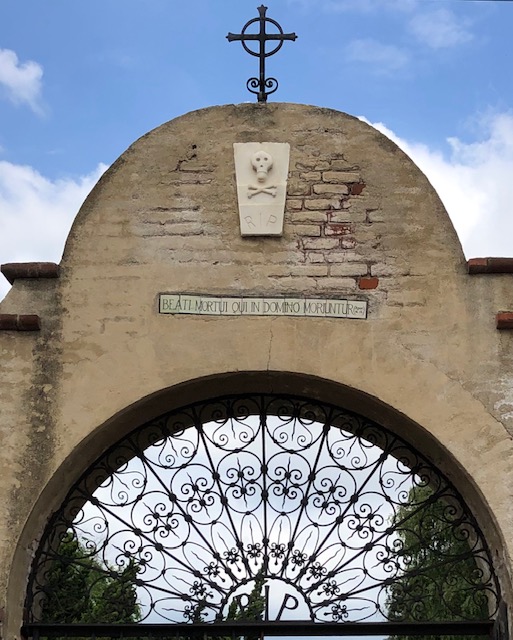
Memento mori is the message, and the purpose, of this cemetery. This ain’t Forest Lawn!
The Pueblo of LA was founded (1781) out of El Mision, where the pobladores gathered after long treks up from Mexico. Supplies, services, and soldiers from the mission guard kept the infant settlement going, as did the Franciscan fathers who often had to make the 10 mile trek in a careta, sometimes toting a bell as well, to offer mass. (This would have been in one of the willow-post and tule-thatch versions of Our Lady Queen of the Angels — the fine adobe La Placita wasn’t built until 1818, giving the Angelenos a real church — officially, an “assistencia” of the Mission — of their own.)
The old burial grounds of La Placita, now gracefully restored to the California Floristic Province.
Though La Placita had its own burial grounds, the grand Mission remained the center of Southern California civilization for generations. Many scions of the local families were born there, offspring of the Spanish soldiers, and many chose to be buried there, too. Headstone-hunting here, one expects to spot Angeleno names. But it is overwhelming to see stone after stone, a lithic “Who’s Who” of the Californios.
Refugio Martinez de Temple
Olivas; some Verdugoes
Yorba, more Verdugoes, Asufina, Lopez, and a couple of Nietoes in back.
The bell tower collapsed in an earthquake in 1812. It makes a picturesque burial chapel. The bench honors Eulalia Perez de Guillen, long-serving mayordomo — housekeeper — at the Mission. The Mission’s resources were rich, its visitors were international, and Eulalia set a legendary table. If California Cuisine has a mother, it is Eulalia. RIP.
This place held — holds — sacred power for the Californios, and for us modern Californians, their heirs upon the land that holds their bones. Say a prayer this All Hallow E’en for the Indian-Spanish-Mexican-African-Anglo-Americans of San Gabriel, whose cultural encounter, em-bodied here, was the dynamic force that built this state. Requiescat in pace.
[After reading the essay about the Early American origins of Hollywood Regency, return here, Patient Reader, and click. You’ll see a short movie about the how the pretty, sedate, but often hilarious faux-horsey style came to dominate the streets-scape — the “program” — of many neighborhoods of LA. This is especially true where the Industry settled — Hollywood, Beverly Hills, Silverlake, WeHo, the Valley. Critics dismiss these as knock-offs, or “knock-offs of the knock-offs” — though even the marvelous show-place homes in Bel-Air were dismissed as such when they were built in the mid-century. And, obviously some knock-offs are better than others. But Neoclassical style is knock-offs right the way down, with Palladio knocking off Greece and Rome and John Nash knocking off Palladio and William Strickland knocking off Nash, and Jefferson spinning the whole thing toward the Federal, which had two or three revivals just in the 19th century. And simultaneously, the vernacular cottages and self-built farm houses of the American homestead became so clever at aping the Neoclassical that the Hollywood Regency architects were often quoting the “feel” of vernacular small-town America, with all the Hollywood gloss and gloop they could pour on. So hail the knock-offs! They ARE the style, only built on a smaller scale, or even just tacked on to the outside of a stucco box. Many commercial buildings and apartment buildings in the style are worthy of notice, and of critique, and of preservation, just as much as George Cukor’s famous house is. LA should guard these houses like Philadelphia guards her row-houses, Brooklyn her brownstones, and San Francisco her Painted Ladies. ]
The home-grown LA style known as “Hollywood Regency” is not to be taken literally, either as a style, or a name for a style. It is a dismissive epithet that stuck — like Gothic or Stick Style or Methodist; a campy in-joke put-down, nailing the casually misleading social pretensions of some of the owners of the houses. Whether a huge Bel Air mansion, a secluded Valley Village cottage, a chic designer retail shopping center, or a swank West Hollywood apartment complex — and all these must be included in the style; restaurants too.
These are not academically-researched copies of London’s Neoclassical masterpieces. Instead, they are a highly mannered, but extremely exuberant vocabulary for treating a European villa with American design tricks, outre gay decorator ideas, and the elegant Art-Deco Hellenic polish that Hollywood evolved out of 300 years of Palladian-Anglo-Franco-American houses in the Colonial East Coast. In fact, one of the greatest sources for Hollywood’s style, due to the shared latitude, and similar sunny climate, and a similar gracious, but exploitative economy, was the graceful stuccoed Federal style of the Carolina Lowcountry.
“Painted Row” in Charleston
Like 100 apartments in Venice or Van Nuys
Mansard roofs…gay colors
Charleston’s palmettos; where LA got the idea to plant Baja fan palms (1927).
Charleston’s old Huguenot Church
DuBose Heyward’s House
Rose-painted porch
Neoclassical Thalian Hall, Wilmington, NC. Originally brownstone; it was “Hollywood Regencied” in the 20s
Beautiful Georgetown. SC…once the indigo capital of the world!
Sky-painted porch off the river.
John C. Calhoun’s mansion
Whitewash, boxwood, iron and bronze
THE ULTIMATE SOURCES OF FEDERAL ARCHITECTURE IN AMERICA:
Patient Reader, recall the history of the builders of the following houses, and about their tensions and rivalries and personal economies, and how important their struggles were. Now put all THAT passion and patriotism into “Hollywood Regency,” the optimistic, nostalgic architecture of the Depression and WWII years. But then, with a sag, understand this inspiring grab-bag of American History as merely so much classy B-roll background for the staircase unveiling of one’s bias-cut gown by Adrian, with matching mob cap; or for the cabana unveiling of one’s toned body, diving into the pool at the Toluca Lake place.
Every house in America is, ultimately and intimately, descended from this one: Mr. Jefferson’s Monticello.
Manor-and-outbuildings
Hamilton’s The Grange. Sets the standard for middle-Atlantic farmhouse. Thousands of historic houses in New Jersey and New York follow this style: only room for one or two slaves.
The Father of The Country is also one of the Grandfathers of the Bastard, Hollywood Regency.
In the 30s. when the often gay, often English designers and decorators were asked to order up columns and urns and white porches and wrought-iron gates and carriage lamps by the ton for the studios and/or rich clients, they sniffed, “Oh, I see, you want all that mannered, dandy-ish nude stucco Greek Regency stuff? Well, darling, then let’s just throw a taupe drape over a white column and call it a day.” That’s exactly what clients wanted, for the movies themselves had taught Hollywood that Life Was Drag. One didn’t have to BE Medea, or Dolley Madison, to live in a chic Greek or Federal house. So architects turned out faux (i.e., “Hollywood”) gestures of Federal Period (i.e., “Regency”) houses. These buildings got stripped through the ultra-efficient Modernism of the Hollywood design process, into that image in your mind of “Tara…. or even Twelve Oaks! If I could only live there with Ashley….” That’s Hollywood Regency.
Few Industry types are actually from the FFV — except, tellingly and fascinatingly, Randolph Scott, who provides an important clue to how the style evolved. The revered Hollywood actor was born in Orange, Virginia, and through locally-bred horsemanship and, ahem, being Randolph Scott, came to the attention of Marion du Pont, the owner of James Madison’s Montpelier. She was A du Pont (!) and a horse breeder of first rate during the Golden Age of American equine culture. He was one of Hollywood’s gods-on-horseback. Both were bi-sexual. So they re-did Montpelier in Hollywood Regency because it seemed, by the ’30s, MORE gracious and Southern and romantic and beautiful than the famous Dolley Madison version of the house. THAT’s the essence of Hollywood Regency. [The Park Service has since restored it to Federal appearance; good! Hollywood Regency belongs in LA.]
One has always lived in Hollywood Regency “as if…” as if one were a product of Philadelphia dancing assemblies, New York publishing houses, Boston universities, or Charleston Society’s summer barbecues. And as if one gets that these fantasies are impossible luxuries for a bum like one. But on the other hand, note the clipped lawn in the honor court, the 14-foot ceilings, the hardwood floors, the graceful turned iron railings, the modern interiors…one could get used to an old fashioned house, especially when it’s rent-controlled.
Happy Labor Day! Celebrate the mythic history of Labor in California: take in View a select few of the labor-related panels from the World’s Longest Mural.
Sharp Viewers remember: from 1974-1984, the visionary Southern California artist Judith Francisca Baca and her collaborators at S.P.A.R.C. re-made an ugly stretch of the Tujunga Wash Flood Channel with a vision; and with her own labor, plus the labor of numerous others especially the schoolchildren artists. The result is a masterpiece of local history painting, unique in the world.
Labor upon land, is the human story. Whose land it is, and who gets to labor upon it, and who doesn’t, is one of the great themes of Judith Baca’s mile-long work.
Let Paul Robeson have the last word on labor in America; the quote is his.




 The Valley Village View