Category Archives: State emblems

For The Kindling Of Devotion

THE THEATRE OF CONVERSION, Part 6: Drama, Music, Art and Architecture at Mission Santa Barbara

Vintage postcard. Note the bells, and the illumination of the ‘scaena’.

Saint Barbara, with her Tower, is the patroness-saint of cannons and arsenals. Thus Gov. Felipe de Neve thought it a good name for the fortified presidio town he decreed in 1782, to control the Channel. It took four more years, and administration changes, for the Franciscans to get their chance to evangelize there. The Chumash lived on the beach at Yanonalit, the place of their chief Yanonali, and also in the islands nearby in great numbers, in great sophistication, and in great contentment. When the Franciscans trooped up the hill on Dec. 4th, the Feast of St. Barbara, to evangelize the Chumash, the friars relied upon their own arsenal: not bronze ordnance but bells, and a creche. Dec. 6th, only two days after the founding, was the Feast of St. Nick, or Sinter Klaas, and then, bang, it’s Advent. At Christmastide, Franciscans staged of colorful pageants to re-enact the story of Peace on Earth — angels, shepherds, Wise Men and all. Each night of Christmas there would be a choir outside the church singing Spanish songs — not Latin — and a simple mystery play with locals taking part as, for instance, shepherds adoring the creche. “Creche” derives from the Italian town of Greccio:

Now three years before [St. Francis’s] death it befell that he was minded, at the town of Greccio, to celebrate the memory of the Birth of the Child Jesus, with all the added solemnity that he might, for the kindling of devotion. That this might not seem an innovation, he sought and obtained license from the Supreme Pontiff, and then made ready a manger, and bade hay, together with an ox and an ass, be brought unto the spot. The Brethren were called together, the folk assembled, the wood echoed with their voices, and that august night was made radiant and solemn with many bright lights, and with tuneful and sonorous praises. The man of God, filled with tender love, stood before the manger, bathed in tears, and overflowing with joy. Solemn Masses were celebrated over the manger, Francis, the Levite of Christ, chanting the Holy Gospel. Then he preached unto the folk standing round of the Birth of the King in poverty, calling Him, when he wished to name Him, the Child of Bethlehem, by reason of his tender love for Him.

— St. Bonaventure, The Life of St. Francis of Assisi

Santa Barbara has set up its creche, with live ox and ass, or at least sheep and donkeys, since the 18th century. It ought to be remembered that domesticated stock animals like sheep were completely alien to California. It must have taken years for even motivated and observant Chumash neophytes to understand the associations between these bleating sheep with their wooly fleeces, and the approved lowliness of the shepherds in the Nativity story, and the god in the manger, and the fine gray woolen robes the Franciscans wore, and the coarse, scratchy white ponchos and pantaloons all neophytes would be forced to weave and wear and wash, too. The Christmas shepherds’ gift to the proudly naked Chumash, it turned out, was laundry.

The lavenderia, or wash-trough, on the Mission grounds. The neophytes would lay out woolens on the sloping mortared-stone sides to soap them and beat out the soil, then rinse the garments in the flowing central trough. Finally, they would dry them down on the sunny slope where the Rose Garden now wows visitors. Back-breaking work, yes, but it’s a nice view of the bay. That’s very Franciscan.
“You missed a spot, Maria.”

The Franciscans evangelized here as they had in Spain and Mexico for centuries; at Christmas that meant staging a midnight pageant, in a tabernacle, or on the front steps of the town church. In many cases in Italy and Southern Europe this had been an old Roman temple. Thus it is likely that the wide front porch, and the serene Classical facade rising behind it like the scaena in a Roman theatre, were at least in part designed, or at least used, for the staging of pageants, proclamations and concerts. We know that the Franciscans enacted these Christmas plays out of doors. Versions of these plays survived in Santa Barbara from oral traditions brought from Mexico. They are among the very few literary productions of Alta California.

La Pastorela, the Shepherds Play, was written down from memory by Pablo de la Guerra in the 1860’s. It has been revived and is performed in Santa Barbara every holiday season. It tells the adventures of three shepherds, traveling the road to Bethlehem with their gifts for the manger. (Franciscans also produced pageants of the Three Kings, the Flight into Egypt, etc.)

PREACHING TO THE CHOIR

St. Francis was a former troubadour, sang incessantly, and composed songs and canticles. Music and common musical celebration, i.e., singing together, are indispensable to Franciscan Christianity. This was even more important in California, where, not surprisingly, those Indians with the greatest aptitude for music were the Indians who learned Spanish the fastest.

“The scarcity of first-language Spanish speakers at the Missions — customarily consisting of the priests, a mayordomo, and three or four soldiers for a guard — meant that musicians had the greatest access to priests and thus greater exposure to Spanish language than did other Indians. Music instruction, rather than formal education, had been the aide for language adoption….By joining the choir, Indians had chosen to learn the new music and to learn enough Spanish to cooperate with the priest in their joint venture. Although Indians learned from the priest, they shared their talents with him. Reciprocity, rather than simple dominance, characterized these clerical events.”

— James A. Sandos, Converting California, 2004

Thus in California, building a fine neophyte choir for each Mission was among a missionary’s proudest achievements. (All agreed the finest choir was that led by Fr. Narciso Duran, at Mission San Jose.)

Even the most advanced European masses and motets were performed at the Missions, as proved by the scores found in the music libraries. European explorers and visitors to California, who had heard choirs and orchestras in Paris and Rome and London and Madrid and Mexico City, remarked on all the Mission musicians with favor.

“The most outstanding trait of these Indians is their inclination for music. In the missions they learn soon and easily to play the violin, the cello, etc., and to sing together in such a manner that they can perform the music for the Mass of a very complicated harmony, certainly better than the peasants of our land could learn after years of study.”

— Pedro Botta, doctor on a visiting French ship. Cited by James A. Sandos in “Converting California”, 2004

Leather-head drums, the vaquero’s Spanish guitar, the Presidio’s hot Spanish trumpets, the shepherds’ horns and pipes, the bass viol and bass guitar, even the keyboards in the form of the quasi-mythical San Jose organ, all came together in the California Indian Mission Band. And this musical seed burst into musical fruit out on the Ranchos, a century later. The Missions are the real mothers of American Western Music.

BUILDING AND DECORATING THE MISSION

Santa Barbara was Fr. Lasuen’s homage to the mother church of Mexico, the Metropolitan Cathedral on the Zocalo in Mexico City, the church and plaza decreed by Cortes upon the ruins of Tenochtitlan.

Santa Barbara Mission was founded by Fr. Fermin Lasuen, the second Father President of the Missions. a Basque recruited to the College of San Fernando in Mexico City. He was the real father of California vernacular architecture. Lasuen transformed the tule-thatched, stockaded missions into the architectural emblems of Spanish California. Lasuen specially recruited European colonist-master-craftsmen. Here, as later at San Fernando, guild carpenters, stone-cutters, masons, sculptors, music masters, instrument makers, and choir directors, from France, Spain, and Italy, taught Chumash artists 18th-century European artistic techniques.

The rear of the church. It is handsomely built of cut stone, in a practical Southern Mediterranean style that St Francis would have known back in Assisi; or that Fr. Lasuen knew, six centuries later, during his Basque childhood..
Chumash petroglyphs. Note the saw-tooth star discs, which made it onto the ceiling at Santa Barbara.

Chumash decorative skill and artistic traditions, applying Vitruvius’s Roman rules, made Santa Barbara, appropriately, the real bombshell of the Missions. Coast Chumash have one of the most ancient and developed fine arts traditions of all the Southwest tribes, including symbolist religious painting, rock and sand paintings, groovy and intricately executed body art, and imposing stone carvings. A Chumash neophyte at Santa Barbara produced the very first European-style sculpture in California. Lions in fountains is an old Spanish trope; but here it is a Native American animal, Puma concolor, stylishly interpreted by a Native American artist. Later Chumash artists added allegorical statues to the facade.

This fantastic mountain lion forms the fountain-head of the massive lavenderia, or wash trough.
Chumash sculptors graced the pediment with four statues: “At the center apex, Hope is seen seated with an anchor in her lap; Faith is seen seated at the left corner holding a cross; and Charity is at the right corner, holding a young child in her lap. The figure of Santa Barbara stands in a niche under the apex and holds a chalice in her proper right hand. Her skirt is decorated with a relief of a tower, her attribute.” — From the 1927 Smithsonian Catalogue of California Mission Art


Of all the Missions, only Santa Barbara managed to survive Alta California’s chaotic history more or less intact, with Franciscans serving mass on-site, from the 18th century to today, through lean times and fat. As the other Missions were abandoned after secularization, the padres at Santa Barbara worked to preserve their libraries, archives, and as much as they could of the art and more or less gilded liturgical paraphernalia. This allowed Santa Barbara to excel in another European art, that of history. Most of the finest Franciscan historians of California have been brothers at Santa Barbara, including the famous Fr. Zephyrin Engelhardt.

Fr. Zephyryn Engelhardt, prolific scholar of Alta California, is buried in the friars’ crypt in Santa Barbara’s cemeterio.
The Spanish “river of life” motif, traditional on doors, was carved by Chumash woodworkers for the gift shop entrance.

Going Over the Tehachapi Line, Through The Grapevine

An old-fashioned holiday View: the ravishing scenery of Tejon Pass covered in snow, as I travel over the Tehachapi Mountains in a Greyhound Bus, from North Hollywood into the Great Central Valley.

Just last week, on Christmas, snow had closed the 5 Freeway; more snows were predicted this morning. But half an hour before my trip, the dark clouds vanished, and across the Valley, skies suddenly turned blue. Our route is along the “Old Los Angeles – Stockton Road”, also known as “El Camino Viejo.” Stockton or Bust!

“Southern California is the land ‘South of Tehachapi’ — south, that is, of the transverse Tehachapi Range which knifes across to the ocean just north of Santa Barbara… In the vast and sprawling state of California, most state-wide religious, political, social, fraternal, and commercial organizations are divided into northern and southern sections at the Tehachapi line. When sales territories are parceled out, when political campaigns are organized, when offices are allocated, the same line always prevails.”

— Carey McWilliams, Southern California: An Island On The Land, 1942

These lands, the lush hills and canyons between San Fernando and Grapevine, were the core territory of the Tataviam, the “People of the Southern Slopes.” This territory was between the Chumash peoples’ hills toward the Ventura coast, and the Kitanemuk peoples’ hills clustered around mighty Mt. Tehachapi itself. The Tataviam range was small but it was incredibly strategic; then, as now, the Pass was an economic corridor. Naturally, the big Tataviam rancheria in the pass, Castac, was, like Achoicomenga to the south, a prosperous mixed-language settlement and trading center. Unlike Achoicomenga, which was obliterated by Mission San Fernando being built on top of it, Tataviam speakers somehow survived around Castac, even after the U.S. Army built Fort Tejon at the top of the Pass (1850). There were even Tataviam speakers working at Tejon Ranch in the 1920’s when anthropologist J.P. Harrington found them and worked with them to preserve Tataviam language and culture. One of these last Tataviam was the chief stockman and overseer of the whole massive ranch.
And just like that, you’re “through The Grapevine,” out of the Pass and into the awesome Central Valley. All this range-land is, or has been, part of Tejon Ranch. The huge estate became the private farm of the Chandler family, who used to publish the LA Times. The descendants are always threatening to develop the hell out of it. So far, most parts of the storied spread seem scarcely to have changed since the 1950s.

The Golden Globes

In the Golden Year, Aldous Huxley novelized the experience of being driven over Cahuenga Pass and down into the heart of the San Fernando Valley:

“Below them lay a great tawny plain, chequered with patches of green and dotted with white houses. On its further side, fifteen or twenty miles away, ranges of pinkish mountains fretted the horizon. “Whats this?” Jeremy asked. “The San Fernando Valley,” answered the chauffeur. He pointed his finger into the middle distance. “That’s where Groucho Marx has his place! Yes, sir.”

At the bottom of the hill, the car turned left along a wide road that ran, a ribbon of concrete and suburban buildings, through the plain [Ventura Blvd.]. The chauffeur put on speed; sign succeeded sign with bewildering rapidity — BLOCK LONG HOT DOGS and BUY YOUR DREAM HOME NOW! And behind the signs the mathematically planted rows of apricot and walnut trees flicked past [NoHo, Studio City, Sherman Oaks] — a succession of glimpsed perspectives preceded and followed every time by fan-like approaches and retirements.

Dark green and gold, enormous orange orchards maneuvered, each a mile-square regiment glittering in the sun. Far off, the mountains traced their un-interpretable graph of boom and slump. “Tarzana!” said the chauffeur, startlingly; and there, sure enough, was the name suspended in white letters across the road. Meanwhile the mountains on the northern edge of the Valley were approaching, and, slanting in from the west, another range was looming up to the left. The orange groves gave place for a few miles to fields of alfalfa and dry and dusty grass. then returned again to groves, more luxuriant than ever.

— Aldous Huxley, After Many A Summer Dies The Swan, 1939

“The Citrus Belt complex of peoples, institutions and relationships has no parallel in rural life in America and nothing quite like it exists elsewhere in California. It is neither town nor country, neither rural nor urban. It is a world of its own.”

— Carey McWillians, Southern California: An Island On The Land, 1942.

“For the orange, as Charles Fletcher Lummis pointed out, is not only a fruit but a romance. The orange tree is the living symbol of richness, luxury and elegance. With its rich black-green shade, its evergreen foliage, and its romantic fragrance, it is the millionaire of all the trees in America, the “golden apple’ of the fabled Garden of the Hesperides. The aristocrat of the orchards, it has, by natural affinity, drawn to it the rich and the well-born, creating a unique type of urban-rural aristocracy. There is no crop in the whole range of American agriculture the growing of which confers quite the same status that is associated with ownership of an orange grove…to own an orange grove in Southern California is to live on the real gold coast of American agriculture.”

— Carey McWilliams

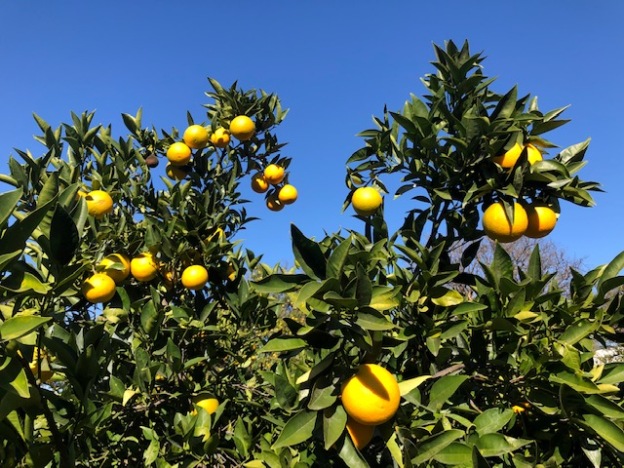
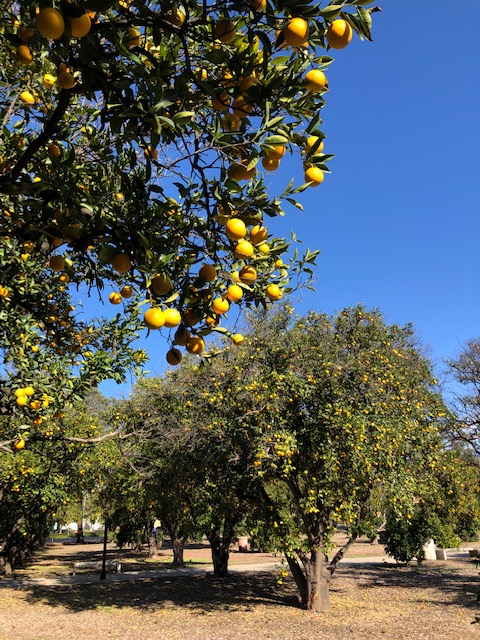
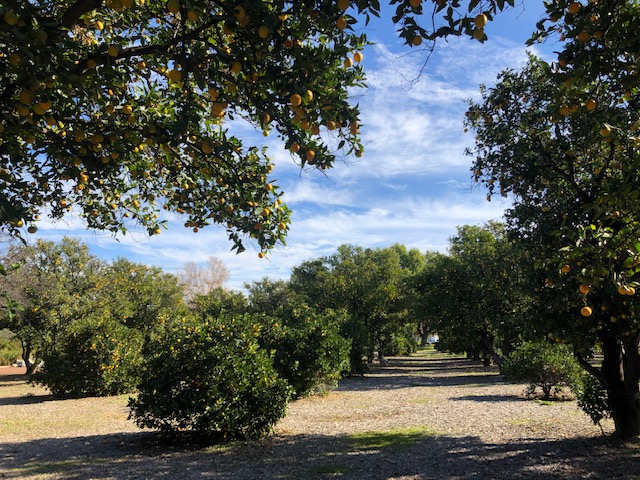
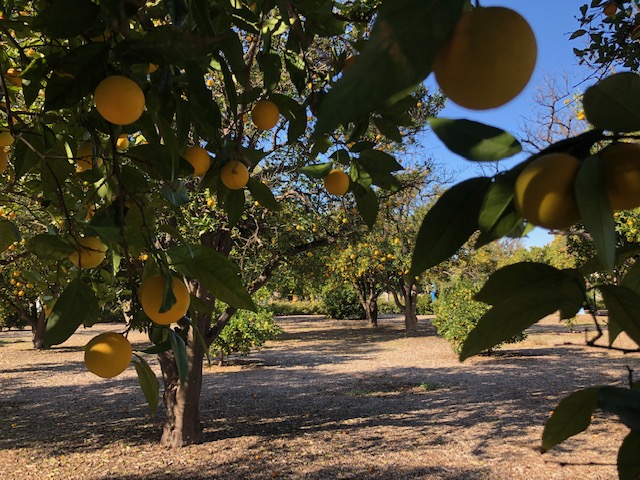
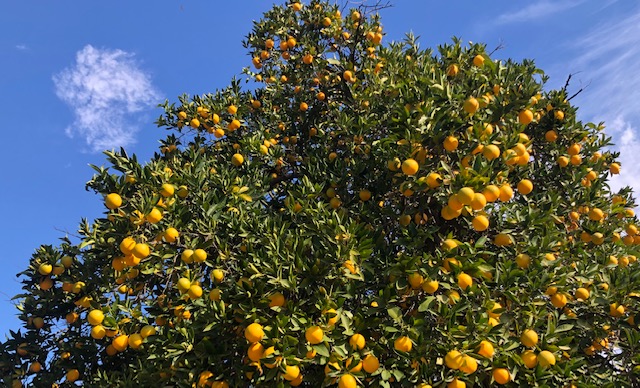
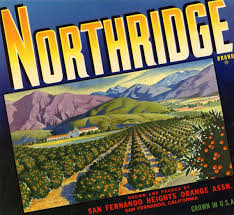
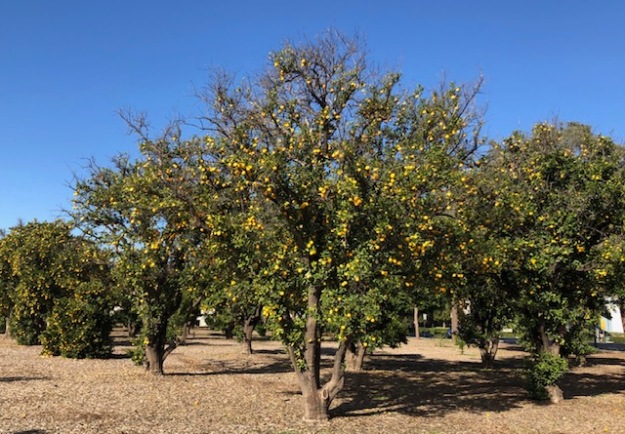
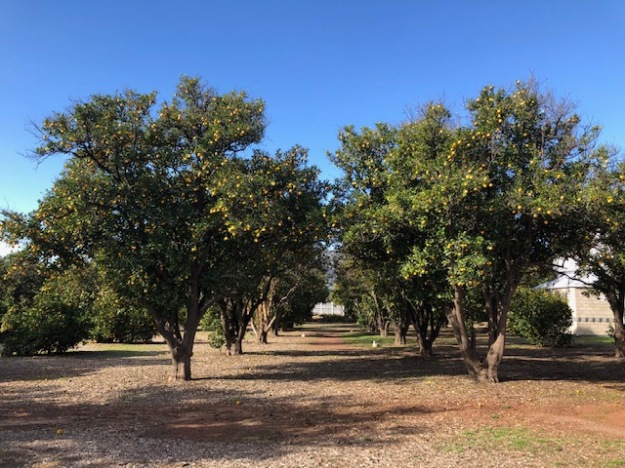
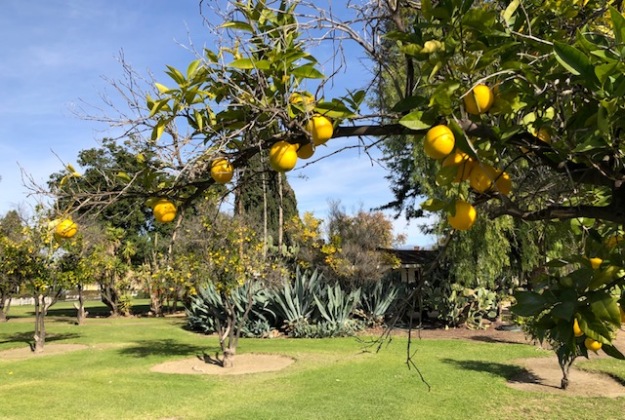
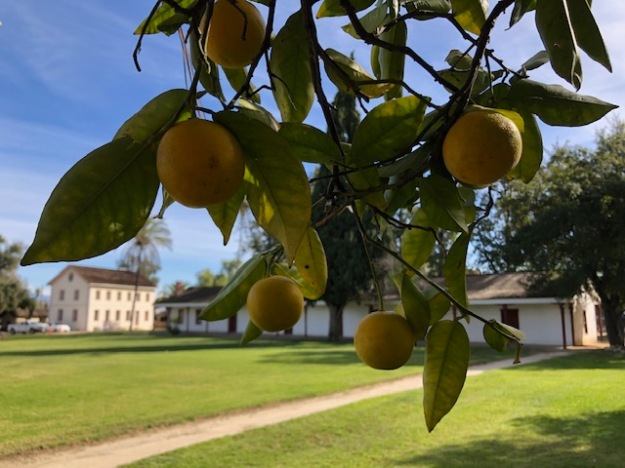
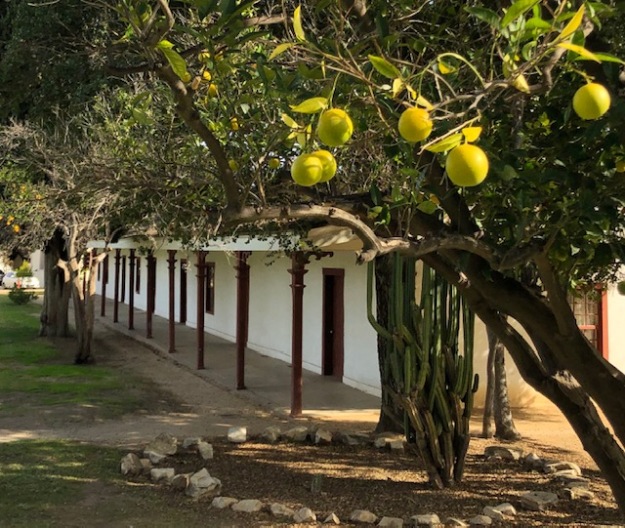
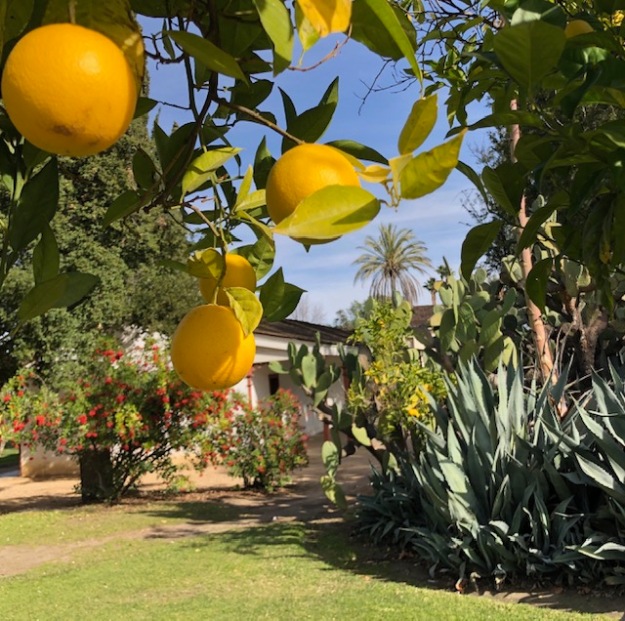
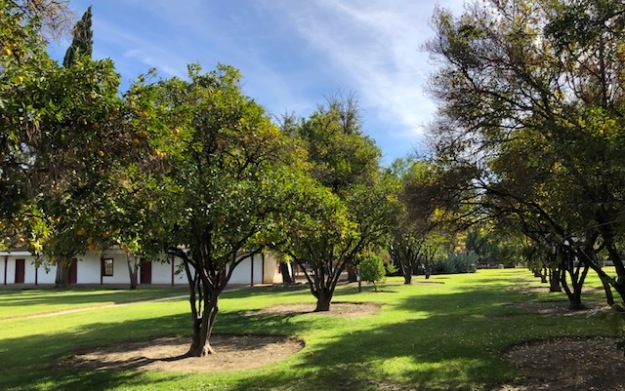
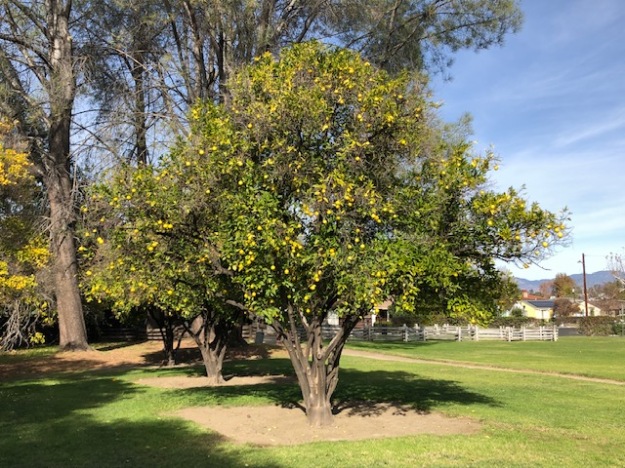
The last big grove of Valencia oranges in the Valley is this one, on the campus of Cal Sate University Northridge. Planted in 1940, it was already there when San Fernando State College opened in and around it, in 1952. The town of “Northridge” was originally named “Zelzah.” But in the early 20th century, Valencia orange farmers looking to make fortunes wanted to be on the right kind of land at the right elevation with the right soil, at the northern edge of the Valley. So to lure wealthy East Coast settlers to put in groves, the town changed its name to “Northridge.”

Few other American cities can boast that they are the native soil of a major agricultural crop. Los Angeles is the mother of the Valencia orange, and pioneer immigrant William Wolfskill was the father. A mountain man and fur trapper who settled in Taos in 1821, Wolfskill became a naturalized Mexican citizen, which meant he could own land. He arrived in LA in 1831, along the Santa Fe Trail. He passed through San Gabriel Mission; there he ate at Eulalia’s sumptuous table, talked with the curious Padres, and first laid eyes on an orange grove. These were the first oranges in California, planted in 1804 by the homesick Franciscans. Ten miles later, Wolfskill forded the muddy Rio de Los Angeles. It may have been a flash of vision and entrepreneurial inspiration, but he grasped that the lush river bottom lapping the edge of the sun-drenched adobe pueblo was the Garden of Eden, that here fruit of all kinds could be produced in abundance, and that there might be a world market for it. He settled in LA, and eventually bought Louis Vignes’s famous El Aliso Vineyards, which had been California’s original agribusiness. [Vignes had founded his winery under the shade of the mighty sycamore tree, El Aliso, that for generations sheltered the Tongva rancheria of Yang-na.]

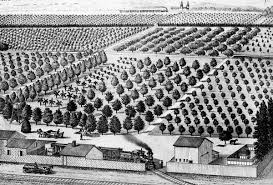
During and after the Yankee conquest, cultivating all kinds of crops, Wolfskill worked to spin the Franciscans’ abandoned orange trees into California gold. He turned the sandy flats east of the Plaza into California’s first commercial agricultural and horticultural laboratory. [Today, the nursery site is covered by Union Station’s sprawl of parking lots, trackbeds and platforms.] Using the Mission stock, selecting and cross-breeding with other, probably Asian strains, he created the perfect orange for Southern California’s foggy coastal valleys and cool, well-watered plains. Wolfskill’s career as an agribusiness tycoon put Southern California at the center of world commerce. As a bottom-line matter, consider that the Southern Pacific Railroad based its decision to come to Los Angeles on the economic potential of horticulture and produce freighting; and when they did, they laid the tracks and parked the depot adjacent to the orchard’s front gate for economy of shipping. [Somewhere in all this, probably when the depot was built, Yang-na’s sacred old El Aliso sycamore came down.] Wolfskill later developed groves south of LA around Santa Ana, laying the foundation for what became Orange County.

“Wolfskill was highly influential in the development of California’s agricultural industry in the 19th century, establishing an expanded viticulture and becoming the largest wine producer in the region. One of the wealthiest men of his time, he expanded his holdings, running sheep and cultivating oranges, lemons and other crops. He is credited with establishing the state’s citrus industry and developing the Valencia orange. It became the most popular juice orange in the United States and was the origin of the name of Valencia, California.”

— Wikipedia article on Wolfskill

“‘Of all the trees,” wrote Charles Fletcher Lummis,”that man has corseted to uniform symmetry and fattened for his use, none is more beautiful and none more grateful than the orange.’ It has certainly been the gold nugget of Southern California. Not only has it attracted fully as many people to California as did the discovery of gold, but since 1903 the annual value of the orange crop has vastly exceeded the value of gold produced. With an average annual income of one thousand dollars an acre, it is not surprising that the orange should be a sacred tree in California.”

— Carey McWilliams, writing of 1942 dollars
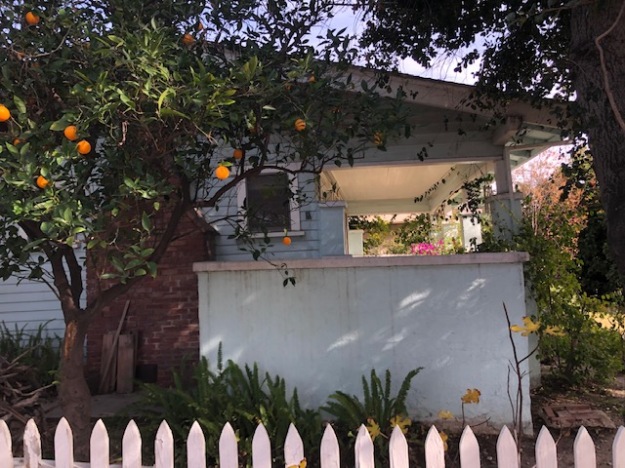
The big groves are gone forever, but the mystique of Los Angeles still includes the promise of a backyard juice tree. The struggling screenwriter of myth still has only to throw on his or her bathrobe each morning, and reach out the kitchen window, to squeeze a golden orb of sunny vitamins into a breakfast glass. Whether or not that glass also contains vodka, depends on the screenwriter.

Hardly Strictly Strickland

TAKE A LONG VIEW of the architecture in Philadelphia. “Firsts” and “finests” are thick on the ground here; below are merely a few of the buildings that have caught my eye, thrilled my soul, and warmed my cold hands and feet, during many visits over the past 50 years.

First: Carpenters’ Hall, the home of the builders’ Guild. Every building in colonial Philadelphia — her distinctive brick row-houses, the sedate Quaker meeting houses and serene churches — all were shaped by Guild members, none of whom was a college boy. Together, they shared (and kept) the secrets and short-cuts and methods that made Philly the second city of the British Empire. (At the time, remember, London was a foul-smelling stew, Edinburgh a medieval rats’ nest, Birmingham a smoky pit, and Calcutta a teeming and noxious offense to humanity; giving Pennsylvania’s “Greene Countrie Towne” a claim as Britain’s most gracious, sanitary, and pleasant seat.)

Carpenters’ Hall, where the First Continental Congress met in 1774. Inside and out, it is a “text book” of 18th-century vernacular architecture. Guild masters, journeymen and apprentices had only to look around it to get stylish ideas about masonry, fenestration, framing, wood milling, and decoration, which they could incorporate ad hoc into their projects.

The Carpenters’ Guild’s masterpiece was the Pennsylvania State House, an entire civic-center complex which, in 1775, hosted the Second Continental Congress. No public buildings in the colonies were greater or more elegantly appointed.

The Founders’ Generation preferred the glory of Rome to the wisdom of Greece. This is reflected in the Palladian windows on the State House, and in the columns and pediment of the First Bank of the United States (1795). Mr. Hamilton, the first Secretary of the Treasury and the Father of American Debt, had a big hand in the design selection for Treasury offices. He wanted Americans to tremble before the awful majesty of the debts he decreed and which they have had, ever since, to accrue to live. Thus the Roman style was chosen, and White House architect James Hoban and D.C. planner Samuel Blodgett worked out the design.

But after 1800, pure democracy and Attic severity were en vogue. William Strickland, a Monmouth County boy who made good, contributed mightily to this shift. (And not just in Philadelphia: Strickland is responsible for the cool classicism of the capitals of the new states along the Ohio Valley, Tennessee and Kentucky.)

“Strickland was born in the Navesink section of Middletown, NJ, and moved with his family to Philadelphia as a child. In his youth, he was a landscape painter, illustrator for periodicals, theatrical scene painter, engraver, and pioneer aquatintist. His Greek Revival designs drew much inspiration from the plates of The Antiquities of Athens. Strickland and his mentor Benjamin Latrobe competed to design the Second Bank of the United States in Philadelphia (1819–1824), a competition that called for “chaste” Greek style. Strickland, who was still copying classical prototypes at this point, won with an ambitious design modeled on the iconic Parthenon. Proud of the building, Strickland had it included in the background of his 1829 portrait by Philadelphia society painter John Neagle.”

— Wikipedia entry on Wm. Strickland

Strickland was popular among the moneyed classes. For his Merchant’s Exchange, the commercial center of Philly, Strickland adapted Greek ideas, and Roman ideas, and Egyptian ideas, and Regency ideas, a misch-masch we call “Neo-Classical.” But he made something entirely new out of it all; something approaching the Modern in its utility and clean lines. Dock Creek, an inlet of the Delaware, allowed barges full of goods to tie up outside, so cargo could be loaded and unloaded right into the cellar, while merchants ascended from the dock to the large trading floor above to strike their bargains.

Neo-Classicism was his forte and he could knock these off all over town (see the Mechanics’ Bank of 1836). But Strickland also helped bring the Gothic Revival to America. His St. Stephen’s Church (1823) is a precious Gothic Revival example, the earliest, and the only building of the style to survive in Philly.

Strickland’s great rival in town was the English immigrant John Haviland. By publishing architectural pattern books, Haviland let out the secrets of design, and broke the professional hold of the trade guilds. From Haviland on, trained architects would be in the driver’s seat of American design.

John Haviland, 1792 – 1852, seen here with his influential book.

“Haviland arrived in Philadelphia in September of 1816 and within a few months had settled in as one of the few professional architects in the city. He first appeared in the Philadelphia city directories in 1818 with an office at 26 North Fifth Street. In what would become time-honored tradition, Haviland advertised himself by producing a book. Builder’s Assistant, Containing the Five Orders of Architecture, for the Use of Builders, Carpenters, Masons, Plasterers, Cabinet Makers, and Carvers… (Philadelphia: John Bioren, 1818, 1819, 1821) appeared in three volumes over several years. This publication was a landmark event in American neo-classical architecture; not only was it one of the earliest architectural pattern books written and published in North America, but it was probably the first to include both Greek and Roman orders.”

— Haviland’s entry in Americanbuildings.org

My favorite Haviland building is the Walnut Street Theatre, America’s oldest playhouse. The original building was a circus hippodrome; Strickland was hired (1811) to turn it into a playhouse, and his work includes the stage and flies and orchestra “pit.” But in 1828, Haviland was hired to renovate the hall with a new facade, and his lovely Neo-classical designs are what greets the playgoer today.

FRANK FURNESS, b, 1839, d. 1912

Furness was the master of the post-Civil War era. His was the time of the railroads, of industrialization, and rapid urbanization. The son of Philly’s leading Unitarian minister, he was a genius sui generis. His buildings defined the “look” of Victorian Philadelphia, and though nobody adopted his style — nobody could — his influence on subsequent generations of architects was profound. (He is also, probably, the only architect to be awarded the Congressional Medal of Honor, for bravery during the waning days of the Civil War.)

His Broad Street Station was the largest train terminal in the world; his Provident Bank stood head-and-shoulders above the conventional buildings in the Chestnut Street financial district. His churches, mansions and country homes sheltered the big-wig families who were later sketched in “The Philadelphia Story.” Almost ALL his buildings have been torn down, victims of myopic 20th-century “redevelopment” schemes that hated urbanism and Victorianism in equal measure. Fortunately, two of his greatest and most innovative buildings survive, both at educational institutions. The Library of the University of Pennsylvania revolutionized libraries, and the Pennsylvania Academy of Fine Arts transformed fine arts study. Both narrowly escaped destruction or dismemberment, and have come to be beloved by generations of students. Behold:

LIT BROTHERS: “HATS TRIMMED FREE OF CHARGE”

Lits was founded by a woman, a milliner, and ladies’ hats — Victorian hats, covered with feathers, plumes, cherries, twigs, birds, bangles and beads — were their fortune.

“In 1891, Rachel P. Lit (1858-1919, later surnamed Weddel, still later Arnold) opened a woman’s clothing shop on the corner of Market and N. 8th Streets. With the administration and innovative advertising techniques of her brothers, Colonel Samuel David Lit (1859-1929) and Jacob David Lit (1872-1950), their small store soon became one of the largest retail stores in Philadelphia. From 1895 to 1907, the store continued to expand, with the company taking over the remaining buildings on the block of Market between North 7th and 8th Streets – including the J. M. Maris Dry Goods Store, the Bailey Store and the J. B. Lippincott & Co. Building – and adding new buildings at either end of the block designed to blend in with the existing buildings. With alterations and additions, the Lit Brothers Store became the only full block of Victorian architecture in Philadelphia, composed of 33 buildings constructed between 1859 and 1918, with a common interior. The new buildings and the alterations were designed by Charles M. Autenreith and Edward Collins. Although the store on Market Street was often called the “cast-iron building”, only two of original building’s facades (at 719-721 Market and 714-718 Arch Street) are actually cast iron. The other buildings are brick, faced with marble or granite. The two end buildings are brick and terra-cotta, with galvanized iron trim and octagonal towers. The uniformity of the entire Renaissance Revival-style acade is supported by the use of a classical arch window in all of the buildings, which are painted the same color.”

— Wikipedia article on Lit Brothers
Reading Terminal, 1893. The famous Market is on the ground floor; best cheesesteaks in Philadelphia. This Renaissance head house was merely the front office for the huge train shed that ran north for two or three blocks. At one time it was the largest covered space, or longest roof in the world. The whole massive, splendid complex has been converted into the Pennsylvania Convention Center. I bet half the delegates at any given confab, will spend their whole trip down in the Market.

THE FIRST MODERN SKYSCRAPER IN AMERICA: PSFS

“To replace their Walnut Street headquarters, the Philadelphia Saving Fund Society (PSFS) began planning a new building on Market Street. Under direction of bank President James M. Wilcox, they began seeking designs for a building, of which that by architects William Lescaze and George Howe was accepted. Together, with influence from Wilcox, they designed the new PSFS Building. Completed in 1932 at a cost of $8 million, the PSFS Building was a modern departure from traditional bank architecture and other Philadelphia skyscrapers. Designed in the International Style, te building was the first skyscraper of its type built in the United States. Part of the modern amenities installed to attract tenants included radio reception devices installed in each of the building’s offices by the RCA Victor company.The skyscraper was completed during the Great Depression, and the neon initials of the Philadelphia Saving Fund Society were kept lit throughout the economic troubles to create a symbol of hope and consistency for the city. In the early part of the Depression the initials were jokingly said to mean “Philadelphia Slowly Faces Starvation.” Over the years, the building with its sign became a Philadelphia landmark.”

— Wikipedia article on PSFS

Patient Reader, thanks for following this Long View. Just remember, scrolling through the blog saves you from the fate of following one of my Death Marches through Philadelphia in a freezing drizzle.