Welcome to the blog of writer and musician Andrew Martin. Here I'll post original photographs and observations as I encounter the history and culture of the San Fernando Valley, the City of the Angels, Alta California and the far-flung Pacific Rim… but mostly the Valley.
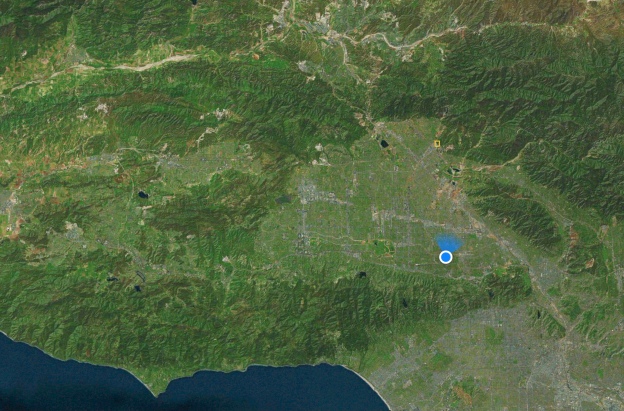
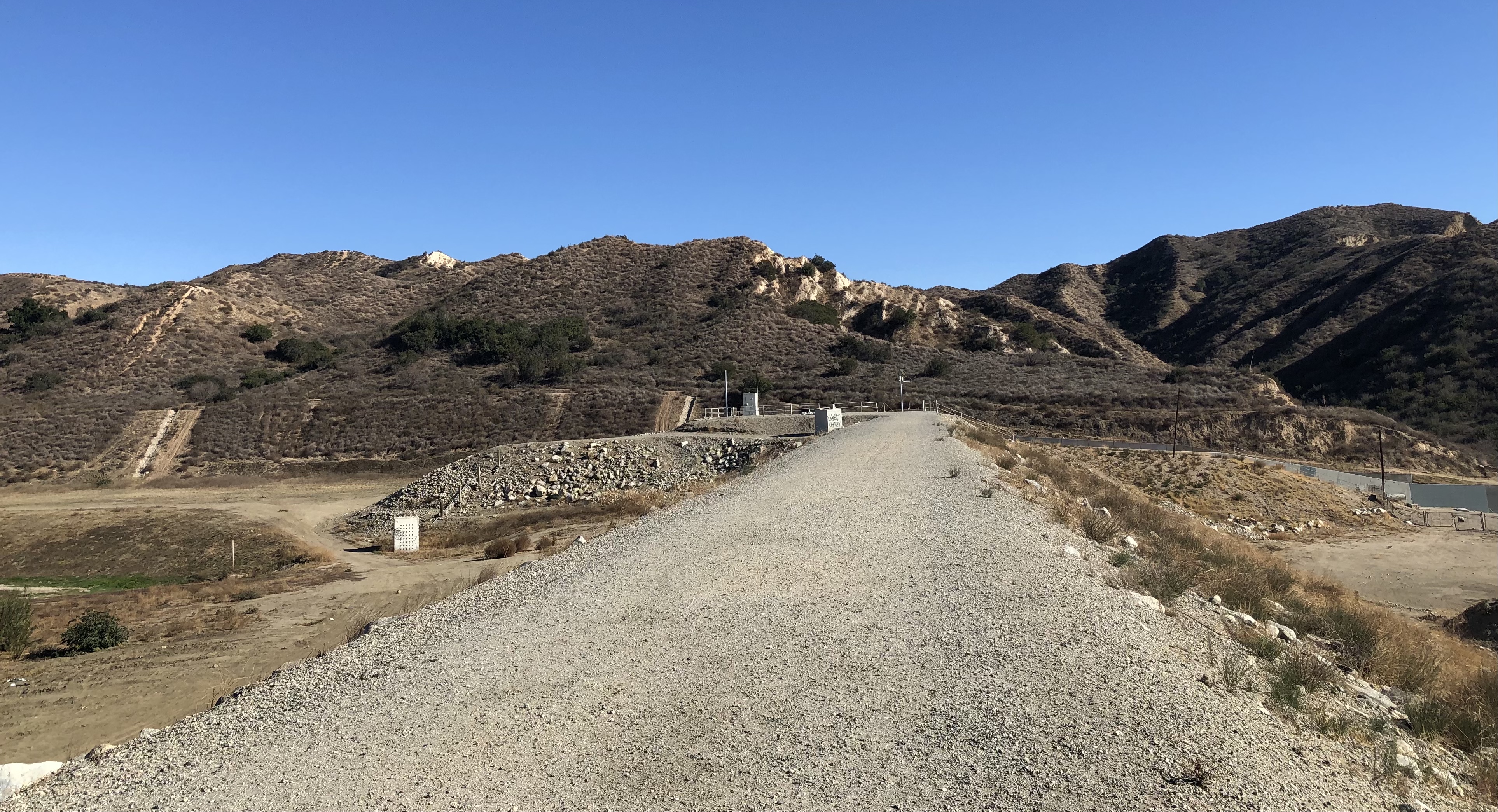
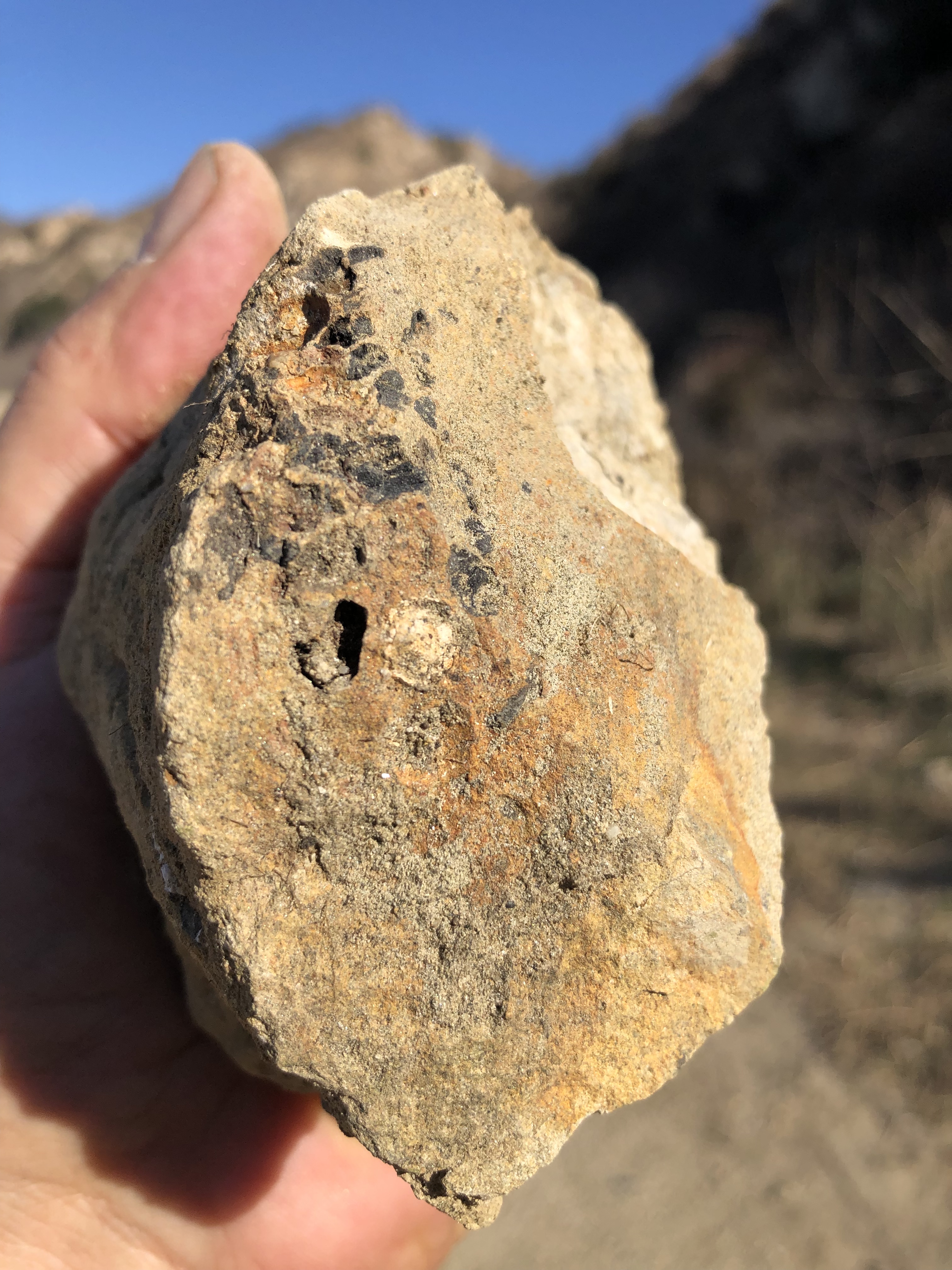
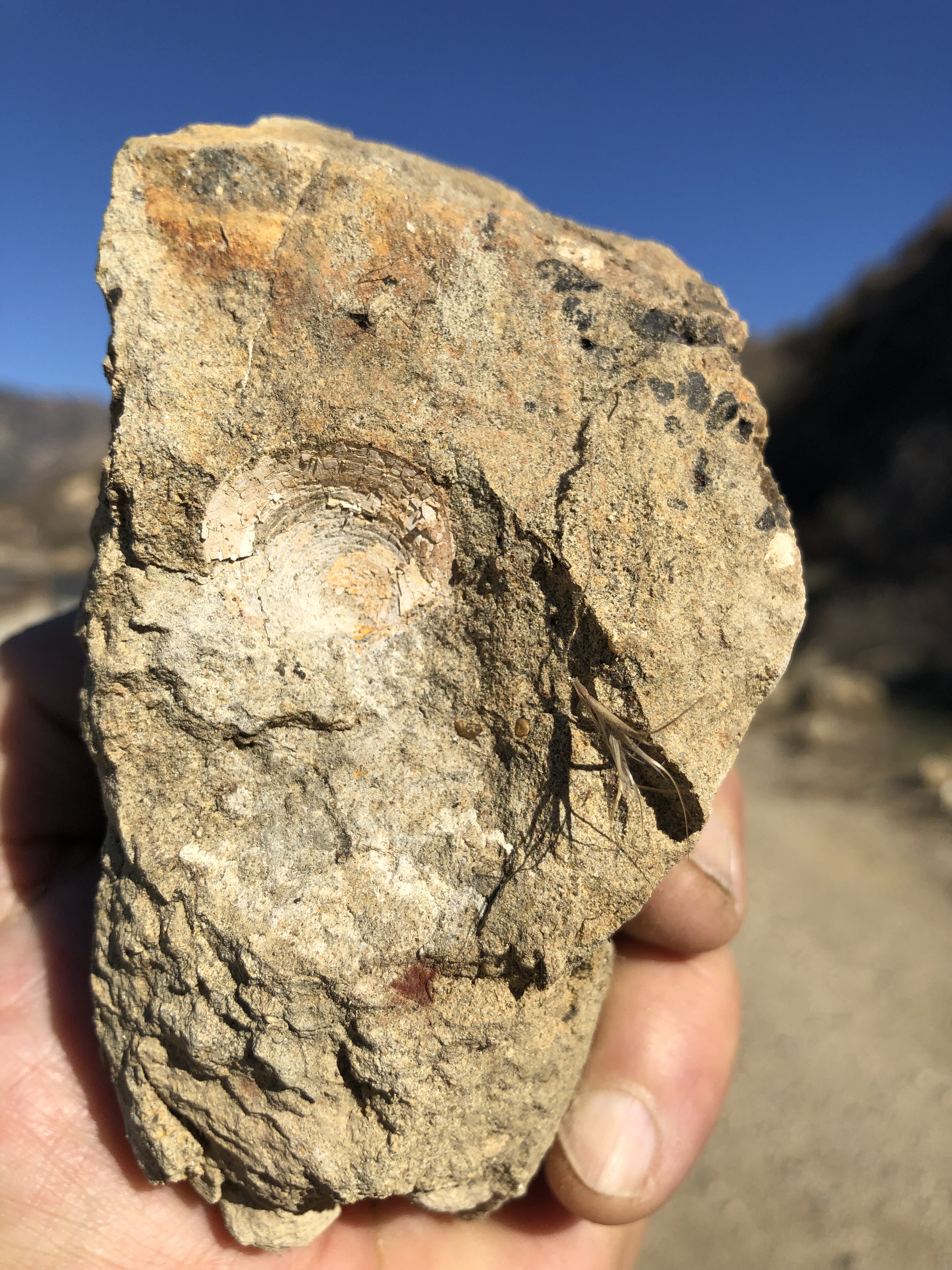
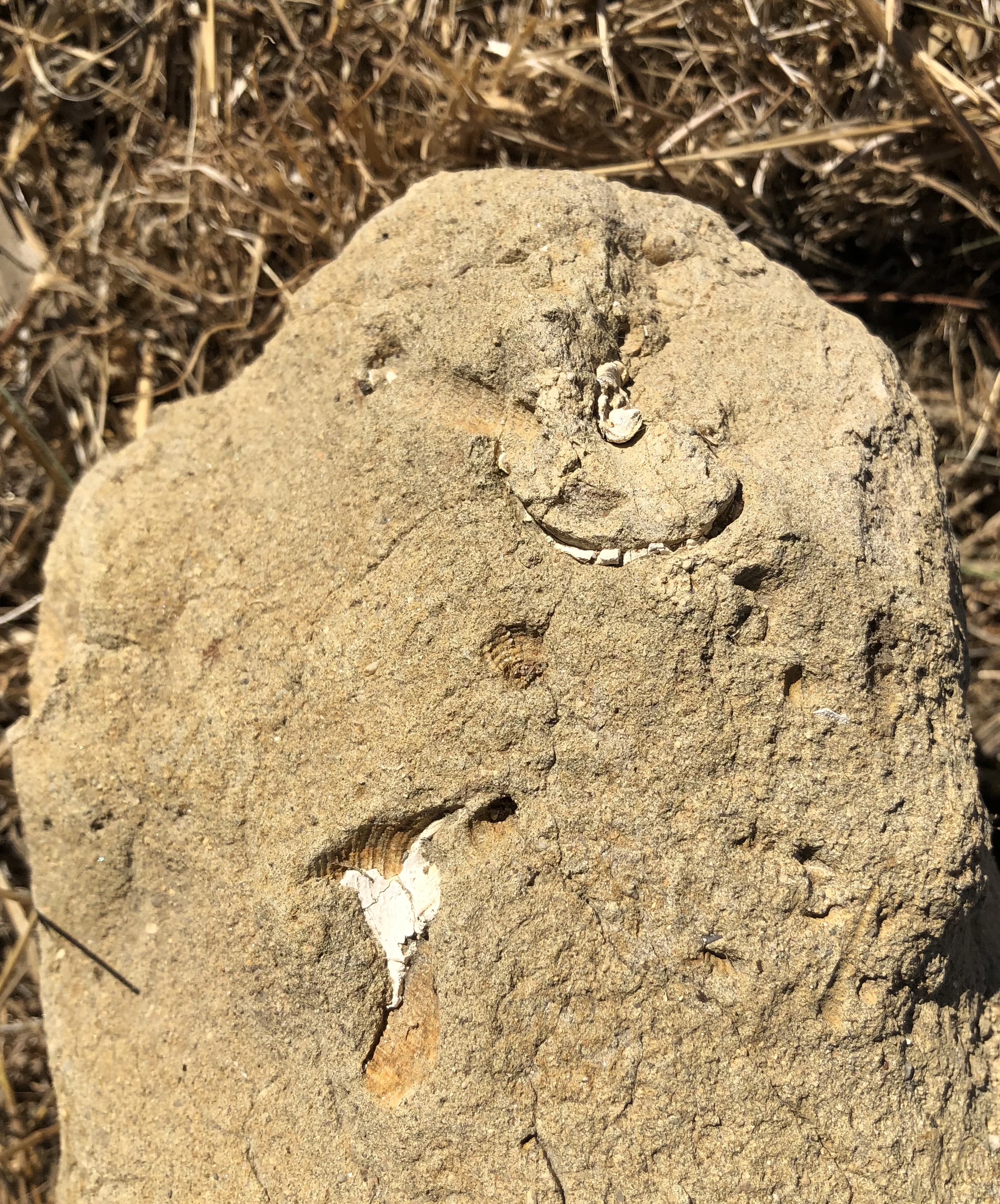
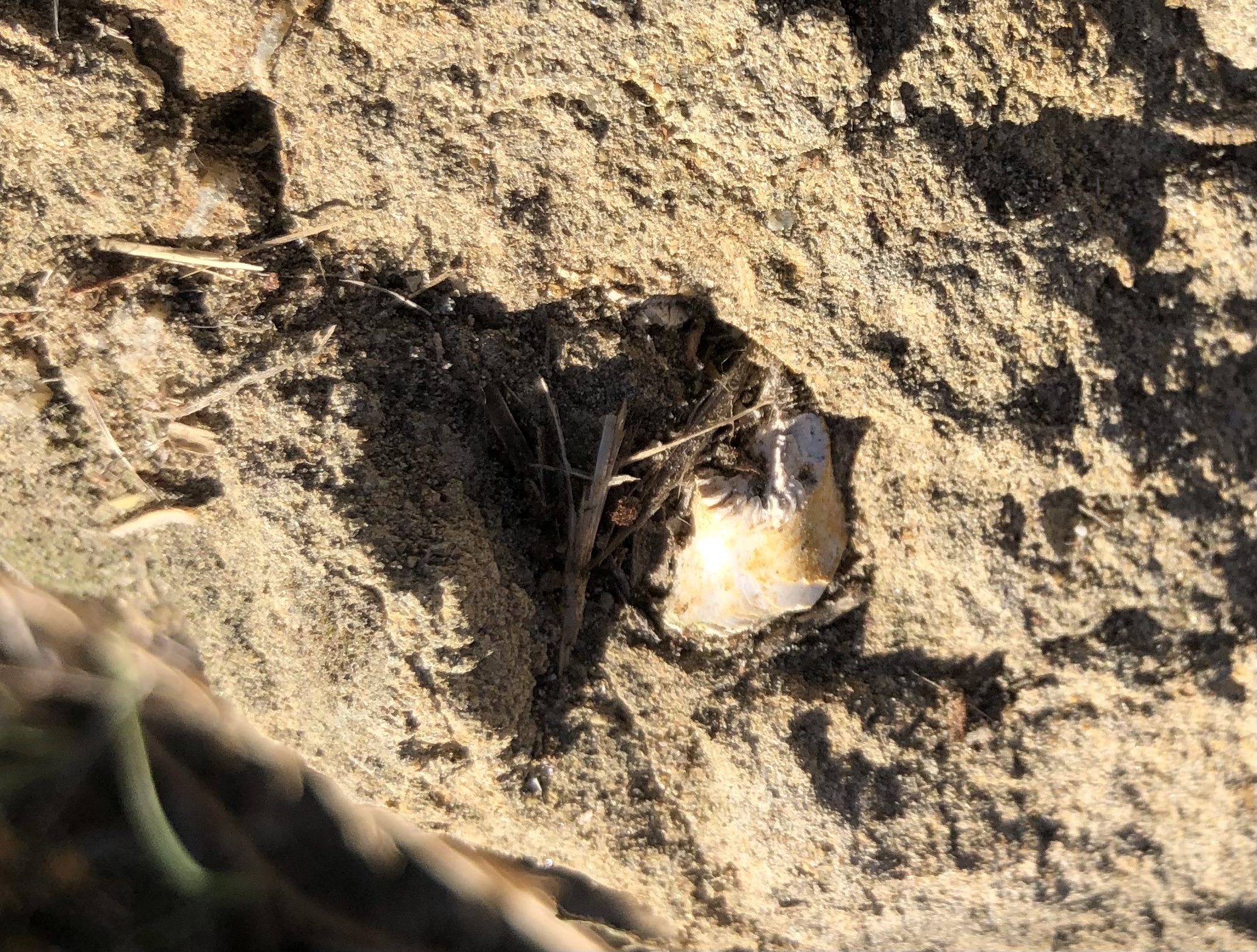
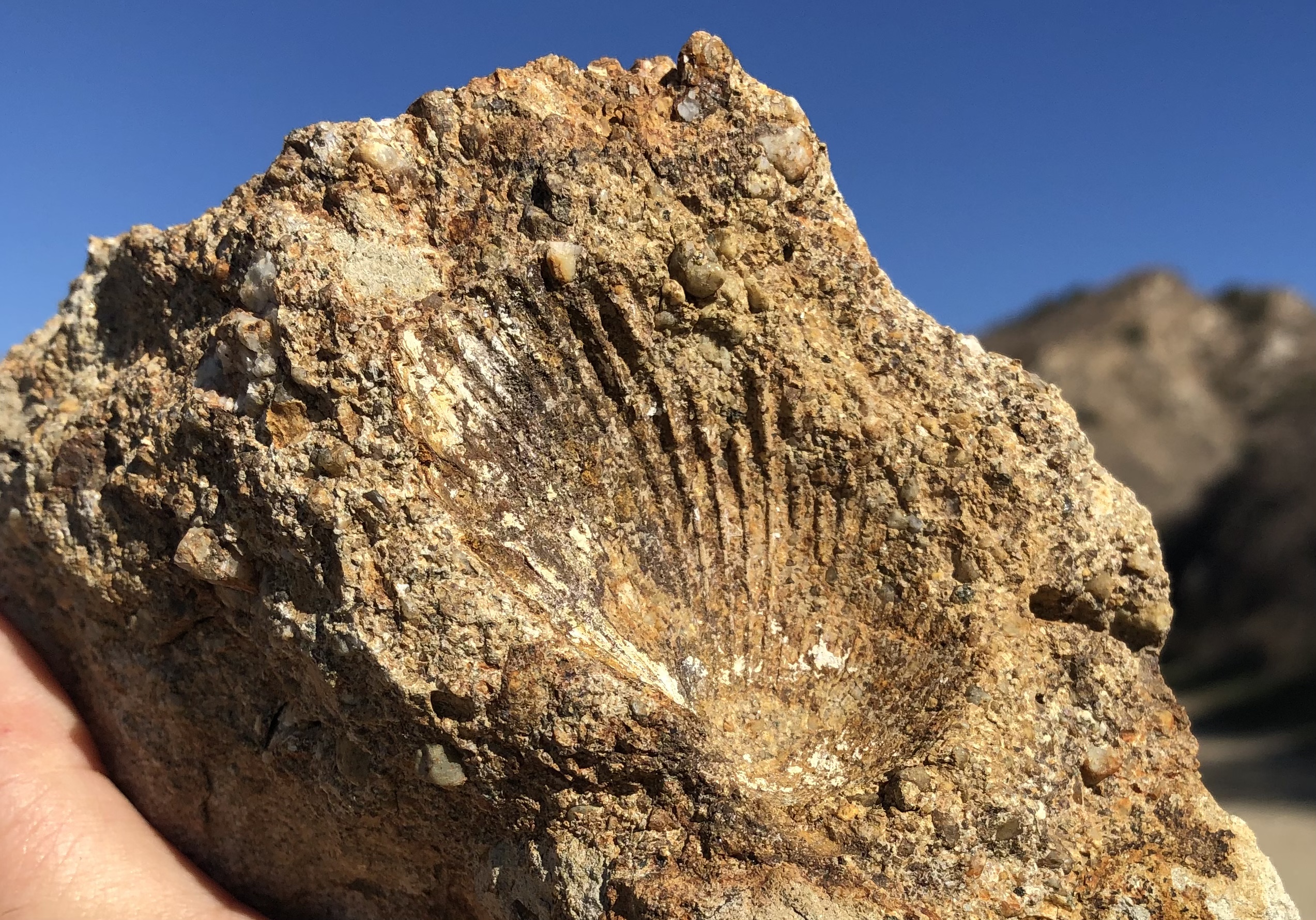
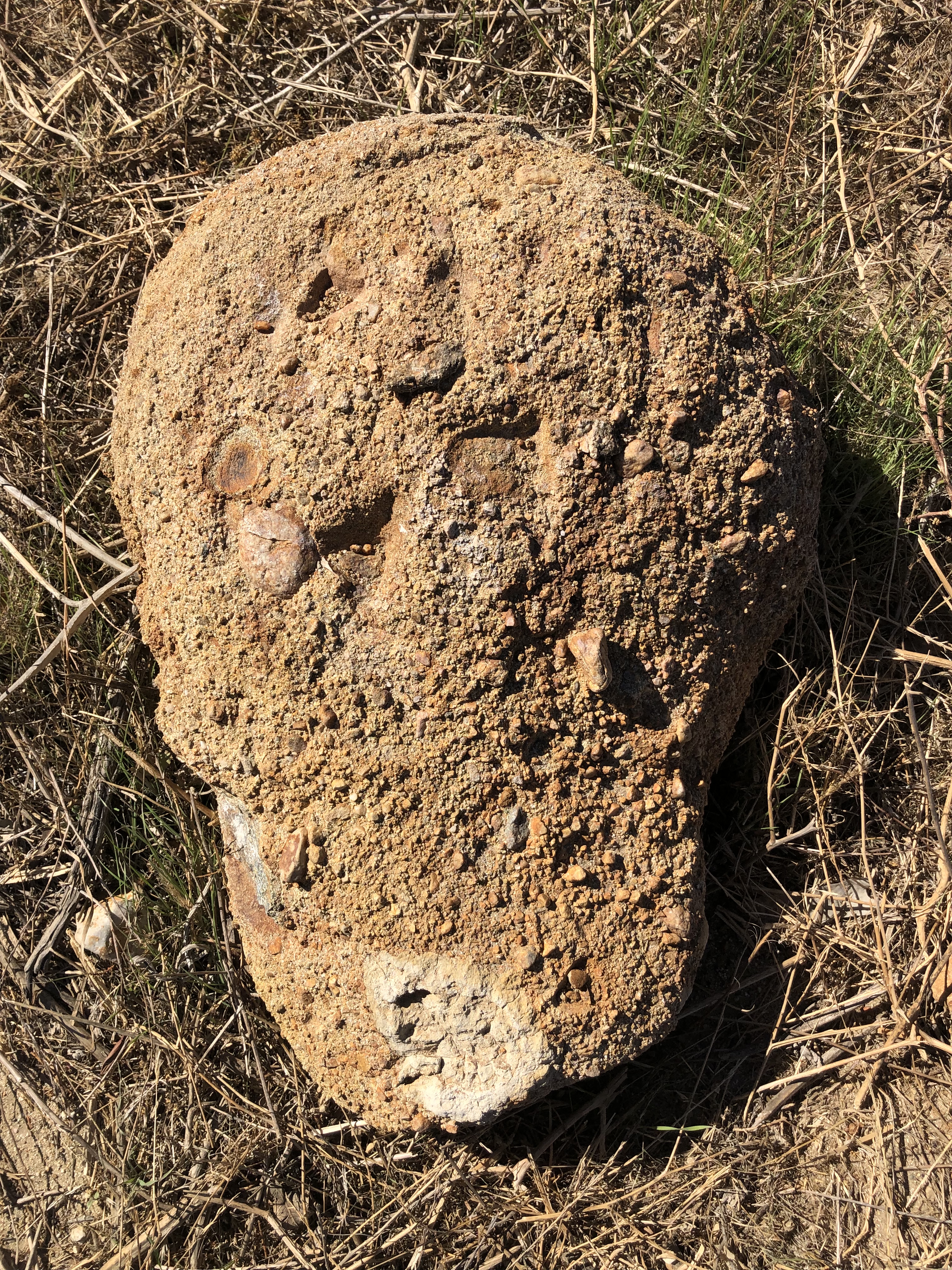
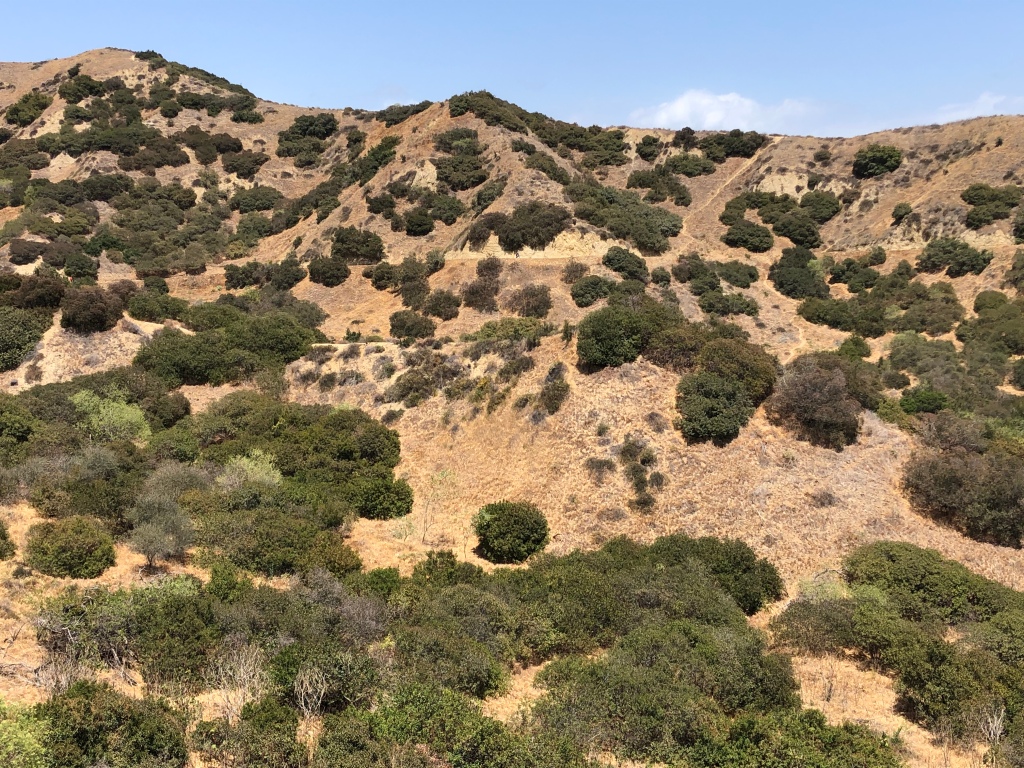
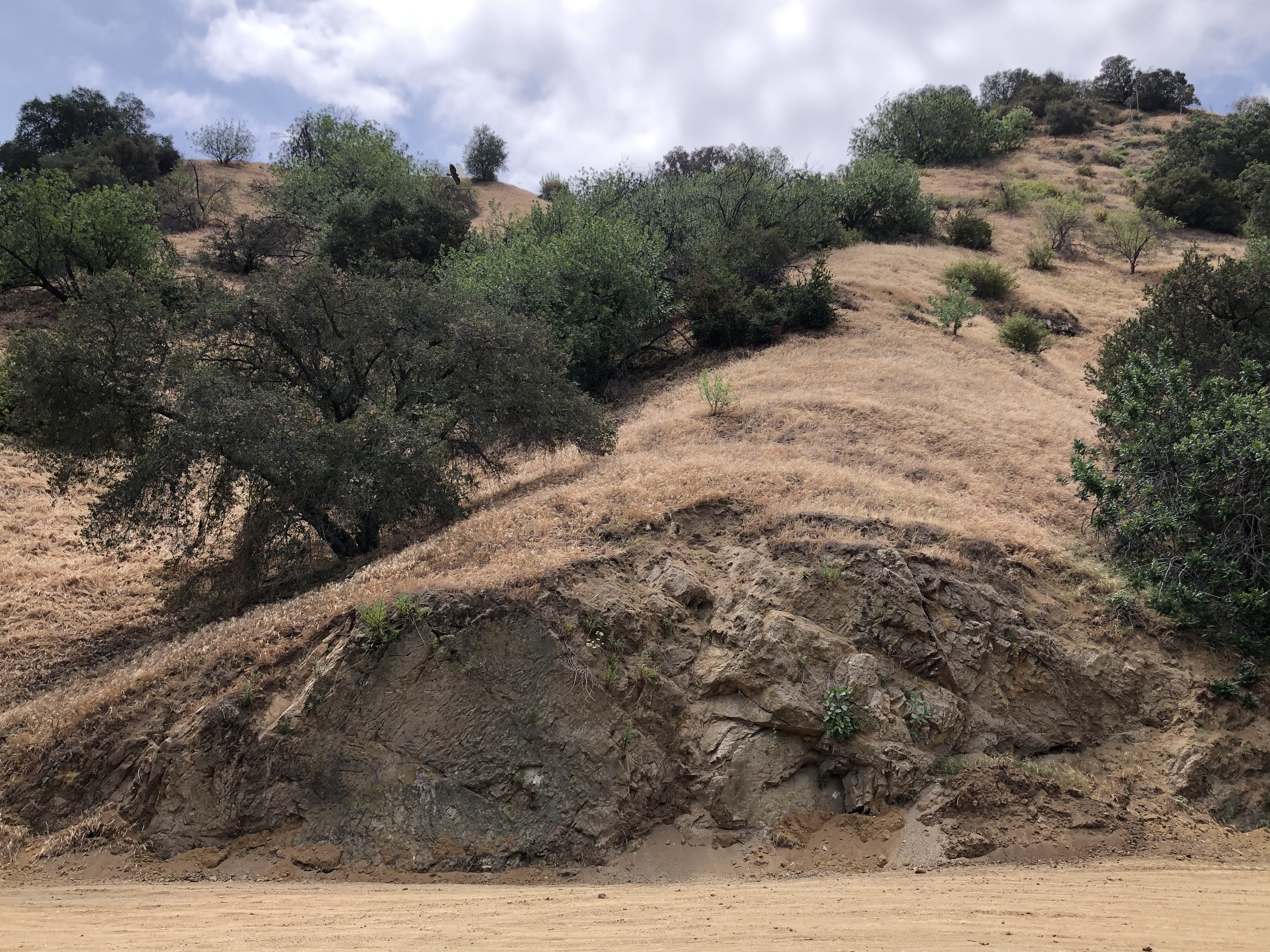
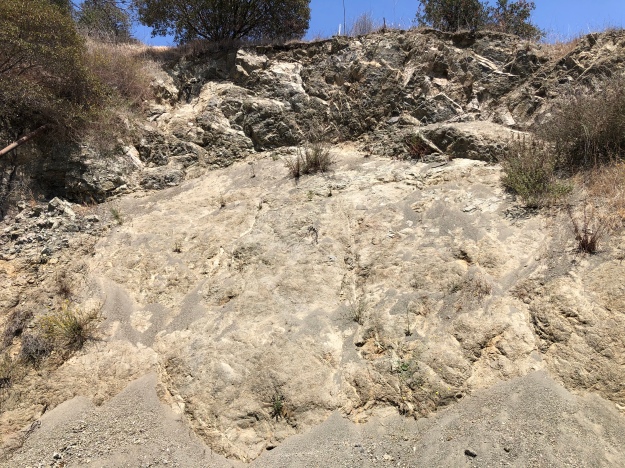
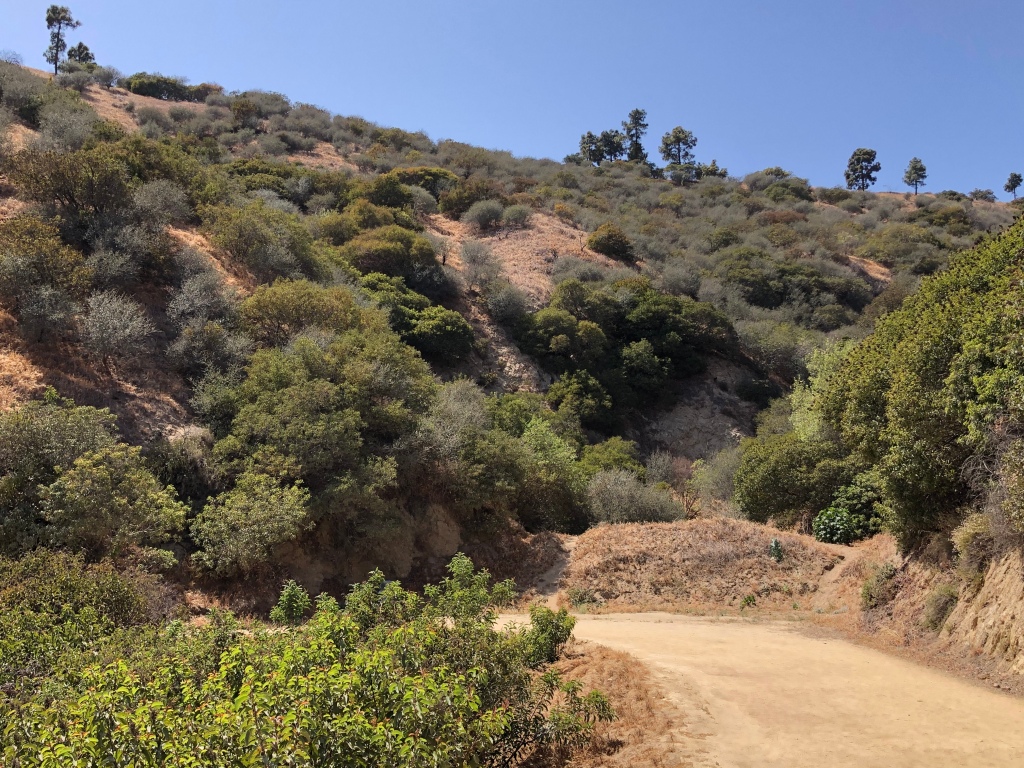
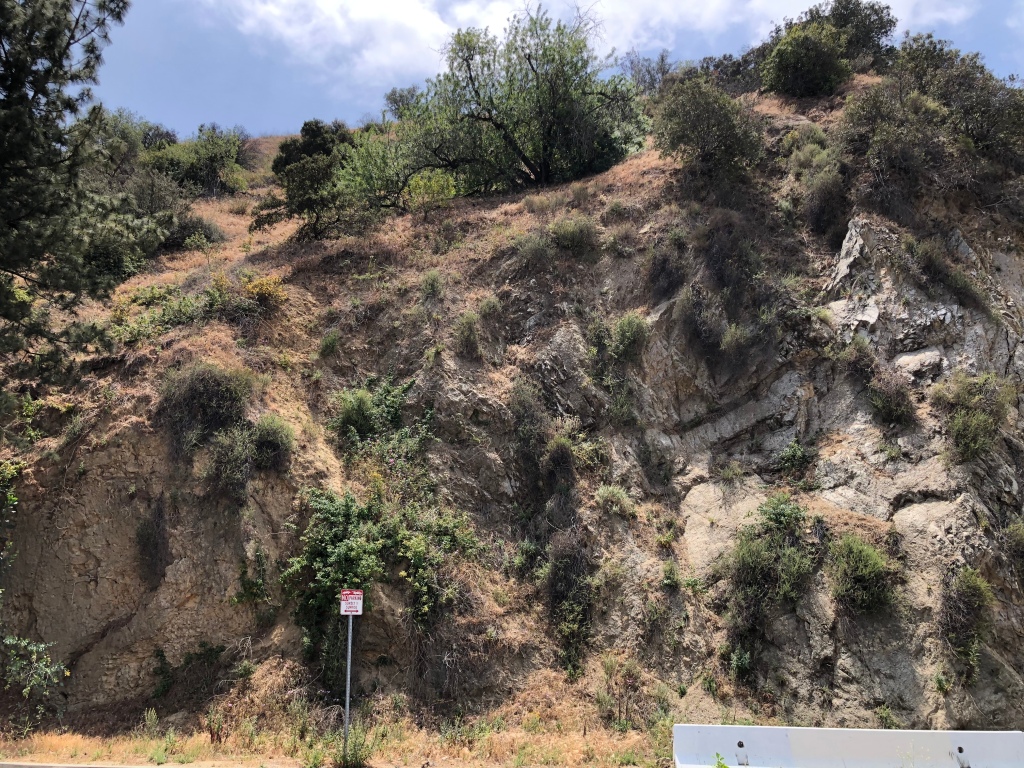
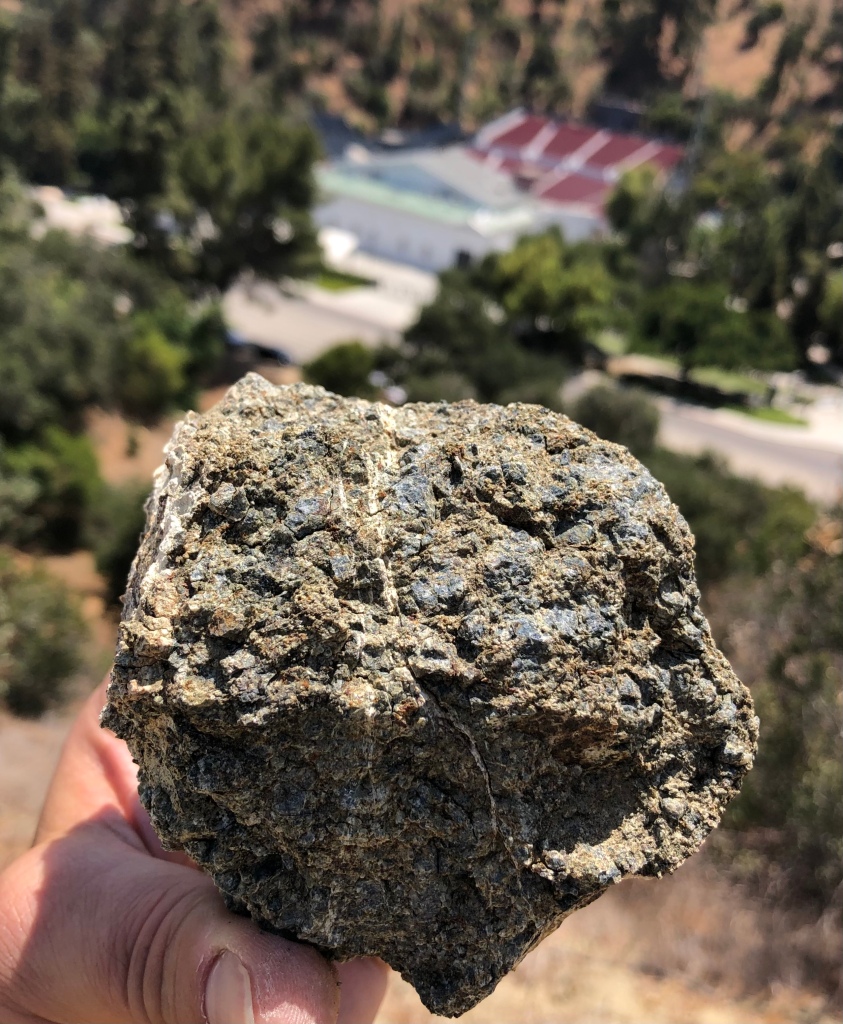
I found fossils of shellfish in fragments of freshly fallen conglomerate on the trailside of Pacoima Creek, between Lopez Dam and the Lopez hills.
They are reminders, miles from today’s shoreline, that the San Fernando Valley was once embayed, the playground of scallops and clams. Later all that shallow bay muck was uplifted — crunched up — by convergence of the migrating West Transverse Range fault block against the edge of the North American craton. The line of suture where the fault block docked (at San Gabriel Fault) is now just a couple of miles north of this spot.
Moules frites?Deviled littlenecks?I frutti di mare…petrificado; en croute.Only the shell of its former self.Fresh yellow-green mineralizing fluid?
A Patient Reader Down East has sent this fantastic and moving We Gather Together. It is so beautiful I thought it should be shared. It is the only Dutch Reformed hymn, Ithink, that is common in all denominations in America.
Enjoy this treasury of photographs showcasing the geology, botany, and fascinating social history of LA’s greatest park, now celebrating its 125th birthday.
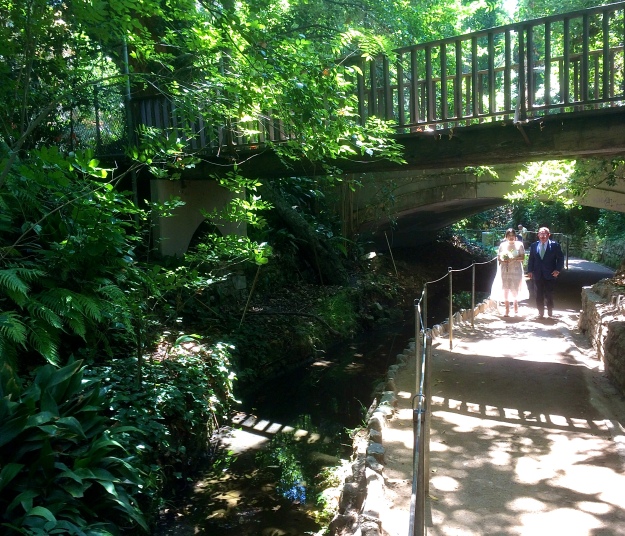
My favorite picture ever, I think. A bride escorted by her dad up Fern Dell. I had just passed the wedding party and officiant at the top of the trail, nicely kitted out, waiting in excitement. The bride was grimacing with fright as she caught the light. What a spot for a wedding! What a spot for anything.
TRAILS CAFE
The rancho adobe (in some form, since 1795!) was preserved as Park Ranger HQ.
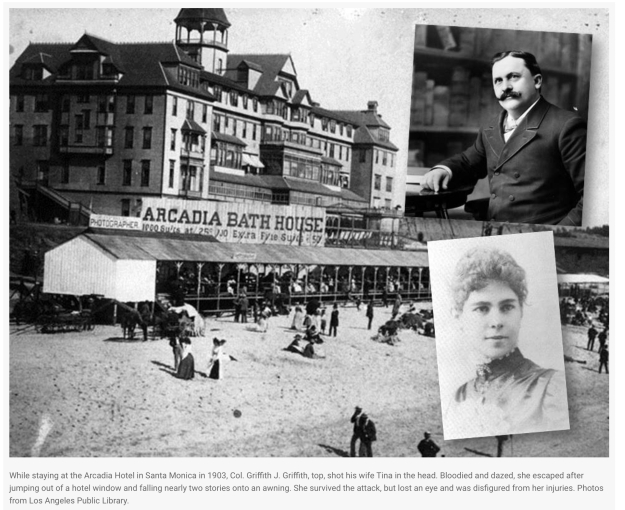
This unbelievabvly rich land was Rancho Los Feliz — “the Felizes’,” the first (or second) rancho grant in California. It was granted as a reward to a retiring military intendente of Los Angeles. The Pueblo was successfully settled and competent, the Tongva successfully relocated to San Gabriel, and happy Mexican farmers were churning out grain in the vast riverbed. Griffith J. Griffith bought the rancho from Yankee speculators for a song, and when he offered it to the City, with his grand visions of civic adornment and classical education and human uplift and ecological connection — he practically had to beg the City to take it. They were afraid to take Griffith’s gift, thousands of untouched watershed acres, because Griffith personally, had problems… it turns out,he shot his wife in the face, in a hotel room on Santa Monica Beach. The City Fathers were afraid the voters’ wives’ ministers’ wives would reject the City Council socially, if they shook hands with a beast like Griffith. He did two years in Q.
This photo is from the California Department of Corrections online article about Q’s famous alumnus, which tells the whole lurid story! Click, Baited Reader, click….
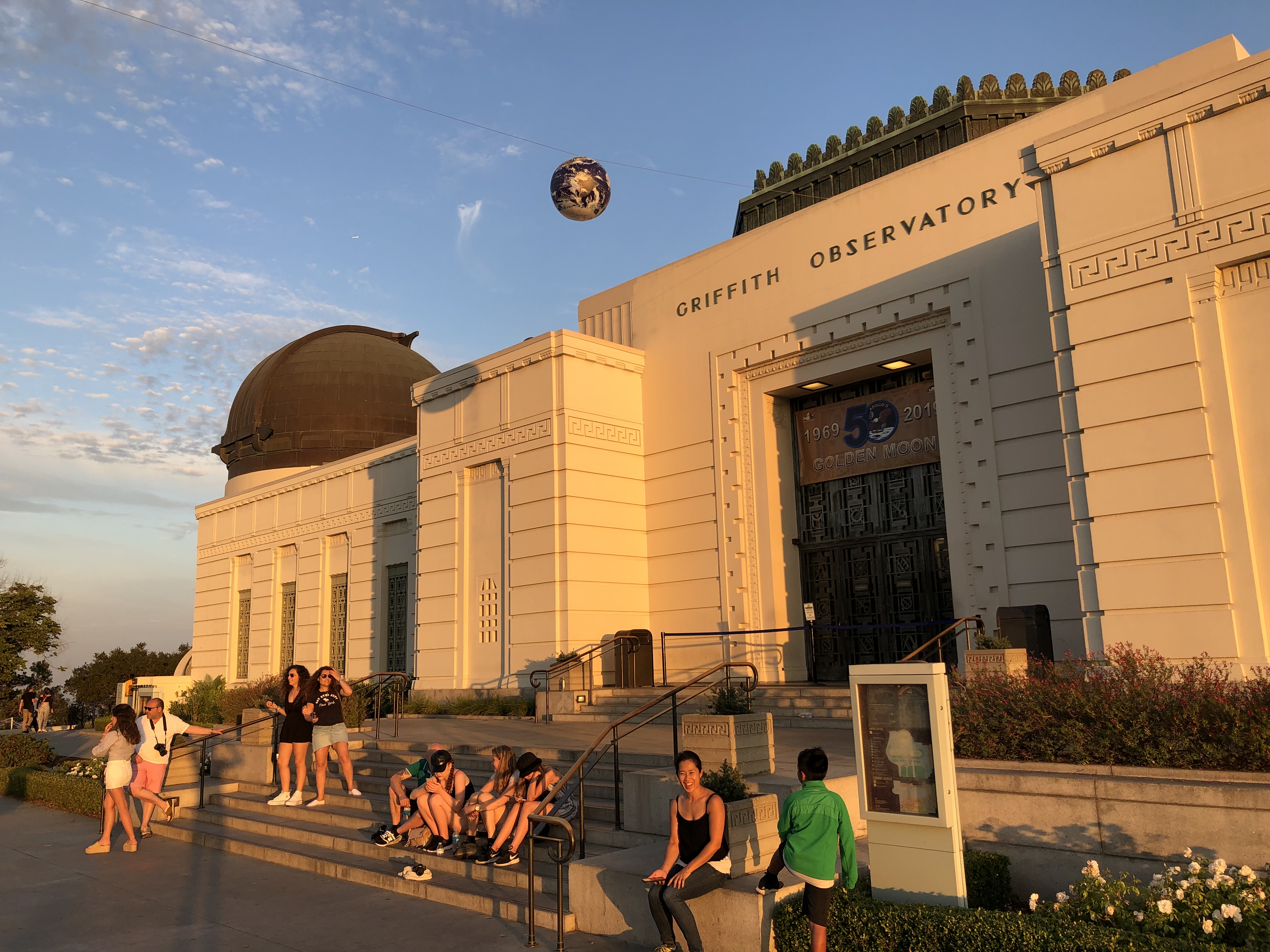
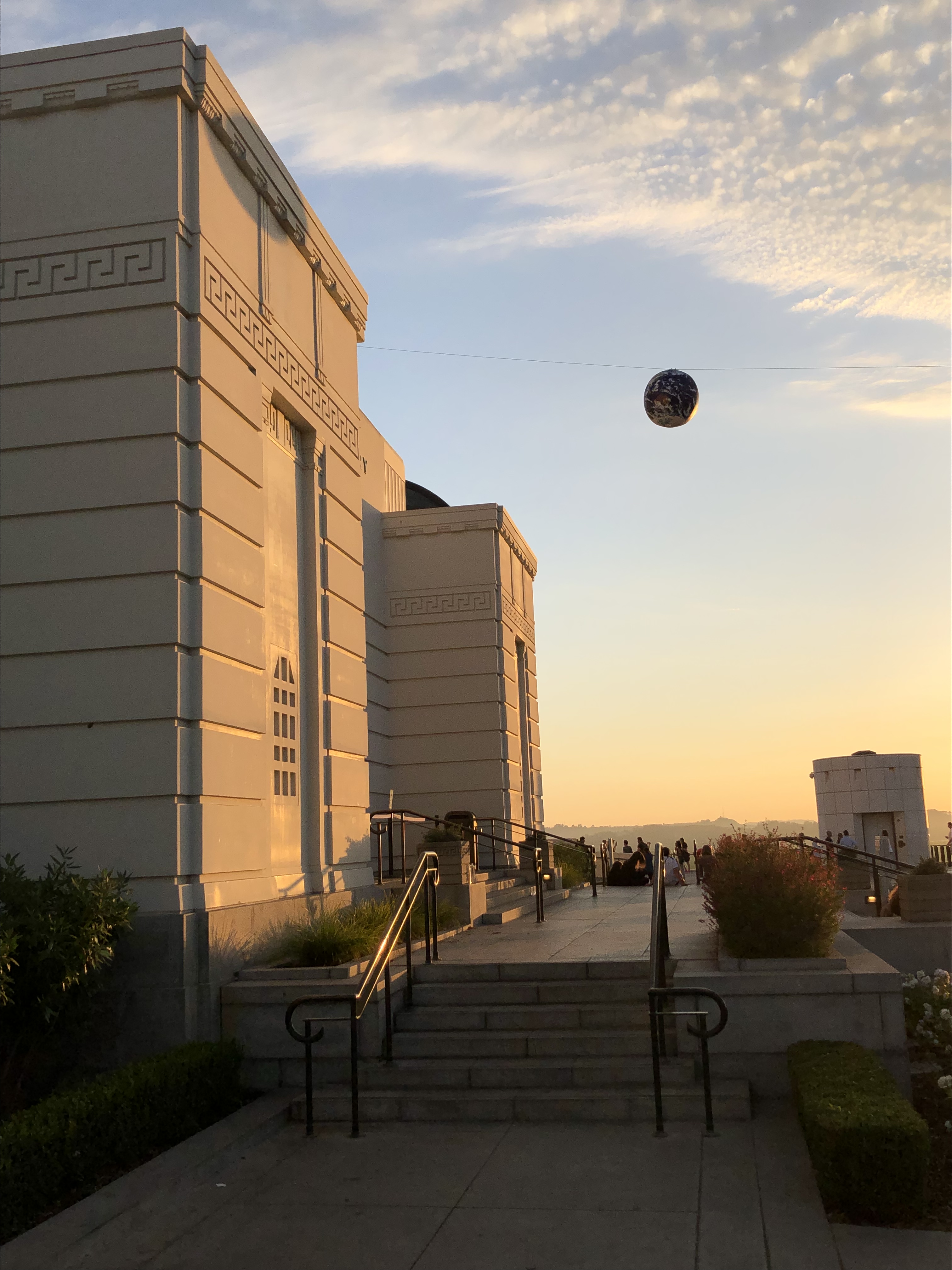
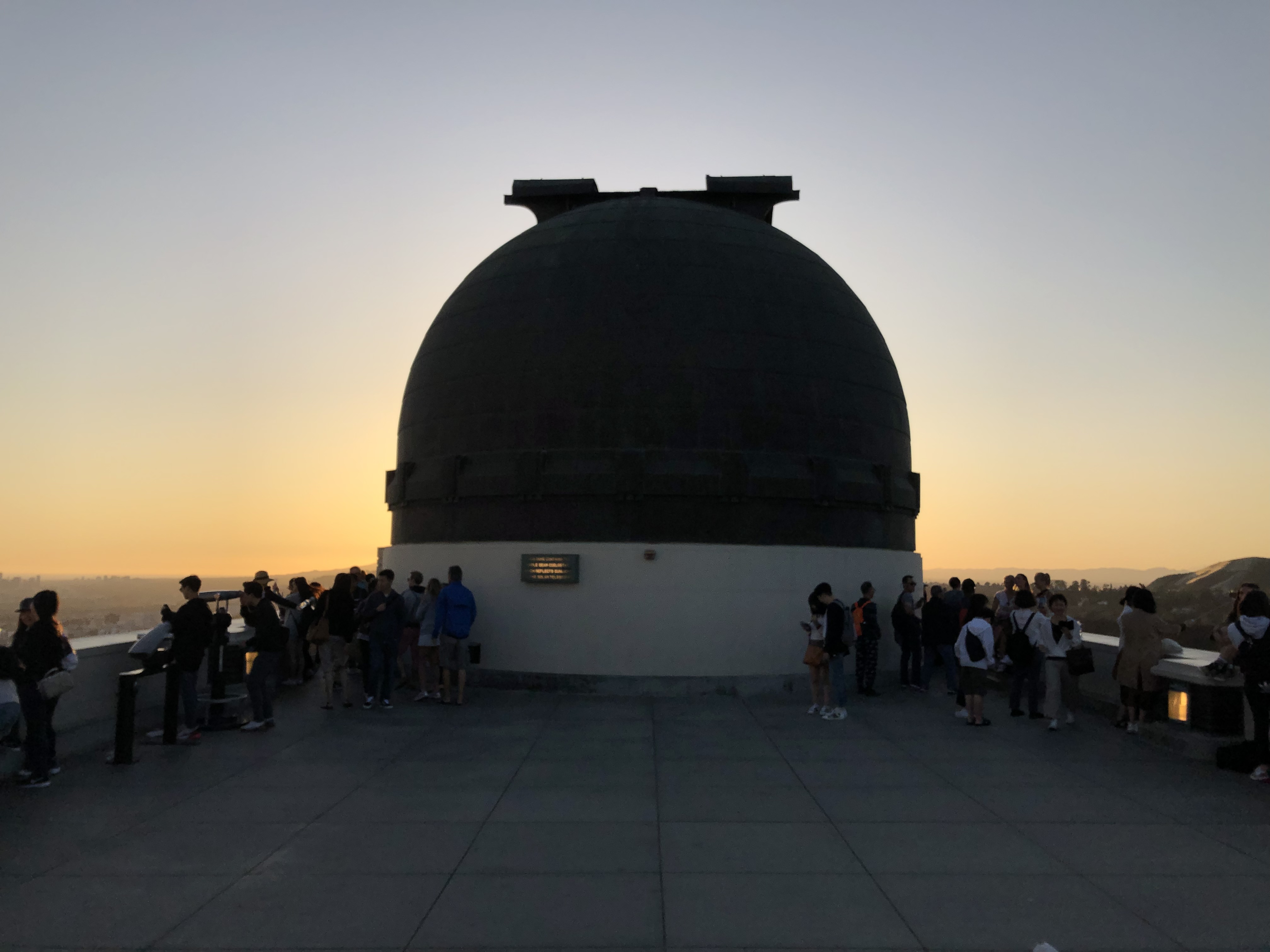
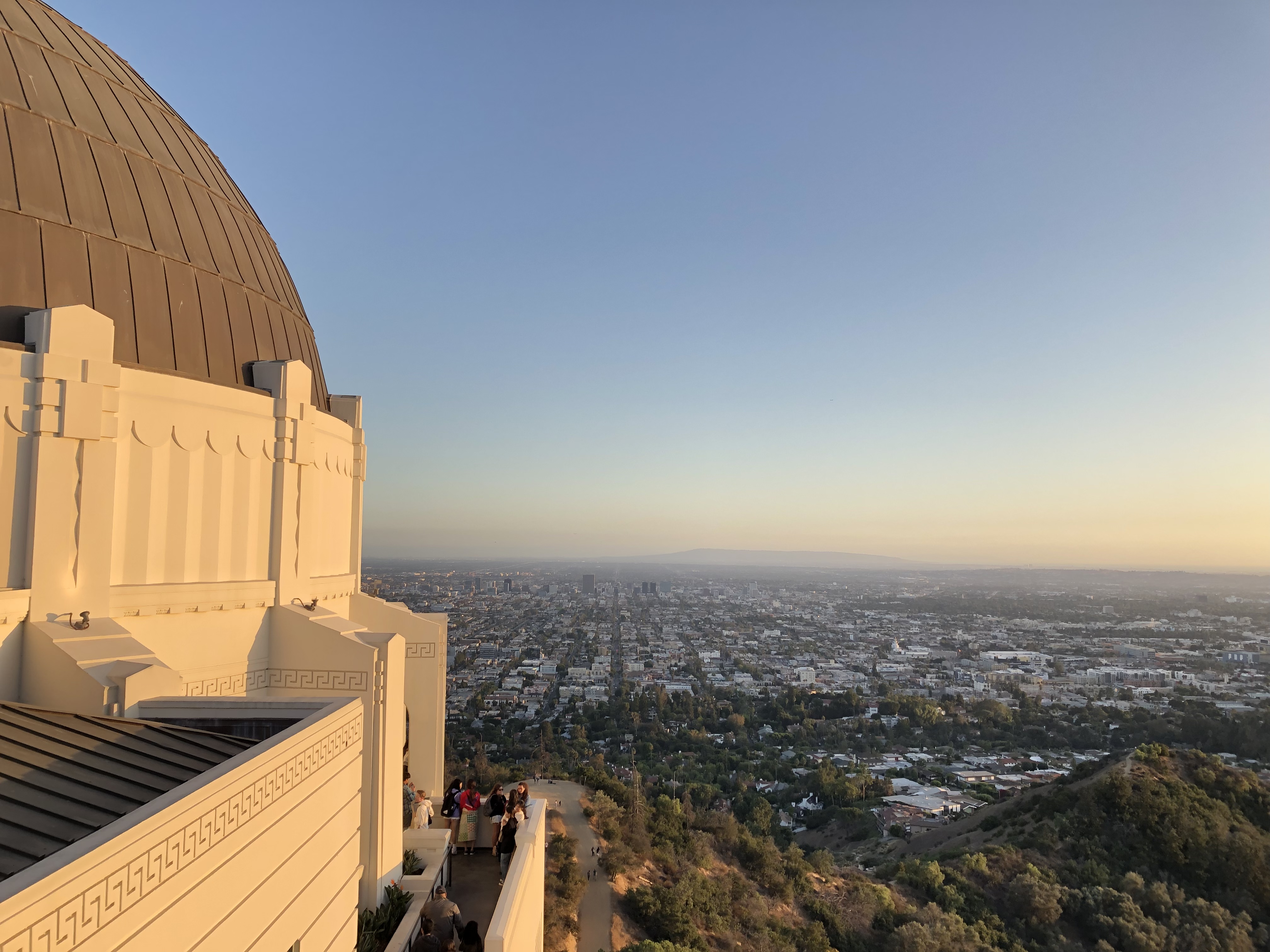
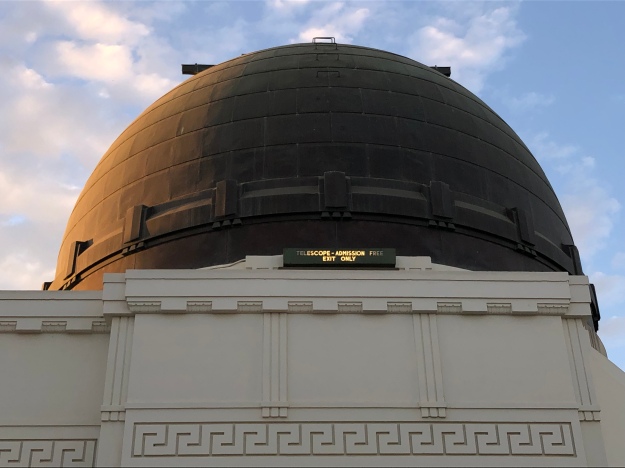
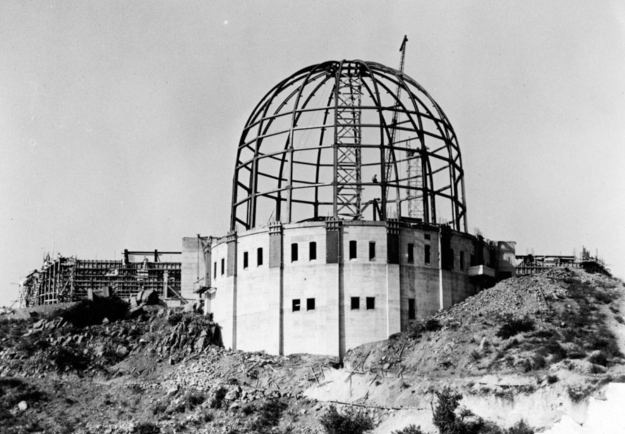
It took decades before Victorian propriety thinned out enough for the City to take possession, and it took decades more (1930!) for them to get around to building the Observatory and the Greek Theatre; both were stipulated in the conveyance. The delay was a good thing too, architecturally, for the Observatory — by then, the grace of Art Deco had come in to soften the Greek of Griffith’s preference, and the Federal Fascism that looked forward to Roosevelt’s New Deal; and it could all coalesce with modern engineering. It is one of the most iconic buildings on planet Earth (which it turns out is where we are; go inside and they’ll explain.)
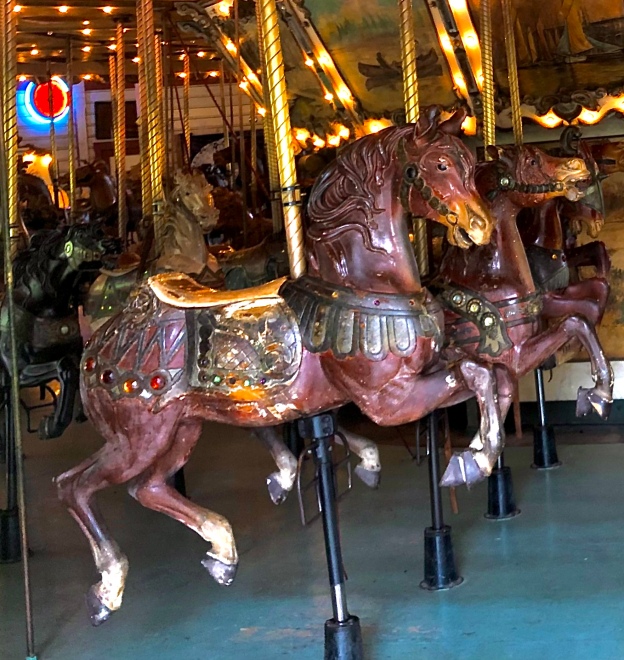
The Griffith Park Merry-Go-Round. Since we’re nosing into the Holidays anyway (Sinter Klaas, Dec. 5), and there’s apparently no other footage anywhere of the Merry-Go-Round, and the dead operator who loved and maintained this instrument for years can be seen in the video in his Sinter Klaas cap, here is Jolly Old St. Nicholas, with bells and whistles, and the moose bugling along. Enjoy the View Walt Disney had, a bench in the Park, watching his Merry- kids -Go -Round, and see if you dream up anything as lucrative as Disneyland, like he did. Dream harder…
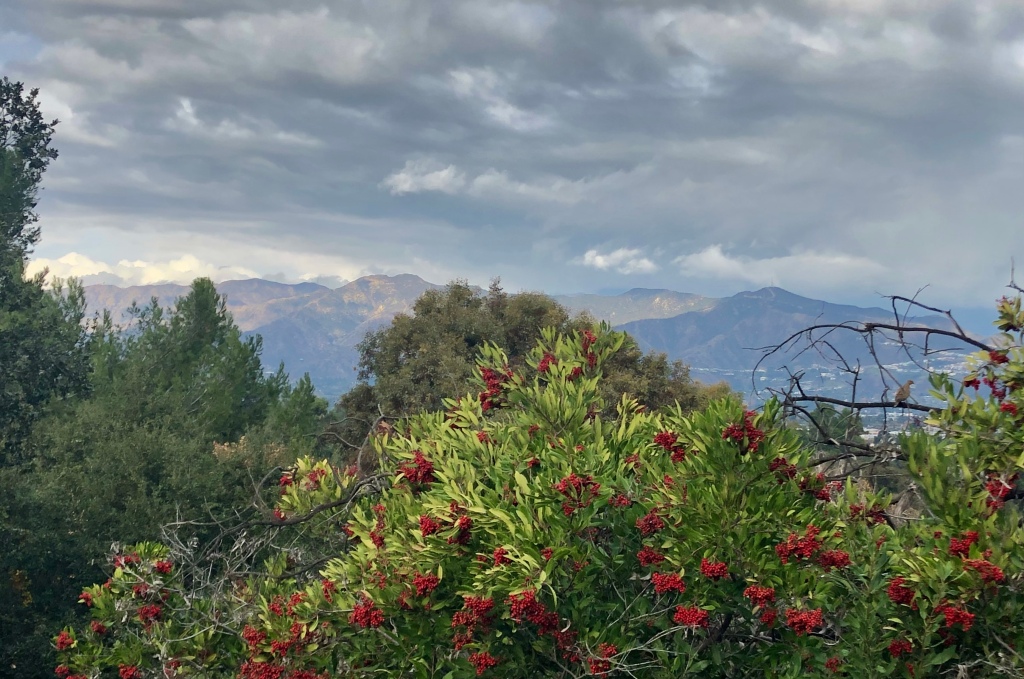
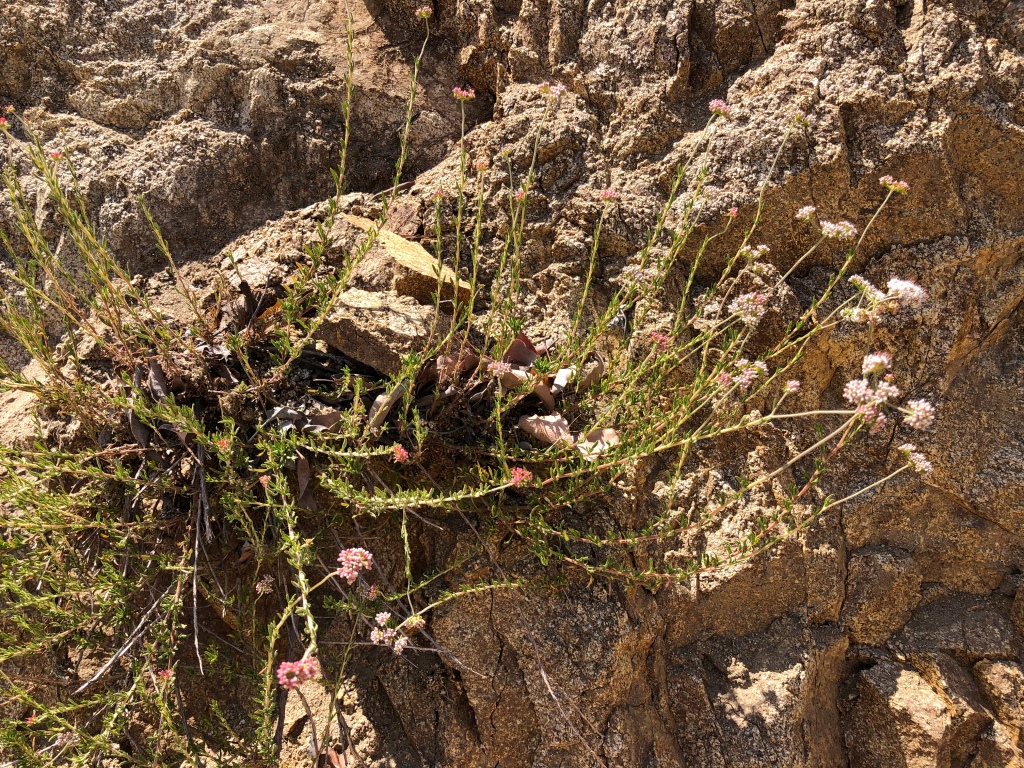
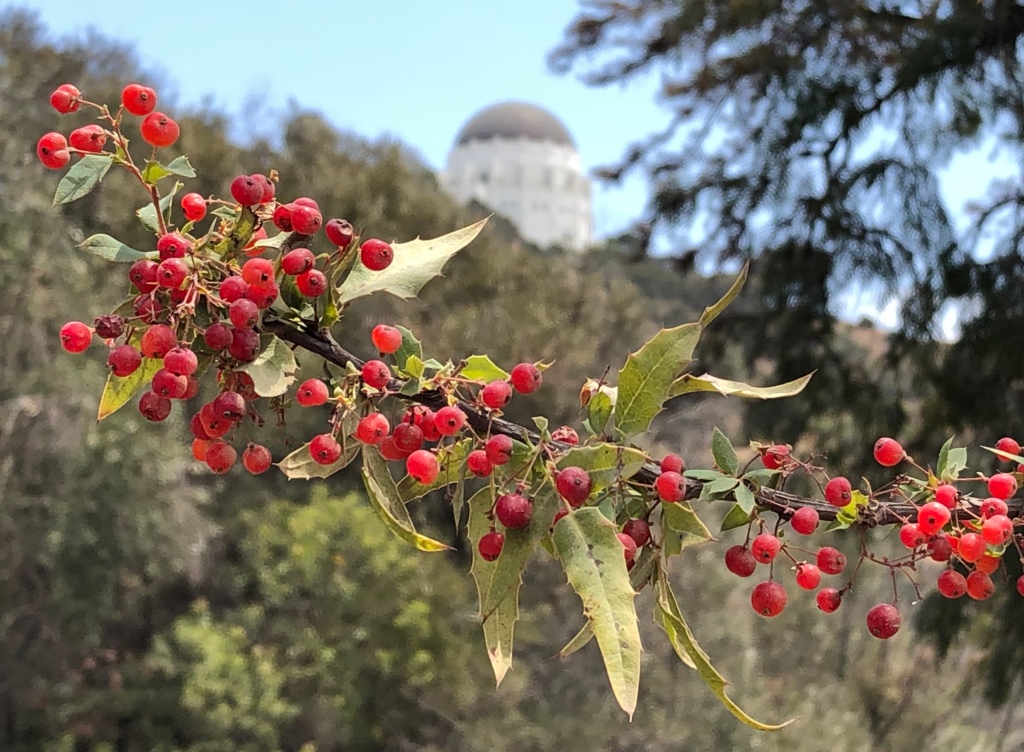
“Griffith Park is 125. It looked 125 five years ago. It will look it twenty years from now. I hate parks.”Holly-leaf cherry, Prunus illicafoliaToyon, Heteromeles arbutifolia. It is the official native plant of the City of LA.Covellite, a secondary volcanic rock.The gorgeous Nevins Barberry, Mahonia nevinii, is one of the rarest plants in the California Floristic Province. Around 500 wild individuals of the species are recorded, and most of those occur in Griffith Park.
VAN NUYS — A VIEWING: PART 6New Netherland 1654-1664
The story of the Van Nuys family of America begins with Aucke Jansen, farm boy and carpenter, who established his family in New Netherland in 1651. When we left the Jansens in chilly spring 1654, they had given up on Manhattan, where the city was building the Wall through their backyard. (Imagine: ugly palisades and planks a few feet from their window, spiting their View clear up to the Park, and heilas! shading the windowboxes Magi just filled with iris bulbs, watercress and wild strawberries…)
Building the Wall. We’ve seen that the issue of “who’s going to pay for it?” occasioned a rebelllion of the City Council and the wealthy poorters against the Governor, a rebellion pervaded with all kinds of republican, and (so Stuyvesant thought) ”English Puritan” sentiments. The Puritans had beheaded Charles I, and Cromwell and Parliament were running the British Isles. And of course, militant PuritanNewEngland was just next door. New Amsterdam needed urgent defense. But the rich burghers didn’t want to dip into their silk purses just to save the Company money. They gave an argument that sounds much like “taxation without representation is tyranny.” When a Remonstrance to that effect was presented to CEO Stuyvesant, he duly presented it to his corporate board. The Dutch Masters were baffled to find themselves in the position of being expected to think like statesmen, psychologists, anthropologists, city planners, and military generals. After all, they were just businessmen! Externalizing everything human or natural off the balance sheet was the very focus of their lives. And THEY, in Old Amsterdam, certainly weren’t going to pay for building somebody else’s Wall. Stymied, the City Council turned to the Company workers and held a shame auction, asking the carpenters and sawyers and masons to be patriotic and volunteer free work days to the effort. Aucke bid two days free work — one more than the least he could do. It’s the most eloquent expression I’ve found in the records of New Netherland, from either side of the Atlantic, about what Aaron Copland’s Common Man felt about the Powers That Be during that crisis. But that, and the Wall, and the war, are all in the past….
The years of peace between 1654 and 1664 were the pivotal make-or-break decade for Aucke and Magi’s family; thus it was a pivotal decade for New Netherland as a civilization. Also for the colony’s owner the West Indies Company. Thus, too, a crucial tienjaar for its owner, the United Provinces of the Dutch Republic, and their owners: the Dutch people, incorporated as a syndicate of the States General, the House of Orange, the Classis of the Reformed Church of Amsterdam, the Portugese Synagogue of Amsterdam, and the Bewindhebbersof the East India Company; with controlling interest held by the States of Holland and, need we add, the Bank of Amsterdam. All these wholly-owned subsidiaries, therefore, hadmuch in the balance that decade. In fact in 1654, it seemed up at the front office, the Municipal Chamber of Amsterdam, which set all the above cartel up, and more or less ran it with eyes on every ledger and hands in every till, that applying a bit more effort right now, marshalling the forces of all the above institutions to make New Netherland thrive, might tip the scales from failure to success. But what if success itself, just tips the scales back to failure? That’s Broadway, kid….some of the above subsidaries would succeed; some fail. Thus it was a pivotal decade for American history; as it was for the British Empire; the French Empire; the Iroquis Confederacy; and the Leni-Lenape nation. Because capitalism imperialism democracy religious freedom globalism. Or as Mel Brooks put it: ”Tonight, Broadway…tomorrow…?”
The Jansens are headed for the wilds out beyond Breukelen, where, already since 1652, Aucke was part-owner of a good bit of land. Damn good land. And a damn good bit of it! In fact, some of the best land on Long Island. But that spring of 1654, the family only made it as far out of town as an overpriced rental at ‘t Breukeleveer, the Ferry. But Aucke needed to be there: Dir. Gen. Stuyvesant’s first priority, even higher than the Wall, was Building Brooklyn Ferry. Also the Manhattan terminal thereof, and paving de Strand, and setting schoeylingen — planks — along de Heeren Gracht, the Canal, and de Dok,the Dock. Then he and his partner re-did the job after a washout. In 1657 Stuyvesant decreed a Market adjacent to the Canal, and a Joist for the stevedores to haul goods up to the street, which was paved for the purpose, today Stone Street, and many wealthy traders moved in to be near the action. By 1660 all this was up and running. So ‘t Veer, and later Breukeledorp, Brooklyn Village, was Aucke’s base for commuting to those jobs in town. Brooklyn was leafy and salt breezy, quieter than the City, but still busy and loud. Plus, it was built on the side of a hill — an idea fraught with anxiety for any Dutchman, especially farmers.
https://workwhile.agency/magazine/2018-sep-workwhile-design-talk Note the clever play on the motto of the Dutch Republic and Reformed Church, ”Eendraght Maakt Maght” — unity makes strength. Instead the poster declares, Een DRAGHT maakt maght” “One DRINK makes strength!”
‘T Veer…het werk van Aucke Jansz. van Nuys.
The Manhattan ferry landing
Aucke was not a finish carpenter; he wasn’t even a very good joiner it seems. He sometimes rushed a job, sometimes took forever, and disappeared for weeks at a time, likely off farming. He may have been best at dock-pilings and trekschuyt bow-bumpers. Still he is one of a handful of construction foremen who built the New York and Brooklyn Waterfront; built the Wijk of the World on the East River; built the engine of America’s wealth.Aucke was a lead contractor on one of the biggest civic improvement projects in Early America. Could Whitman have been channeling into our souls, any other than Aucke Jasnsz. van Nuys…?
Others will enter the gates of the ferry and cross from shore to shore, Others will watch the run of the flood-tide, Others will see the shipping of Manhattan north and west, and the heights of Brooklyn to the south and east, Others will see the islands large and small; Fifty years hence, others will see them as they cross, the sun half an hour high, A hundred years hence, or ever so many hundred years hence, others will see them, Will enjoy the sunset, the pouring-in of the flood-tide, the falling-back to the sea of the ebb-tide… It avails not, time nor place—distance avails not, I am with you, you men and women of a generation, or ever so many generations hence, Just as you feel when you look on the river and sky, so I felt, Just as any of you is one of a living crowd, I was one of a crowd, Just as you are refresh’d by the gladness of the river and the bright flow, I was refresh’d, Just as you stand and lean on the rail, yet hurry with the swift current, I stood yet was hurried, Just as you look on the numberless masts of ships and the thick-stemm’d pipes of steamboats, I look’d.
— Excerpt from ”Crossing Brooklyn Ferry” in Leaves of Grass, by Walt Whitman, 1856
Robert Moses Peter Stuyvesant decreed all this modern apparatus so that farmers from Long Island — Aucke — could bring their fresh produce and cash-crops to Market in Manhattan. Stuyvesant was focused on infrastructure because of his pivot to grain, away from tobacco. Amsterdam had become the world center of the tobacco industry on the fumes of its own weed. Hudson Valley tobacco was a smooth, satisfying smoke, the finest in the world, sold at a premium on the world market in Amsterdam. The Co. handled Virginia tobacco too, but as mid-market stuff. Taking their cue from the market, the Dutch Masters took care to specify standards for cultivation, harvest, curing, shipping, and packaging of all grades, but especially branded New Amsterdam toebak:
Behold, the market, getting their first taste of Midwout Wowie. “De Toebak Drinckers” by Adriaen Brouwer, 1636.
But tobacco destroyed the soil, and of course, killed the population. Grain was a cash-crop too, but greater supplies of grain locally, would both nurture the population of New Netherland, and also grow the profits of the traders and Company. Stuyvesant knew infrastructure reduced costs for the farmer….which would attract more Dutch wheat farmers to settle Long Island, which would in turn, pre-empt the steady trickle of illegal English squatters from stealing those good but sparsely populated meadows. Stuyvesant saw the city as the American entrepot for foodstuffs, including sales to hungry but flinty-soiled New England. This golden grain would be grown in what Stuyvesant planned as ”breadbasket Long Island.”
Magdaleen, recall, was also working hard, raising and educating the kids, and getting paid in wampum for stringing wampum for pay. This too was easier to do from Brooklyn, more later. The family were probably trudging over Park Slope to their farmland whenever they could, if only seasonally to reap the sea oats and black grass from the salt meadows. The colony’s horses placed a premium on this nutritious fodder, which made salt meadows valuable even if not in grain. Midst the hammering of nails, and the clattering of clamshells, and the verhuilende kinderen, and the horncalls of the ferryman — every three hours, whoa, fuggedaboudit! — the Jansens still could conjure all that fragrant sandy loam waiting for them just over the Slope. Can you conjure that green place? He’s no Whitman, but let Jacob Steendam, Aucke’s land partner, help you:
Jacob Steendam, the First Poet of New York, wrote The Praise of New Netherland in 1661 and published it in Amsterdam as promotional literature. He was one of the most remarkable men in New Netherland history, and, it turns out, became a pivotalcharacter in Aucke Jansen’s story during the crucial years discussed below. Excerpts might lure Patient Reader to click the link, to get to the full text of Henry C. Murphy’s 1865 Memoir of Steendam:
The land in Aucke’s (and Jacob Steendam’s) name was in the meadows straddling the borders of today’s Flatlands and Flatbush. Like his Manhattan lot straddling Wall Strteet, this land also turns out to have a fascinating, quasi-legendary history. The facts were tracked down in 1924 by Frederick van Dyke and his results were published by the Knickerbocker Press. Keskachaugeis a tour-de-force of local history, written to persuade his generation of New Yorkers that those tumble-down shacks in the middle of Brooklyn were a precious heritage for the city and nation, truly historic and truly worth saving:
Above: Frederick van Dyck’s conjectural map re-creation from his book Keskachauge
How did Aucke and his poetic partner get hold of such land? One reason: they were both Company employees, corporate insiders…It turns out, twenty or more years before in the early 1630’s, local executives of the WIC took advantage of a loophole. Director -general Wouter van Twiller, with Andries Hudde, the Company’s surveyor-general; and Wolphert Gerritsen van Couwenhoven, an old-timer who was first recruited by the Company in 1625 to farm Bowery #1, and later worked as steward for Killian van Rensselaer’s patroonship, bought Long Island land titles for themselves in secret side-deals with the Canarsee Indians without Company approval.
The Manatus Map of 1639, erroneously called the Vingboom Map, was probably drawn by Andries Hudde, then the colony’s surveyor. Frederick van Dyke suggests in Kescachauge that Hudde, expected by the Company to highlight the copious land available, deliberately hid the extent to which Long Island was already owned by him. He fudged the shoreline to obscure deep-water Jamaica Bay, as well as its barrier islands containing Indian wampum works, which should be to the left of the heart-shaped farms, 28. Note the long-house marked Kescachew. The label reads Dit zoort van Huizen bewonnen de Wilden — The Indians live in houses like this — perhaps to distract attention away from the obviously Dutch farms and plantages adjacent. Some of Hudde’s land, after he died, was patented to Aucke and J. Steendam.
These estates were named after Amersfoort, whence they came, and Couwenhoven called his ”Achterveldt,” the ”back plain.” Slimy Dir. Gen. Kieft, who replaced the grasping van Twiller, made noises about reforming these irregular land grants, but tolerated them for his own reasons, which had to do with dispossessing and exterminating the Indians. But he did have the plantations assessed…though not taxed… and they are rich. We see why Stuyvesant became interested in this land:
16 morgens of land in two crops of wheat. That’s about 30 acres.
Kieft was recalled. When Peter Stuyvesant came stumping in, he pledged loudly that he would curb this speculative abuse and grant no more big spreads…but on those old properties, which the Company seemed only dimly aware of, he slipped in and took the Bouwerij of Amersfoort for himself, with back-door sales or grants or share-tenures of the surrounding land to his own cronies, two of whom seem to be Aucke Jans and Jacob Steendam. And adjacent to these excellently fertile lands was the Money Store, where Magdaleen could go and get plenty wampum at wholesale; it was the Wholesale Wampum District!
These large patents of the good land pre-empted the Company from selling them as small plots. Again, patroons like Jan van Rensselaer and Adriaen van der Donck were outraged at Stuyvesant. Van der Donck sailed home to call the Dir. Gen. out for his hypocrisy, and relentlessly lobbied the Company Chamber in Amsterdam to have him removed and replaced as governor by…Adriaen van der Donck. [Ver Donck seems to have been a bit of a Jared Kushner…a Jonckheer is a “young blood,” a rich man’s son, a showy entitled youth. “De Yonkhers” was what the English heard the Dutch call his estate on the river. He is also, thus, likely to have been the original butt of that New England lout’s ditty about pumped-up Dutch trust-fund kids, Yonkeer Doodle, which might be translated today as ”Young Master Hipster.”]
Map commissioned by A. van der Donck as frontispiece for ”Representation of New Netherland’ Van der Donck had Stuyvesant’s letter of recall from the board in his pocket as he was walking up the gangplank to the ship that would deliver it to the City Tavern in New Amsterdam — when Cromwell attacked Holland and the matter was squashed: ship and letter were recalled for the duration, and the board stuck with Stuyvesant. Ver Donck didn’t quit: the polymath wrote this book, in 1655, with this fabulous map.
The WIC demanded Stuyvesant return flipreorganize develop for profit and tax those big land patents pronto for farm towns. (Remember, they had given over the huge Bouwerij #1 on Manhattan to him in 1651. How many manors does a CEO need?)
From Dr. Strong’s History of the Town of Flatbush, 1864:
Delayed (enabled?) by the War and the internal administrative chaos, in 1654 the Dir. Gen. duly developed the fertile prairies of de Vlakke Bos, including his land and Aucke’s land, as a new model farm town getting started right! MIDWOUT! The hub of the Bay, centered around the First Church of Long Island:
“Flatbush was apparently intended to be Holland’s village, the village of Holland’s care after the long night of the religious wars had ended, and before the struggle with England for supremacy of the sea had begun.” Below is one mid-seventeenth century version of the allegorical Dutch Maiden. She holds the palm of victory and resurrection; she does not bear a martial staff holding a Dutch cap of Liberty. Also, here the emphasis is on the Walled Garden — the mediaeval fortress of protected virginity. The allegorical Belgic Lion, who always appears with the Maiden, is here no living beast, but is reduced to a blazon on a shield. I take this to mean that with the loss of Antwerp, of Flanders and Brabant, the Lion of the South has been sacrificed and is now but an inanimate but rampant buffer between the Maiden and France. The Garden itself, a sacred temenos, is always the Garden of Holland.
Excerpt from Wageninen Agricultural University’s paper on historic Dutch wheat culture:
RELIGIOUS LIFE IN NEW NETHERLAND, 1654-1664
In addition to being a Company Man, and a good wheat farmer, there’s another possible reason Aucke and Jacob got land: they were both of the church, churchy, and so was Stuyvesant. The Director General was the son of a Reformed Church dominee, who married a Reformed dominee’s daughter (Judith Bayard). With all his colorful contradictions, Stuyvesant was a true scion of the Belgic lion, equally staunch in fighting for the cause of the United Provinces — which had only won its war of self-identity in 1648, the year after he arrived in America — and promoting the Reformed Church, causes which he understood as identical. Stuyvesant’s Dutch identity, independence and schoonhijd, was inseperable from Calvinist theology. He understood his political role to be: promote the structured patriarchal middle-class authoritarian community values that had just formed his nation. “Community values” meant the Reformed Church would prevail in New Netherland’s official public life. Few of the worldly businessmen who hovered around the Heeren Gracht doing deals, seemed to care about religion. Stuyvesant thought there was little chance they would ever get it, with only one church on the whole seaboard between the Chesapeake and Hartford. This was St. Nicholas, crammed into Fort Amsterdam. Even that was a tardy arrival: the Company was only embarrassed into building a church at all, in 1638:
De Vries wrote “Voyages to New Netherland” as a memoir of his bad experiences trying to live, trade and invest new money and settlers in the colony. He blamed the Amsterdam Chamber, but mostly the on-site executives, whom he found to be corrupt and incompetent. All the little colonies de Vries planted were wiped out by Indian attacks; those were caused, de Vries accuses, by Kieft’s deliberate provocations. Adriaen van der Donck, of couse, had much to criticise about little St. Nicholas and its churchwardens.
Sir Kenneth’s got Harlem on his mind at the Frans Hals Museum
“When one begins to discuss the question, ‘does it work?’ or even ‘does it pay?’ instead of asking ‘is it God’s will?’ one gets a new set of answers. And one of the first of them is this: that to try and suppress opinions one doesn’t share is much less profitable than to tolerate them.”
— Sir Kenneth Clark, Civilisation Part 8 “The Light of Experience”, about the Age of Reason in Holland.
Dutch tolerance is so famous, we forget it is no older than Broadway; and it was worked out as much in the Bowery as on the Damrak. During the crucial years that Aucke was hammering Brooklyn Ferry, the sole and only implantationofreligious freedomEVER by a European nation on this continent, took place. And it seeded in Brooklyn and voluntered on the “South River’ — the Dutch name for the Delaware — which let Penn blossom in Pennsylvania; and freedom of conscience bore precious fruit in Franklin; and Jefferson…. and the Bill of Rights. It came about because the WIC’S books were a Breughel hellscape of red-ink in the 1650s; the fall of Recife in Brazil to the Portugese was a national calamity, but it also blew new holes in the Company ledger; many of their investors and traders were ruined or homeless or both. So the Amsterdam Chamber were simply furious when their CEO Peter Stuyvesant, soldier, statesman, Latin scholar, Bible scholar, poet, admirer of Spanish literature and cuture, suddenly turned into Archie Bunker when the first Jew stepped off the boat in New Amsterdam.
We know that Jew by name; Asser Levy. Kosher butcher, civic gadfly, pillar of Old New York. All Americans are in Mynheer Levy’s debt, and in the debt of the wealthy Portugese Jews who arrived a few weeks after him, who added their chutzpah to his ongoing efforts at civil rights. These were port Jews from Recife, Brazil, which had just fallen to the Ports. But they had deep contacts within the WIC, and some were investors.
Below, two occasions when Aucke and Asser had court-mediated transactions:
Hmmm…in 1662, Aucke wrote a check to Asser for over 400 fl., quite a lot of money indeed. (Of course it wasn’t a check, but it was a notarized conveyance of funds, and Asser apparently had to pay 1% for the transfer-of-funds service, to the city’s notary.) Was Aucke satisfying a butcher’s debt? Had he borrowed 400 fl. from Asser, and was he re-paying what he owed with interest? Nothing appears acrimonious. In 1665, a very strange case comes up: Aucke had hired out his eldest daughter (as what?) to Mynheer Levy — or Mevrouw Miriam Levy — and before the year was up, the girl up and quit, and went to seek work (as what?) at the house of a wealthy young newlywed Christian couple, the Bayards. Asser Levy went to court and demanded that the maid’s dad, Aucke Jansen, should appear and give good reason why the girl wouldn’t honor her contract. I read this episode with sympathy for Levy. He seems hurt, and wants the public to know he is faultless in the girl’s flight from her contract. It is not outlandish to surmise Anti-Semitism was involved, but it is possible there wasn’t a whiff of it. After all, Aucke and his daughter knew the Levys were Jewish when he hired her out. Levy was a kosher butcher; could it simply be that the girl found it outlandish to keep two sets of plate in the house? Was Levy’s wife a termagant? Or was it all a Dutch-door operetta in which the faithful girl had to flee her mistress because young Hans the cheesemaker next door made her ache so? And we don’t know what the girl was employed to do. If she was stringing wampum, the fluctuating price could be a factor. Aucke did not appear to explain the breach of contract. It ought to be noted that the husband of the girl’s new house, young Balthazar Bayard was Dir. Gen. Stuyvesant’s double-nephew; Baltus was son of Anna Stuyvesant, the governor’s sister, and Samuel Bayard, brother of the governor’s wife. The wife was a daughter of Govert Loockermans, the rich patroon. OY!] But the whole episode does demonstrate nicely that family farming, as family butchering, is inherently a community pursuit for the Dutch colonists: family members were routinely placed elsewhere for employment around the social circle, not merely for the extra wages, but as social connection, social enhancement, social bonding, social climbing, and social exclusion.
It is largely through their perseverance in the face of oppression, that America owes its religious freedom and secular Constitution. In 1654, when Levy arrived, no nation had religious freedom, nor did New Netherland. In 1663, despite Stuyvesant’s bigotry, Jews, Puritans, Lutherans, Mennonites, Presbyrerians and the most-despised Quakers had all established private house-congregations in the colony, and this was due to the will of the Corporation in Amsterdam. The WIC were so pissed off at the way their CEO and Provincial Sec’y Tienhoven dissed and persecuted their faithful investors, that gradually the Board fired Tienhoven — whose hat and cane were found floating in a canal. The Amsterdam chamber came close to demanding free thought in 1663. Just in time. By 1664, religious freedom was de facto in New Netherland, thus too in the new English colonies of New York, New Jersey, and Pennsylvania — and no place else in America. Thus it was affirmed by the English as a convenient fait accompli. It thus remained a de jure precedent in 1790, and happily, ever after. We would never have gotten it otherwise. Thank Asser Levy, Moses da Silva, and a few greedy investors in Holland.
There are a hundred threads in this crazy-quilt of a decade we might yet pull. One we mustn’t fail to grasp emerged in 1655, when de Witte Paerd sailed up the Narrows to land the first purpose-ventured cargo of Africans to be auctioned as farm slaves to the burghers. There had been enslaved Company farmhands, Brazillian drummers, family fieldhands, patroon’s butlers and maids etc. in New Netherland before. Stuyvesant owned thirty or forty. Now came….. ”slavery” — a business, a trade, a solution. As the ordinance makes clear, it would be a lucrative re-export for the Company, should anyone want to sell them South. Aucke hadn’t yet finished de Dok; or the slip on the Lords’ Canal; and Stone Street hadn’t yet been set; so while the illustration gets right the spirit of the calamitous event, the first public auction, we must imagine the Africans wading in irons to the East River Strand, the muck soft under their bare feet, but sharp with glacier stones and piercing shoots of saltgrass.
This is a Long View but it might have been much longer. We’ll pull more dangling threads in the next bit. For instance, the story of Aucke’s mysterious competitor-friend, fellow church builder, Midwout neighbor, and all-around Ned Flanders, that Freryk Vlypzen, Company carpenter, later aka Frederick Phillipsen, Lord of the Manor of Phillipsburg. In the name change lies the hub of what made this decade so crucial and pivotal. For now, take away five things: 1) wheat is the new wampum. 2) Dutch Reformed remains hemmed in a kraal in Flatbush model town, while religious freedom opens wide the Narrows for immigrants from everywhere to New Amsterdam. 3) The Indian balance of power in the Hudson Valley shifted away from the Keskachauge, after Penhawitz’s tribe at the Canarsie wampum works was decimated by the North River Indians, Mohawks; they muscled in to cut out the Leni-Lenape middle-man, and bring their beaver pelts directly to the Dutch. Next were the Mahicans; then the Susquehannocks… 4) The English are prowling; the Connecticut border is completely undefended, and the Dutch are distracted as hell by a debt-bloated balance sheet and the pains of forging modernity; in the light of the above, 5) Black slave labor and Dutch slave trading are going to be just another way of doing business and getting ahead in New Amsterdam — er, New York.
















































 The Valley Village View