Welcome to the blog of writer and musician Andrew Martin. Here I'll post original photographs and observations as I encounter the history and culture of the San Fernando Valley, the City of the Angels, Alta California and the far-flung Pacific Rim… but mostly the Valley.
This past weekend when I clicked “publish” on my blog about the origin of the Gold Standard, I opened the news headlines and was amazed to read about a Golden Anniversary: it was 50 years ago, on August 15, 1971, that Pres. Nixon came on TV to announce that the Universe had changed. The dollar would no longer be backed by the Gold Standard. I unpublished, and rewrote to mark the event.
“Ooh, Archie, Wage, Price, Rent Freezes Announced?” “Stifle, Edith, he’s no El Presidente, he’s just sticking it to the You-know-who-skis”.
Nixon’s forgotten bombshell came despite the Gold Standard having been staunch Republican policy for 100 years, and in contradiction to the library of Republican economic tracts and editorials and sermons promising ruination should we leave the Gold Standard, and to boot, he announced it as an imperial fait accompli…so, wow, goodbye to all this:
Nixon is correctly regarded as small-minded, anti-intellectual, bigoted, regressive and paranoid. So it is astonishing that, though he considered them maggots, he actually seems to have read the reports sent up by the weak-kneed pink Ivy League effetes staffing his cabinet offices. He perceived that with hard money, the Main Street economy was in imminent danger of a crash, a slump, and then a slippery, never-ending deflation. [Patient Reader, take that bemused look off your face, economic troubles for the masses were really a big worry to him. Back then, under the New Deal, and having fought three wars in succession, we hadn’t known hard times for a generation. Nixon worried about bringing home an army of angry, dope-smoking veterans exposed to Godless Communism. If the country had no jobs for them, no churn, no frontier, no growth, and no future, his historical page would be a wet crumpled-up wash rag on the john floor of the Library of Congress’s remaindered book jumble sale.] Nixon’s base were Christian Main Street cloth coat conservatives, not the worldly Rockefeller wing. Bankers existed, in the world of downtown Van Nuys, to make car loans and give enough interest on the savings account so that a man of 24 had enough saved already to buy a low-mortgage bungalow for his pregnant bride. And too often, they wouldn’t do even that. Nixon didn’t go to Yale and showed it now; he thought the Old Money was betraying America by hedging their American wealth in gold, and limiting America’s future growth. Nixon looked past the aura — the mystical, Calvinistic, 17th century alchemical absolutist purity of the Gold Standard — and saw the Witch of the East. He dropped the house. William Jennings Bryan was right. The one-earner + one-shopper + two-car passbook-saving Malthusian-positive family, his base, had been crucified upon a Cross of Gold.
Four-score years before, and more, the Republicans caricatured currency reformers as heretical zealots, and equated leaving the Gold Standard with trampling on the eternal law of God. In the 19th century down to the 1970s, it was the Bank of England and the Banque Rothschild that was the vampire squid wrapped around the face of humanity, relentlessly jamming its blood funnel into anything that smelled like gold. This anti-Gold Standard cartoon from the Populist Era is remarkable, for Nixon apparently came to this View.
“Prosperity without war requires action on three fronts. We must create more and better jobs. We must stop the rise in the cost of living. We must protect the dollar from the attacks of international speculators. [Slyly dog-whistling to voters: the “You-know-who-skis.”] We are going to take action. We are going to move forward to a new prosperity without war that befits a great people, all together, and along a broad front.” — From Nixon’s Saturday, August 15 1971 broadcast
Nixon became convinced a larger money supply would help achieve conditions for the marvelous velocity of money effect of full employment. This would need planning and management, and strong Federal control. But it was not socialism, if it was managed by a guy like him.
Pres. Roosevelt, in 1933 during the Depression [caused by the “Lords of Finance: The Bankers Who Broke The World,” Ahamed, Liaquat Penguin, 2009] had already faced down the gold-bugs by doubling down on gold.The New Deal aggressively moved to buy, hoard, smuggle in, and prop up the gold dollar by counter-intuitively making dollars not convertible to gold. Gold was recalled from circulation, wedding rings excepted, and citizens were given back paper currency at a set price. The U.S. Treasury buried them in Fort Knox and made it illegal for Americans to buy gold coins at all. This earned the howls and hatred of conservatives for being a class traitor. But Roosevelt intended to maximize the amount of gold available to the government to back the paper he needed to prime the pump. 40 years later, in a sense, Nixon was just making the New Deal official: not only was gold not convertible, but the amount of dollars issued into the economy would henceforth bear no relationship whatsoever with the amount, or price, of gold in the world’s vaults.
It took a Quaker Siegfried from California to finally slay the dragon of the Rhinegold. World governments were marshaled into the scheme, the Fed banks and Treasury Dept. and International Settlements systems were upgraded to IBM punch cards, and by mid 1973, the apparatus for the petrodollar was up and running. So, while the Brady Bunch went to Hawaii, Nixon’s mandarins were placing the dollar in an intricate “basket of currencies and commodities” (gold included, and oil); all balanced against each other in the new global currency market. That sounds like a Round Table of equals, but in reality, it was dollar imperialism. The keystone role of the dollar as the world’s trade coin was mortared in place with a kind of agio — an extra premium value over other currency. This was guaranteed because of the agreement that the worldoil market would be denominated only in U.S. dollars. This means that before any other country gets to fill their gas tank, even with their own oil, their money has to first stop at the U.S. Temple to visit the moneychangers. This agiopetroleo, which few American citizens even know exists, is the source of Original Sin: American Exceptionalism. It floods our economy with billions and billions of unearned dollars’ worth of purchasing power. If another country gets rich by developing, if they use more oil to fuel their growth, their rise isn’t “eating our lunch” at all! It only helps the U.S. economy rise higher still above them! It’s a neat trick, but it…set the planet on fire with burning oil, wars and greed and it has baked the Tree of Life to certain extinction right down to the roots, within my lifetime. It mightn’t have been that way.
Nixon seemed to want to harness the agio petroleo to finance universal health care, up-grade the South to modernize and equalize our racist economy, boom the starter-furniture showrooms once more, and set the clean-shaving barbers in Van Nuys abustle with jovial backslapping and clean racist jokes. There is good reason to believe Nixon would be appalled by what happened: plastic 24% credit traps and Quantitative Easing and underwater mortgages and medical bankruptcies and off-shoring and speculative ballooning of asset prices and austerity and starving the public sector and endless “Disaster Capitalism” wars and baking the Middle Class to certain extinction right down to the roots, within my lifetime.
If you don’t remember the Universe changing to a fairer economy in the early ‘70s, you’re not alone. You DO remember why you don’t remember, though — you just have never thought about why Islamic terrorism appeared out of nowhere at just this time.
1972 — OPEC Nations Oil Ministers meet in Vienna. [yech — why didn’t they book at the Sacher?]
The OPEC nations, who already saw the agio as a slap in the face, a grabby U.S. “tax” biting into their profits, had a collective conniption when the U.S. turned around and quite brazenly, considering Nixon’s audible anti-Semitic asides, shipped massive armaments to reinforce Fortress Israel. They were incensed that the petrodollars Nixon was stealing from them, he was using to kill them. [In their culture that’s wrong.] In 1972 they picked up their oil, in 1973 they took it home. The Oil Embargo caused a world-wide run for the last drops of gas. Since these fumes now had to be bought in the new petrodollars, it caused in turn a run on the U.S. dollar. That in turn caused the value of the U.S. dollar to soar 40% in the new currency markets. Instantly, every American product all over the world was 40% more expensive. Instantly, every consumer in the world, especially Americans, stopped buying American anything.
Who even remembered we had gone off the Gold Standard? Armageddon was on Main Street’s mind by 1973, not currency. Nixon, itching to try out his new shiny, whirring Modern Middle-Class Money Machine, never got his sweaty hands near the plastic-coated controls. Somebody came along and threw a bucket of Watergate on him, and he melted, melted, what a world…
Ah, what might have been. Clean water, clean air, modern jobs, local control, more people working fewer hours for more pay. Capitalism had to deliver for the little guy. Loose money, Nixon believed, would build society from the middle. Instead:
NEXT IN PART FOUR OF VAN NUYS — A VIEWING: The Van Nuys family in Old New York
“One touch of alchemy transmutes our Age to Gold Would you be rich and free, then do as you are told No man will want for food, nor ditto any wife All hail the good the pure the regimented life The Honeymoon of Time, forever I proclaim The Apex of our Clime, for burgher and for dame…”
— Maxwell Anderson, channeling the dictatorial Peter Stuyvesant, in “Knickerbocker Holiday” (1938)
Bank of Amsterdam, by Pieter Jansz. Saenredam
The Bank of Amsterdam achieved a miracle of modernity when it opened in 1609 by simply paying a salary to a dozen alchemists — Alstublieftmijnheer! We prefer ‘metallurgical assayers!’ They sat in the vault purity-proofing every coin that came over the counter, and reducing every pocketful of gold rubble handed over by a grinning cabin boy just returned from an adventure with pirates on the Spanish Main.
“Portrait Of The Assayer Hans van Hogendorp,”by Thomas de Keyser, 1636. Note the magic wand; the assayer will use it to probe your deposit’s purity.
The dwarves with pointy beards gave you a certificate, and took your strongbox away on a little cart down to their fiery realm. There they separated the gold and silver from the dross, and re-coined the precious metals with their own stamp. This defined purity put a demand on Amsterdam’s coins — and more importantly, upon the fully-backed paper that redeemed the deposit after six months’ time, dated on the certificate. You had to come back at least once with your certificate to check in; if not, your deposit was forfeit. Thus you had to stay in Mokum (wat leuk!) or come back soon.
The Jolly Toper, by Frans Hals
If your strongbox full of Polish zlotys was divined by van Hogendorp or one of his colleagues to be 35% lead and 10% tin, whoever redeemed the note you signed over got free paper or, for a fee, good gold Amsterdam premium coins — BUT, subtracting the 45% discount for the debasement, and a handling fee if the customer insisted on coins and another fee for the B. of A. agio, kind of badge clipped to currency giving an extra unit of value — one guilder plus, like the English guinea, or a baker’s dozen. In other words, your goldGod gold really was better than everyone else’s. The Bank gave everybody a reason to turn in bad coins of doubtful value for certificates of good value, simply by being honest, and it worked. For the first time, the whole world had a money standard — nobody ever had to bite an Amsterdam gold piece, or try to stretch a rubber note. However rich or poor you actually were, nowyou knew it. Oddly, that in itself had value.
If a businessman wanted to avoid cheats and swindles, counterfeiting and clipping, bad debts, forged letters of credit, and fly-by-night pawn brokers styled as bankers, he could do business in Amsterdam, or at least using Bank of A-dam paper. The bank couldn’t fail because it didn’t hold fractional reserves, and it didn’t make high-pressure loans to well-connected friends. This is why the paper deposit slips flew all over Europe as currency, achieving that elusive condition for a sudden ballooning of wealth, that can result from harnessing the velocity of money. Anyone the paper was signed to, had that money, at that date. Therefore a debt-ridden cavalier could pass it right on to his landlady and she to the butcher, etc. The mere presence of the note in the cavalier’s purse as he clomped up the stairs to his garret, allowed all his creditors in the community to relax and mark paid each others’ debts on the spot. One day, sure, one of them in the community would cash the actual note, and the money would be there, so it doesn’t need to be here now. For the most part the actual gold, in stamped bullion and coin, stayed down in the vault.
Essentially the Gold Standard was put in place to eliminate gold from circulation. While the gold was buried safely, its ancient mana, its plenipotentia, was all there in the note, a solemn pledge and Covenant, in plain black and white. Silver was systematically re-packaged for export to Batavia, since the Chinese wouldn’t trade in anything else. This in and of itself helped prop up the price of gold in the West, since it all passed through the Bank.
Merchant and Banker Josef Coymans, by Frans Hals
But gold and silver’s age-old burdens, inconveniences… sins…the emotionalism, the Medieval dragon-ish lusts, the temptation to cutthroats, the awful clink of 30 pieces in Judas’s hand, the schlepping, the buried pirates’ hoard, the confiscation by petty tyrants, the horror of refugees stuffing gold in bodily cavities while fleeing across borders, “bad money driving out good,” “mine mine mine!”— that corruption was buried with it.
In the foggy Dutch dawn of Capitalism — the mirror of Calvinism — the worldly husk of money was purged away. The dross, the base shell of money, was interred, and its value resurrected as spirit. Doubt fell to certainty and the peace that passeth understanding. Ideal potency is yours, in the future. Since money was now a thing that could be shown to be “worth it,” potentially pure and ideal, no hanky-panky, it could now be considered Godly. Nobody was being cheated by the economic order: if you played by the rules you prospered; if you didn’t you were still given some credit, which is better than you deserved. You could have been righteous, you could have controlled your circumstances, you could have been frugal, the Calvinists scolded, as they always do, with only a silent shrug in the street. You could have done business in Amsterdam. You could have coughed up to buy my insurance on that sunken ship full of beaver pelts. You could’ve opened that coffee-house on the Spui, now who can afford it? You could have gone to Leiden University, but you hated to read. Why should God give any of the pure, perfect power of the Tears of the Sun to a slip-shod like you? You could have bought the whole block on the canal at the bottom of the market, and then I would be paying you a fortune in rent for that leaky cold-water garret six floors up in the gable. Predestination: Buy you a drink? If you weren’t so lazy and profligate at the taverns, you would’ve had striving parents who knew the value of a guilder, and been a sober and worthy heir to their righteous fortune, and you wouldn’t be drinking away your misery in a tavern at all.. But you are, Blaise, you are.
Adriaen Brouwer, The Bitter Potion
This was the Rise of the Gold Standard. Next: the Fall of the Gold Standard. Then, at last Patient Reader, our Balloon Route Tour will take us back to Van Nuys. Betcha can’t wait.
The navigation lines in the WIC maps converge for some occult reason on Westchester, somewhere east of the Tappan Zee. Mt. Kisco? At 302 feet?
DUTCH STUDIES DEPT.
“We can go to a pub or we can take a beer, and we can come up with many ideas. But: to take an idea; to take the consequences of the idea…to take all the ins and outs, and fill in…and make it work, all the whole, the whole…story….now that is quite a thing. That really becomes something.”
— The opening quote of “Dutchness,” interviewing Dutch designers on their national style. Link below!
The Dutch Republic coalesced in 1581 among the combined Frisians, Groningers, Hollanders, and Utrechters, and most Flemings. The Calvinist Protestant northern states bloodily and relentlessly staved off (literally) re-conquest by their Catholic Spanish overlords in the 80Years’ War. Out of that harrowing struggle for identity was born “Dutchness:” Which is the title of a delightful documentary that interViews Dutch designers on their stijl: https://youtu.be/opzKlkJVm-c
Nuis is the smallest, least significant dorp in the modern province of Groningen, named for the central city, which was once Groeningen, ‘Greeneries.’ This bit of fertile coastal upland is where Anglo-Saxons had previously farmed and intermarried with the Frisians. A thousand years later, when it was the County of East Friesland, this is where the ancestors of Isaac Van Nuys came from, to America. Het Nij Huis could mean the “New House” or the “Near House.” But when Nijhuis was NieuwHuis, two or three generations before Aucke Jansen left it to “Build the Wall” on Holland’s American border, it was the newest, but still the smallest, least significant dorp in a vast vanished lordship called Ommelanden. Princes come, princes go, ditto several different Reformations, frequent invasions from Louis 14th to Napoleon to Adolph Hitler, and finally 70 years of Post-War economic miracle in the Netherlands — and little Nuis is … little Nuis.
From Carrie V. Allen’s “A Record of the Family of Isaac Van Nuys (or Van Nice) of Harrodsburg, KY, son of Isaac Van Nuys of Millstone, NJ,” 1916. Digital PDF at wvancestry.com
By 1651, when Aucke Jansen was hired as a carpenter by the West India Company, the United Provinces were the richest nation on the globe, backed by their astonishing sea-and-don’t-forget-river-power. And — this is the embarrassment of riches — simply greedy for more.
The WarenhuisThe Front Office — West Indisch Huis
We’ll look back later on the rise of the merchants of Amsterdam; but their creation, the WIC, was a corporate trading monopoloy for the “whole Western Hemisphere” set up by the Estates General of the Netherlands, a complement to the fearsome East India Company. [Combine two Hemispheres, and you get the punctuation mark atop Amsterdam’s Stadhuis:]
The colors of the Geoctrooieerde West Indische Compagnie — the Chartered West Indies Company. I never realized before but according to Newnetherlandinstitute.org, the shift from orange to red in the Dutch national colors, about 1650, was more or less gradual and inadvertent. One theory is the orange was too bright to “read” against the glare of sea and sky. Another theory is the orange paint faded quickly. It seems like both theories are really two halves of the same theory. But the orange stripe lives on in the flags of the City of New York and the City of Albany.
Van Nuys was a cognomen before it was the family surname. There were so many “Jansens” in the colony, even several other carpenters’ families, that Company recorods had to distinguish them by where they were born. The Company recruited so many carpenters in 1651 because before that, by mismanagement, by double-dealing from their executives (like Peter Minuit, whom I nominate for the honor, “Father of the Non-Compete Clause”), and most alarmingly, by the recurring incidents of rash, drunken shoot-ups of friendly Indians, the trading post at New Amsterdam, and its outlying farms, now faced concerted Indian counter-attack.
The Company was losing money, despite the fortunes in beaver pelts being made by individuals in the market. After 35 years in business, the Company was several hundred thousand guilders in the red on the New Netherland account. A change in board membership, and the appointment of Peter Stuyvesant as governor in 1647, signaled a new effort to ship over actual Dutch farmers capable of growing food and families on small plots. And by preference, the ideal farmer colonist would be also either a professional artisan with an existing family, or a professional soldier without one. Thus, immigrants who would be capable of building an actual Dutch colony. [The previous colonists were too often either jobbing traders, in and out with the tides and uncommitted to the place; or wild-cat fortune hunters who ran off into the woods to sell brandy and firearms to the Indians in exchange for contraband beaver pelts, which they smuggled through the woods to the English at New Haven. [The Co. had accused Peter Minuit of doing just this, and they recalled him as Governor in 1627. Back in Europe, Minuit got revenge by selling his knowledge of the country to the Swedes, who launched him right back to America to build their “New Christiania,” to compete with New Netherland. This was a terrible shonde, for the board back in Mokum.]
To foreshadow the later events of Aucke Jansen’s story a bit, get acquainted with the Flatbush Reformed Church, which is the Mother Church of the Dutch Reformed faith in America. The famous old relic we may visit today is in fact the fourth church building on the site. The first Flatbush church, the original pioneer construction of planks and shingles, as well as its parsonage, were framed, according to Stuyvesant’s measurements and design, by Aucke Jansen van Nuys between 1654-1660. We will revisit this episode in detail. For now, it is enough to say, that Aucke played a central role in the implantation of the Dutch Church in New Netherland, and that this Church itself played a central role in the survival and florescence of Dutchness in America’s history.
The first church on this site was framed by Aucke. This revered ancient colonial relic, is the fourth.Mary French writes a blog at nycemeter.wordpress.blog. Believe it or not I can’t link you to her article. I can link you to the brave Haitian Times, which covers the noble effort to put up an historical marker about the forgotten Black Cemetery, where New Amsterdam and Brooklyn families buried their slaves well into the 19th century.
I have not found any evidence that the Van Nuyses owned slaves; they certainly did not in Aucke’s or his children’s generation. But a significant percent of the colonists did own one or two, and throughout its history the whole colony benefitted from the labor of the Company’s slaves. An often overlooked part of African-American history is the importation of slaves to the colonies on Dutch ships; on arrival they were auctioned and re-traded among individual wealthy merchants, who would then re-sell and re-ship their human cargo to the Chesapeake English. But in New Netherland itself, most of the slaves were New World-born, arriving with their owners from the WIC’s colonies in Brazil or the Caribbean. They had been already thoroughly acculturated, and at the corporate level, slaves were often given their own house lots, and given trusted posts, or were highly trained in specialty occupations like cuisine, ceremonial trumpeting, and were precision drummers for the militia or merchant marine.
At the small householder level, New Netherland and later New York slavery tended to take the form of a single personal, permanent, “family farmhand.” These hands were supposed, by community morals, to live and work out in the fields. Stuyvesant (who had plenty of slaves or his own, up to 70 persons) discouraged his middle-class farmers from taking house-servants for moral reasons; the nuclear family was a holy space. Dutchness on the whole discouraged slavery, and kept it modest by New World standards. But Calvinism ha a wide latitude for the institution of bondage; and since there were so many small family farms, that meant there were correspondingly, many more slaves than any place in the North. Of the Northern States before the Civil War, the place with the highest percentage of families owning slaves was Kings County, NY with 30%. It partly explains the otherwise inexplicable fact that the Democratic Party of southern slaveholders has always been run and led by New Yorkers (see, e.g. Martin van Buren).
a place as strange as…
Aucke thrived working under the disastrously hot-headed Peter Stuyvesant; he got land and kept his land by loyally saluting the colors of York when the English drumrolls started — saluting right beside the humiliated Stuyvesant. Aucke made himself useful under the hated English Catholic martinet, Gov. Edmond Andros, installed by the despised Catholic Duke of York, brother of King Charles II. Aucke played it the Company Way — whoever the Company fired, Aucke still was there.
Aucke had three wives, all Dutch. His and Magalene’s Nuis-born children, and his American-born children by his later marriages, all grew up and got married in Brooklyn as Dutch-speaking English subjects. From the original Downtown lot granted him by the Company in 1651, Aucke started early trading land, buying and selling farms all over the Dutch areas of Brooklyn, settling his children, serving a year as Schepen, building infrastructure, and investing in improvements including Brooklyn Ferry.
Two beavers rampant: Seal of the City of New Amsterdam
AMSTERDAM, OUD en NIEUW
In 1585 the Siege and Capture of Antwerp by the Spanish had cut the glittering head off Dutch Civilization at the line that became Belgium. All the wealthy and sophisticated Protestant Walloons and Sephardic Jews of Flanders, not eager to face the Inquisition, kept their heads and left. They took all the glitter and spice and “relationships, bubbeleh!” of Antwerp up to the Protestant province of North Holland. They moved en masse into a cheap, reedy mud-flat port on the south side of the frigid Zuider Zee, where peasants had dammed the Amstel at the Ij, to get some land for a wijk. Amsterdam swelled to accommodate the refugees. No it didn’t swell — it unfolded, built modern infrastructure, and developed. It evolved, grew wealthy and wise and beautiful. It was, and is, the sublime organic expression of a Dutch civilization.
The new Amsterdam Stadhuis, City Hall. The first Classical building in the Netherlands, by van Campen. Begun 1648, completed 1667.
This phenomenal growth explains why the WIC had to go all the way to Nuis to find a carpenter willing to go to America. All the really good guild carpenters were building the Stadhuis! Remember the quote at the top —- watch with wonder, the brief animated Growth of Amsterdam:
THE MAGIC OF 1609 In 1609, the City Council of Amsterdam had chartered the Bank of Amsterdam as a publicutility, to deal with the ridiculous international coinage problem. The Bank made sure that the coins that came to Amsterdam, were re-coined there in Amsterdam at a premium. It was immediately accepted as the strongest, most sensible, most stable standard in all Europe. The B of A was a wisselbank — an exchange bank — no loans, no credit, no hanky-panky! — and it worked as planned. Merchants flocked there to dump chewed-up shillings and florins for paper certificates. Ah, clever, clever. Currency, good everywhere on Earth, but mostly spent in and around downtown Amsterdam, where you could buy anything. The Bank gradually separated all the gold from the silver in Europe, and arbitraged the silver in Batavia by slipping it to the East India traders. DThe Chinese traders who met them in Batavia, would take nothing else, not even gold! China used silver coins as its own money system, so demanded silver over gold. This worked out fine for Amsterdam, where gold was higher than silver. In 1609 also, the States of Holland (same folks) sent Henry Hudson off on a slow boat to China, where he found the Hudson River. The Amsterdam traders who quickly chartered ships to follow him there, found Leni-Lenape dripping with beaver furs, who had no use at all for, scoffed at and spat at, both their gold AND their silver. Show me the wampum, said the Canarsee. Until they figured out what that meant, the Dutch embarrassed themselves that day at the Battery, offering Venetian glass beads. The Indians were simply too polite to say Feh!
Peter Minuit was not the first Dutchman to grasp how quicksilver “money” is — while it can be a storehouse of value, it is primarily, and most valuably, a simple medium of exchange. This was the secret of the Bank of Amsterdam — one only needs the tokens. The legendary 24 dollars worth of trinkets and beads he traded for Manhattan was not quite a swindle, as often depicted; nor does anybody today believe there was any binding real-estate deal taking place. What it was, was a barely successful guess at what the Indians seemed to want as a medium of exchange. and how they practiced making bargains for land deals and beaver pelts. Very quickly the Dutch realized that, though they had bought themselves a few months to build a town, the beads were a poor substitute for the big-medicine wampum belts which were so apparently prized by all the Indians all up and down the Eastern Seaboard. Just as quickly, the Nieuw Amsterdam merchants realized all this magicwampum was made locally, ONLY from the distinctive shells of particular quahogs and whelks off Long Island, right here! Thus, by St Nick! the Old Amsterdam traders sitting on the money supply of Europe, suddenly found themselves as New Amsterdam traders sitting on the money supply of North America! Double-Dutch! They immediately set up a sweatshop of overworked Canarsee girls digging clams, for a few clams a day, chopping and polishing the shells into beads, stringing them into belts and strips and straps. They then flooded the market with wampum in large denominations and small change. The Indians knew the Dutch didn’t quite understand what wampum belts meant to them — but in war and peace, the beads did their work. The beavers didn’t stand a chance.
Smug classical economists use Dutch wampum as a laugh-line, a counter-example when teaching that the most prudent fisc and the stablest currency is always the tightest. They say that the Dutch inflated the wampum economy, that they ballooned wampum until it was “practically worthless,” and that obviously Nieuw Amsterdam should have kept their wampum hard and tight with high interest rates. My stars, folks, we’re talking about quahog shells. Economists can easily find a way to make anything scarce, hard, unfair. [Good luck with their digital currency! Show me the wampum.]
From the other side, Native scholars have illuminated for us how the Dutch completely misunderstood the spiritual and social traditions surrounding wampum. Those belts, they show, the real ones, not the Dutch knock-offs, were Big Medicine: messages, symbols, carefully-worked remembrances of truces and alliances, wars, and great leaders. As a European Duke would treasure a medal from this monarch, so a local chief would proudly display the wampum of friendship from his sachem or the Dutch governor. But then the Dutch cheapened wampum by turning it into loose cash that eventually just ended up impoverishing and dispossessing the Indians — who certainly didn’t think they were agreeing to trade their land and living, but to share it. Note the recurring imagery of two rivers, or two men clasping hands in friendship:
Both criticisms reveal, from different sides, how difficult it is to make a money — any money — or a land deal — any land deal — that seems both humane, and fair. But wampum didn’t die because of “inflation” — it died because the Indians had pretty much trapped out all the beaver and sold out or their haunts in the Hudson Valley, out of New York, out of New Jersey, out of “Nieuw Netherland.” Wampum was “near worthless” because it had fulfilled its purpose as trade coin — there was nothing else to buy. The customer had been completely dispossessed, and Aucke’s grandkids already needed new land.
The story of the growing pains of New Amsterdam during that turbulent time just as Aucke and his family were getting off the boat, is most delightfully told in the brilliant Broadway musical satire Knickerbocker Holiday, by Maxwell Anderson and Kurt Weill. I’ve put up the recording, in four files, of the full 1944 radio broadcast with most of the original Broadway cast, including the inspired Walter Huston as the peg-leg tyrant of the Bowery. Click and be drawn…
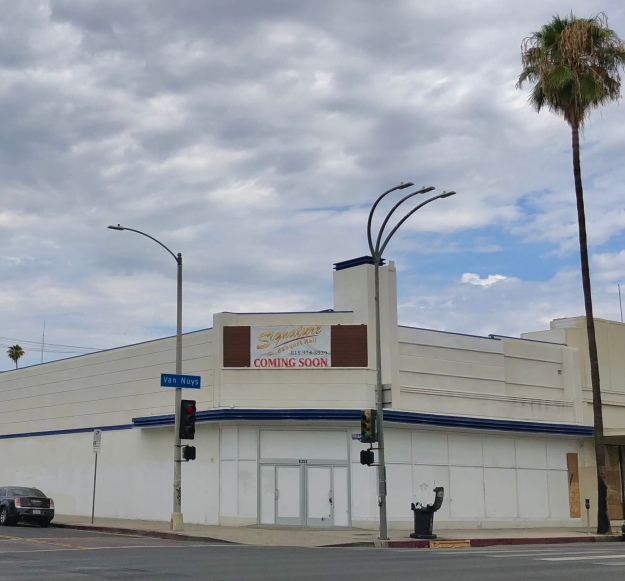
Modern Van Nuys. Ike isn’t to blame for the blight and anomie. What’s a farm town without farms?
The Hub of the San Fernando Valley is flattered, frankly, to bear the Van Nuys name; this may be why it has never changed. (The View regrets the loss of Lankershim; but that burg went “Hollywood.” Show people, shudder.)
Remember Isaac was technically not the founder of the City of Van Nuys but the wheat farmer who sold out to the developers. Technically, too, there never was a City of Van Nuys; it is, and was planned as, Los Angeles. But Van Nuys knew this. He understood regional planning from the ground up and it is a mistake, as has been suggested, to think of him as a rube gulled by the Chandler syndicate or flattered into reducing his price by the developers’ offer to name the town after him. If anything, the Van Nuys and Lankershim names were premium branding; their commercial success (agro-biz) had made them rural celebrities at a time when almost 80 percent of Americans were farmers and 99 percent were desperate to get rich. The syndicate’s development planned mostly 40 acre farmsteads with strategically-placed small-lot market-towns. They hoped to attract young white Eastern farm families fleeing the frost, good kids starting out but who couldn’t afford land back home. Littlecapitalists — this was explicit — eager for a warm, sunny spot to claim their “little land and a living” (Bolton Hall’s phrase, meaning freedom through farming from debt and wage-slavery). Isaac Van Nuys signed off on, allowed his good name to be put on, plans for a modern, model farm-servicing and depot buckle in an integrated agricultural belt, irrigated by nearly free public water, main streets blazing with light at midnight, linked by clean electric rail, to serve a growing metropolis. Isaac was, individually and in partnership with his brother-in-law James Lankershim, already heavily invested in booming Downtown.
Mr. Harry Chandler with Gen. Moses Sherman
Ike had known and dealt with the Huntingtons for years as a leading farmer in Los Angeles County, through whose land passed the SPRR. He had bought (or, I believe, advantageously swapped for) the old Southern Pacific Depot on the old bottomland of the LA River downtown, so that his new grist-mill enterprise “Los Angeles Farming and Milling” could be most advantageously placed right on the tracks between the Valley and San Pedro. In this sense, he was one of the planners of the vision. So the Valley annexation plan as a whole and Van Nuys’s land sale were not “wheel estate” flim-flummery. Rather, all the players were informedby, and self-consciously in-line with, the most progressive, up-to-date, economic, organic and holistic urban design thinking of the time. Remember civic theorist Patrick Geddes?
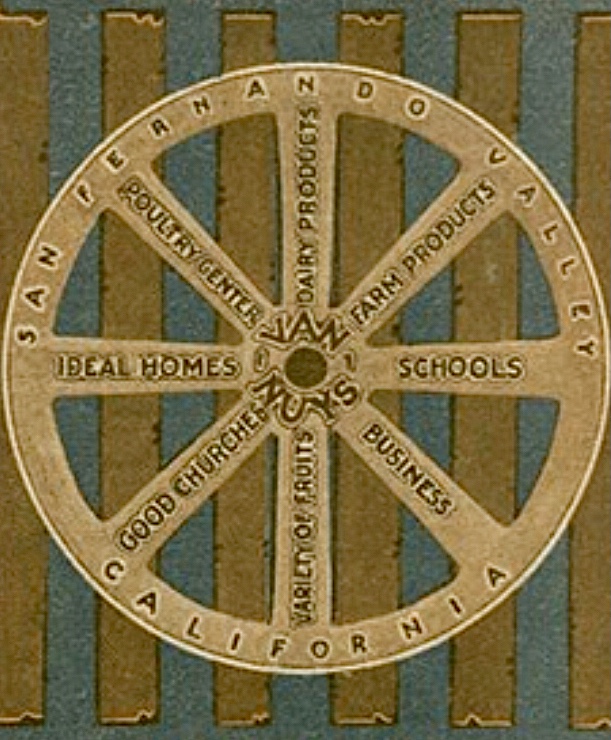
The drawing above is the famous “Geddesian Valley Section.” The other illustrations are also foundational to modern urban studies. Geddes wrote volumes of essential essays and studies, but his prose is tough sledding for laymen. His gift was inspiring an organic vision of cities through right brain engagement. The Boosterism of the Van Nuys promotional image may be corny, but it clearly reflects Geddes’s ideas.
Van Nuys was a key part of a planned Greater Utopia, Ltd. But that meant, it was condemned from the start to be the dusty, Babbittty, railroad farm-town part of Utopia. By plan, Van Nuys was the back service porch of gilded Downtown Utopia, where the nobs would forever guzzle champagne, over the hill and far away. Van Nuys is a Potemkin prairie village: it would never, could never, grow to overtake Downtown in commerce and real estate values, no matter the citizens’ thrift or ambitious industry. Early investors might not have thought about it too clearly, but they could never hope that someday their corner of Van Nuys would be the new booming “Boardwalk and Park Place,” full of hotels. Van Nuys proved the point; Like Pio Pico before him, he brushed off his last ceremonial pair of dusty trousers — his hard farming days of handling a team of twenty mules from the dusty box seat of a combine had gone years ago— and he moved back to LA to throw his pelf on the pile Downtown. Ike spent the last year of his life in silk pajamas unrolling blueprints, planning to corner the era’s Boardwalk and Park Place, 3rd and Spring, supervising construction of this:
The I.N. Van Nuys Building, at 3rd and Spring, LA’s hottest and most-marbled office block. 1912.
Van Nuys sold the ranch in 1909; the town opened in 1911, and Mr. Van Nuys died in 1912 — a few weeks before the I.N. Van Nuys Building opened. He died, also, a few weeks before the first Pacific Electric light-rail train arrived in Van Nuys and rolled passengers up Van Nuys Boulevard (then called Sherman Way). Ike possibly never set foot again in the Valley, never saw the new place called “Van Nuys.” He isn’t to blame for the sprawl, the blight, the anomie of today’s automobile graveyard Van Nuys. For Isaac, eternally, the town with his name was a four-square model farm town, with all the hook-ups a family needed to just move in and start plowing. And for years, it was.
The Jue Joe Ranch in Van Nuys. To Harry Chandler’s consternation, Chinese-American families were eager to live the Van Nuys lifestyle among their white neighbors. They taught LA a thing or two about how to handle the freshest fruit & veg in the glory days of truck farming. May those days come again.
Van Nuys The Man is absolutely absent from popular history as a personality — no memorable words, no bloviations on issues of the day; no hints of his pleasures and peeves, no memoir revealing his evolving sense of himself as a ‘player’; no scandals or rivalries in a town full of them. But this very absence to Modernity, is like the absence of sharp marble chips to a polished sculpture within. It reveals a hard core of values once so common-sensical and traditional they seem colorless today: he was sober, determined, loyal, ambitious, thrifty, patient, enterprising, dogged, nimble, polite, conservative, free-thinking, closed-mouthed, and open-minded. He was quiet and hoed his own row, minded his own family’s interests, yet everywhere he founded and built public things that made LA a first-class city and himself a millionaire. He was good with horses, a proud Mason, a father of three, and he made a fine husband to Susannah Lankershim, for whose mother’s sake he consented to become a public Baptist. He watched the weather, planted seeds and they grew. He was an upstate New York farmer from the old Dutch stock.
NEXT PART: How the name Van Nuys came to be permanently stamped on the dusty lower-left corner of our map, turns out to be a very rich land story indeed if we look into his Dutch ancestors’ experience, and Isaac’s own parents’ experience, and how they found land to farm. It is a Tale of Three Valleys — the San Fernando being the third. The progress of the Van Nuys family encompasses our whole history as an American people. It shows striking continuities, and illuminates pivotal moments in the rise of capitalism and modernity. It is the history of America itself. So View soon, THE HUDSON VALLEY VAN NUYSES…








 The Valley Village View